Recently, scientists discovered that the growth of the ice sheet and rising sea levels have led to large-scale
Vikings first established a foothold in southern Greenlandaround 985 AD with the arrival of Erik Thorvaldsson, also known as "Erik the Red". The Scandinavian explorer and explorer who founded the first settlement in Greenland received the nickname “red” for the color of his hair and beard. Other Viking settlers soon followed, forming communities at Eistribiggo (eastern settlement) and Vestribiggo (western settlement) that flourished for centuries. According to the University of California, Riverside, by the time the Vikings arrived, Greenland was already inhabited by the Dorset people, an indigenous group that predated the arrival of the Inuit in the Arctic.
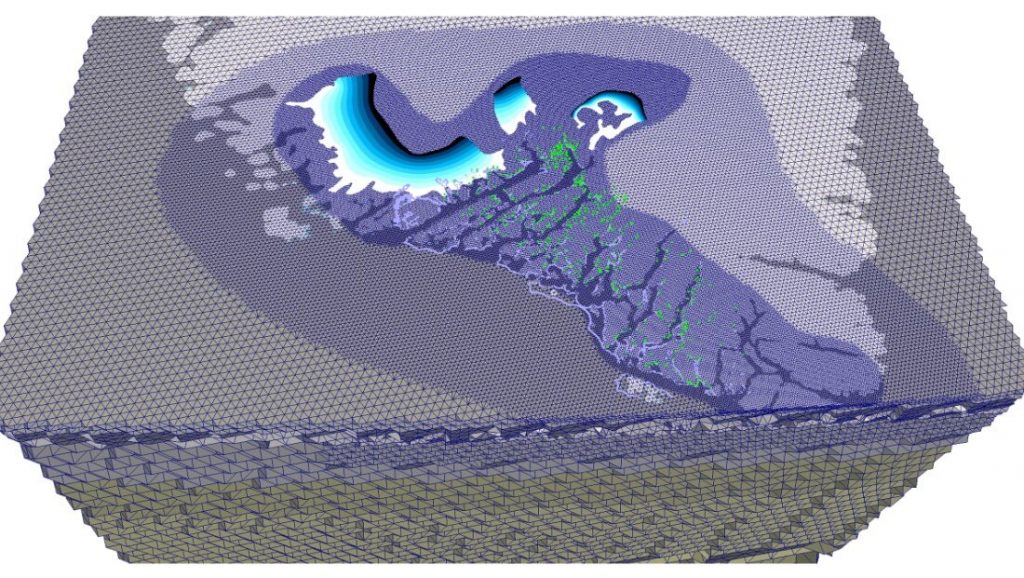 Digital model showing simulatedsea level in the southern Greenland ice (blue to white gradient), Viking sites (green dots), and flooded areas (blue). Image courtesy of Konstantin Latychev
Around the 15th century, traces of habitationScandinavians in this region have disappeared from archaeological records. Previously, researchers had suggested that factors such as climate change and economic shifts likely forced the Vikings to leave Greenland. A new study has found that rising sea levels have played a key role in the sinking of coastlines by kilometers.
Between the 14th and 19th centuries Europe and North Americaexperienced the Little Ice Age. In these cold conditions, the Greenland Ice Sheet has grown even larger. As it advanced, the substrate changed and coastal areas became more susceptible to flooding. The increased gravitational pull between the expanding ice sheet and the sea ice masses pushed seawater onto the Greenland coast. These two processes caused widespread flooding along the coastline exactly where the Vikings settled.
Scientists tested the hypothesis by simulatingestimated ice growth in southwest Greenland over the 400-year period of Scandinavian occupation and adding these calculations to a model showing sea level rise over that time. They then analyzed maps of known Viking sites to see how their findings matched archaeological evidence indicating the end of the Viking presence in Greenland.
Their models showed that from about 1000 to 1400year, rising sea levels around Greenland inundated Viking settlements by as much as 3.3 m, affecting about 204 km² of coastal land. According to models, this flood inundated land that the Vikings used for farming and as pasture for their livestock. It was climate change that became the real reason for their flight from Greenland.
Read more:
New solar cell breaks world efficiency record
It turned out what is happening with the documents of Leonardo da Vinci: they began to change
Listen to the sound of solar plasma as it hits the Earth
Cover photo: NASA
</ p>