An international team of scientists led by the University of Sydney has tested the ability of the network to
To test their network, the scientists used a modified analogue of the n-back problem.This is a popular experiment that is used in neurophysiology and psychology to assess memory.In the test, the test subject is presented with a series of images (visual test) or calleditems (hearing test), must indicate when a particular objectmet n-steps back.
For example, such a task might includedemonstration of a sequence of letters, and the person needs to be told when the same letter was encountered 1, 2 or more steps ago. The average score for most people on this task is 7. This means that most people can recognize the same image that appeared seven steps ago.
The researchers found that the network ofnanowires are also capable of “remembering” the desired end point in an electrical circuit seven steps back. “We manipulated the voltages of the terminal electrodes to force the paths to change instead of letting the network just do its thing,” explains Alon Leffler, co-author of the study.
A series of experiments showed that under the externalexposure to the nanonetwork “learned” and its memory was “strengthened”: the network remembered the paths proposed by the scientist and over time the formed connection did not decrease. This is reminiscent of the work of a synaptic network, scientists note: some connections are strengthened, others are weakened, and as a result, stable connections are formed during the learning process.
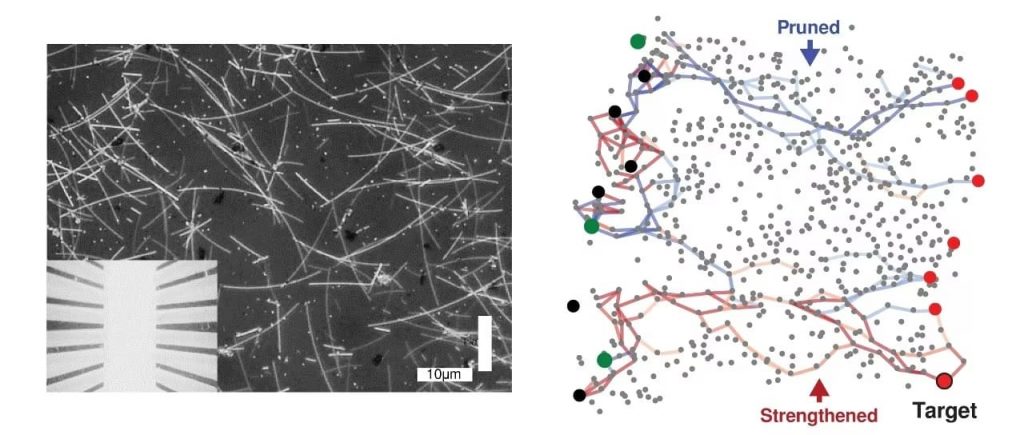 Formation of stable links in a network of nanowires. Image: Alon Loeffler, University of Sydney
Nanowire networks are a type of nanotechnologyusually made from tiny, highly conductive silver wires. Invisible to the naked eye, particles coated with plastic material are scattered randomly to form a grid. Due to their properties, such wires imitate the physical properties of the brain: a network of neurons connected through synapses.
The use of such networks opens up a largenumber of real-world applications: for example, the creation of robotic devices and sensors that need to make quick decisions in unpredictable conditions.
Read more:
There was a photo inside the second deepest underwater sinkhole in the world
See what happened to Mercury when it got as close as possible to the Sun
Scientists are ready to recognize the new tree as the oldest in the world
Cover: A nanowire network (right) mimics the complex connections of neurons in the brain (left). Image: University of Sydney