InSight lander equipped with the first seismograph designed to explore the interior
Since landing and starting work in November 2018In the past year, the InSight module detected more than 1,300 major quakes, scientists report. The capacity of the largest of them was 5 points. Before the advent of the apparatus, it was believed that there was almost no seismic activity on the Red Planet, and scientists did not even suspect the possibility of the existence of such powerful “shocks”.
The researchers note that observations ofhow the seismic waves from these earthquakes change as they pass through the planet provides an invaluable glimpse into the interior of Mars. In addition, a comparison of data collected on the Red Planet, Lusha and Earth reveals the evolution of various "stone worlds".
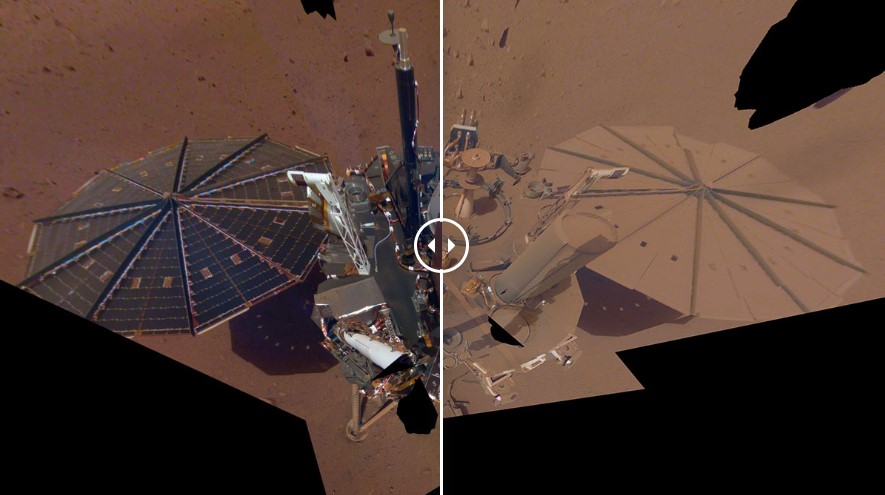 InSight module after landing and after four years of operation. Image: NASA/JPL-Caltech
Problems with electricity generation begandue to the large amount of dust accumulated on the solar panels of the device over the years of operation. Already in the summer, the lander was so low on power (less than 20% of its original power) that the mission team turned off all of InSight's satellite science instruments to keep the seismometer running. As of October 31, 2022, InSight generates an average of 280 to 290 Wh of energy per Martian day (sol).
NASA says the mission will be completelycompleted when InSight misses two consecutive communications with a Mars-orbiting spacecraft used to relay the signal and collected data back to Earth.
Read more:
Archaeologists have officially confirmed the legends from the Bible
Scientists have seen what is on the territory of the Mayan capital. The find surprised them.
Found a planet on the edge of the habitable zone. Its temperature is similar to Earth's.
Cover: Artistic illustration of the InSight lander on Mars. Image: NASA/JPL-Caltech