The Webb Telescope photographed the galaxy cluster MACS0647, which acts as a cosmic lens.
Webb was specifically designed to detectweak infrared radiation from very distant galaxies and allows astronomers to look into the early universe. The nature of galaxies in this early period of our Universe is not well known and not understood. But using gravitational lensing by a cluster of galaxies in the foreground, dim galaxies in the background can be enlarged.
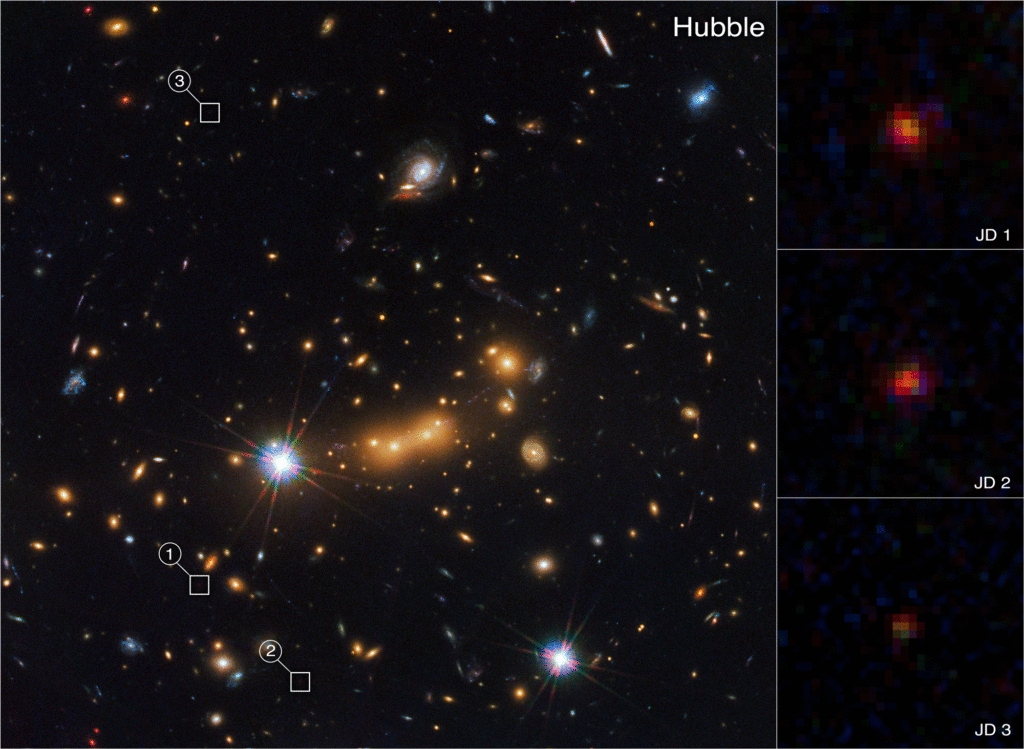 Cluster of galaxies MACS0647 in Hubble and Webb images. Regions JD1, JD2, and JD3 are a lensed image of the same object. Animation: NASA
Researchers discover galaxy for the first timeMACS0647-JD about 10 years ago in Hubble images. The light that has now reached Earth was emitted by this galaxy about 400 million years after the Big Bang. At the same time, in the Hubble images, it only looks like a small red dot.
The Webb telescope, with its sensitivity tonear and mid-infrared radiation, made it possible to see that in fact two objects are located in this area at once. Scientists are considering alternative versions: two different galaxies or two clusters of stars in one galaxy.
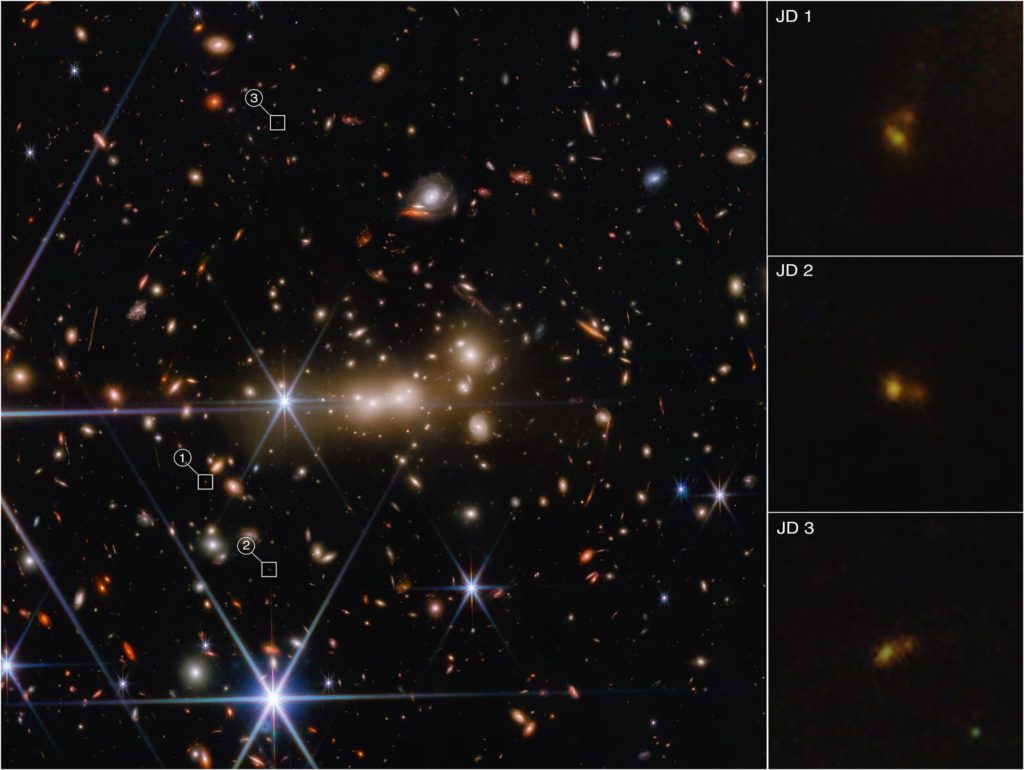 Cluster of galaxies MACS0647 and enlarged images for MACS0647-JD. Image: NASA, ESA, CSA, Dan Coe (STScI), Rebecca Larson (UT), Yu-Yang Hsiao (JHU), Alyssa Pagan (STScI)
Due to the effect of gravitational lensing,of a massive cluster of galaxies arising under the influence of gravity, three images of MACS0647-JD can be seen in the image at once. Different "lenses" increase it by eight, five and two times, respectively.
Read more:
Archaeologists have officially confirmed the legends from the Bible
It turned out what happens to the cells of the body when the heart dies
Starlink signal hacked to be used as an alternative to GPS