NASA's DART spacecraft approached the asteroid at incredible speeds on the night of Monday
The probe crashed into an asteroid located at a distance of about 9.6 million km fromEarth at a speed of 22.5 thousand km/h.The last pictures that he managed to show are the approaching surface of a rocky cosmic body.
Although the collision definitely happened - this can be understood from the interrupted signal, it will take scientists weeks or even a month to understand how the asteroid's orbit has changed.
The latest spacecraft data. Video: NASA
Collision, not explosion
Usually in films about the apocalypse in spacewhole missions are sent with the crew, which at the last moment destroy the asteroid with explosives installed on it. In fact, this method is very dangerous. Fragments from a destroyed object can fall to Earth and cause even more damage to the planet itself and to all those artificial satellites that orbit and provide comfortable modern life.
Unlike dinosaurs, we have missionswhich track the movement of all potentially dangerous objects, which means that we can have time to prepare. The main idea put forward by planetary defense experts is that a dangerous object can simply be redirected by changing its orbit to avoid a collision.
For large space rocksseveral strikers or a combination of strikers and so-called gravity tractors are required. This device has not yet been developed, but it could use its own gravity to put the asteroid into a safer orbit.
Where are the tests taking place?
For testing, the researchers chose a safeasteroid Dimorph. Its size is about 160 m, and its weight is 5 billion kg. It orbits another larger asteroid, Didyma. The pair orbit the Sun for millennia without threatening Earth, making them ideal candidates for safe exploration.
 Models of Didyma (right) and Dimorph (left) built from radar data. Image: NASA/Naidu et al., AIDA Workshop, 2016, Public domain, via Wikimedia Commons
NASA selected Dimorph to strike DART on severalreasons. First, the satellite is part of a binary system and revolves around its "brother" every 11 hours and 55 minutes. This is fast enough for any change in orbit to be noticeable in ground-based telescopes on subsequent observations.
In addition, right now the asteroids areclosest to the earth. The distance to them is only 9.6 million km, the next time such a rapprochement will occur only after 40 years. This is important, because the signal at such a distance travels to the Earth in just 38 seconds, which means that the observation takes place almost in the online broadcast mode.
 Dimorph a few seconds before the collision. Image: NASA
How did the collision happen?
The DART spacecraft is about the size of a machine gun forsoda sales hit Dimorph at 23:14 GMT (2:14 Moscow time). At the time of the collision, he was moving at a speed of about 22.5 thousand km / h. The spacecraft was not as big as classic probes, but scientists are hoping that 600kg will be enough to shift Dimorph's orbit a little.
Most of the last four hours of DART have been automated, and the spacecraft's navigation system has locked on Dimorphos in the last hour of its approach.DART's main camera transmitted photos back to Earth every second until the image turned black when the spacecraft crashed into the asteroid.
As DART approached Dimorph, the asteroidevolved from a mysterious bright dot to a detailed landscape of boulders, rocks, and shaded terrain. Then, just in time, the live feed from DART cut off. Scientists note that even a simple hit on the target is a great engineering success.
Collision of an asteroid and a spacecraft. Video: NASA
When will the results be visible?
The space “shipwreck” had witnesses.A few weeks before the impact, DART launched a small cubesat called LICIACube to follow it and observe the impact of the asteroid. Photos from this cubesat should reach Earth a few days after the impact and show a close-up view of the impact and the ejection it picked up from Dimorph.
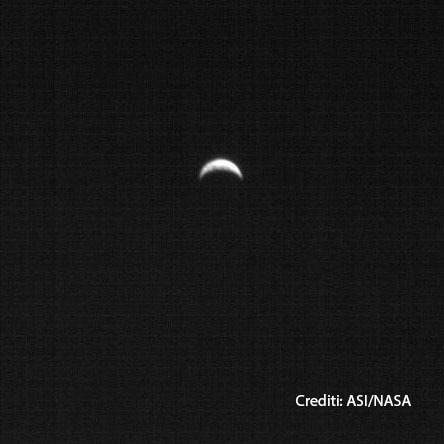 First LICIACube image: Earth from 11 million km away. Image: ASI, NASA
LICIACube was the closest, but he's not the only oneobserver. The new James Webb Space Telescope, the Hubble Space Telescope and the Lucy spacecraft, which is on its own mission to another asteroid, tracked the accident from various points in the solar system. In addition, the collision was monitored by many telescopes on Earth. But it will still take time to know whether the DART strike was successful as a planetary defense test.
More than three dozen telescopes around the world, inincluding at least one on every continent, will track the Didymus and Dimorph asteroid systems over the next six months to understand exactly how effective the test was and how the orbit of the space bodies has changed.
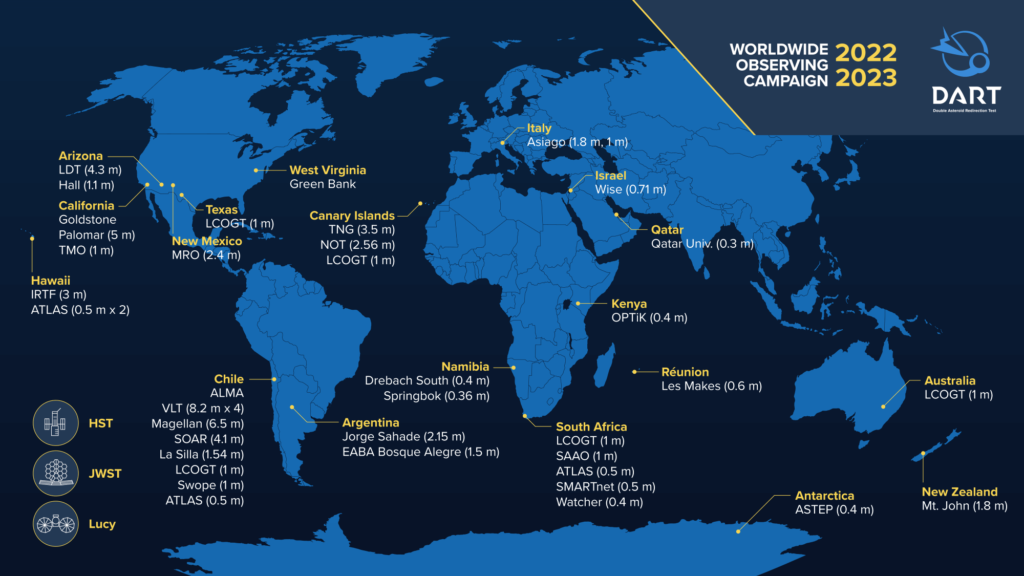 Telescopes that will monitor asteroids. Image: NASA/Johns Hopkins APL/Nancy Chabot/Mike Halstad
The first radar observations ofscientists expect a collision by the evening of September 27, and the most detailed data will come only in 2027, when the Hera space mission of the European Space Agency will reach asteroids and see how the objects have changed after the collision and whether there is something left of the apparatus on the surface of Dimorpha.
Read more:
It turned out what happens to the human brain after one hour in the forest
It became known which tea destroys protein in the brain
Planetologists have found signs of life on Saturn's moon
Cover: Artistic illustration of a DART spacecraft approaching the asteroid Dimorph. Image: NASA/Johns Hopkins APL/Steve Gribben