Apophis is classified by scientists as a "potentially hazardous asteroid." Closest distance of Apophis from
According to scientists, Apophis does not pose a threatcollision with the earth. However, they suggested that a close passage of an asteroid to our planet in 2029 could affect its trajectory and lead to its reappearance. If it does, it could make another flyby of Earth in 2060 or 2068. NASA is not entirely convinced of these estimates. Before any other hypotheses arise, the space agency plans to conduct research directly on the Apophis asteroid itself, sending a spacecraft there to take soil samples and make the necessary measurements.
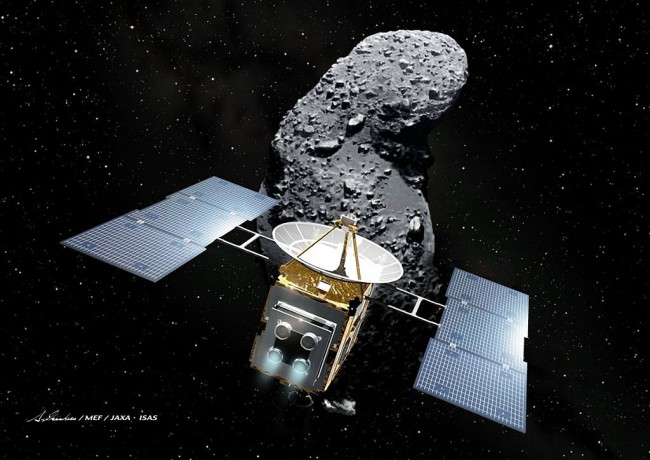 NASA mission to Apophis. Illustration
NASA has already begun developing the missionPlanetary Defense Apophis 2029 (PDM). A report on the preparation of the project will be presented at the upcoming public briefing on April 19, 2022. According to the study authors, the close location of Apophis provides a rare opportunity to visit and study the asteroid. Scientists said the PDM Apophis 2029 mission space probe should encounter the asteroid several months before it approaches Earth.
The main goal of PDM Apophis 2029 after its launchconsists in assessing the potential risk of the approach of a space object, determining the properties of its rocks, the chemical compounds of which they are composed, and making the necessary measurements of the asteroid. In addition, the study of an asteroid is a unique opportunity for astronomers and planetary scientists to see real relics of the formation of the solar system up close. The Apophis 2029 PDM program is a continuation of the DART project, created to change the position and trajectory of potentially hazardous asteroids. The DART spacecraft, the first ever planetary defense mission, was launched by NASA and the European Space Agency (ESA) in November 2021. The ship weighing 500 kg should reach the asteroid Didymos and its satellite Dimorphos in September this year. In October, the ship is supposed to crash into Dimorphos at over 24,000 km/h. The goal of the mission is to change the speed of the asteroid by 0.4 mm/s, which in turn will slightly change the trajectory of Didymos. These asteroids do not threaten the Earth, and this experiment is aimed at developing methods to protect our planet from dangerous celestial bodies.
Read more:
After ten years of work, scientists questioned the standard model of physics
MIT builds stationary heat engine that outperforms turbines
Startup has created tiny robots that work in the human brain