3C 273 is one of the closest and best studied quasars. This object located at a distance
In a paper published in The AstrophysicalJournal, Japanese astrophysicists talk about a new technology with which scientists managed to look inside the system and detect previously unknown radio emission.
A quasar is the nucleus of a galaxy, at the center of whichthere is a massive black hole that consumes the material around it, emitting enormous radiation. Its brightness, as scientists note, overshadows objects that are nearby and interferes with their observation.
In their work, scientists used a radio telescopeALMA to create continuous images of the galaxy at 93, 233 and 343 GHz. Using the technology of self-calibration and subtraction of a point source, scientists managed to achieve a dynamic range record for a telescope of about 85 thousand at a frequency of 93 GHz, about 39 thousand at a frequency of 233 GHz and about 2.5 thousand at a frequency of 343 GHz.
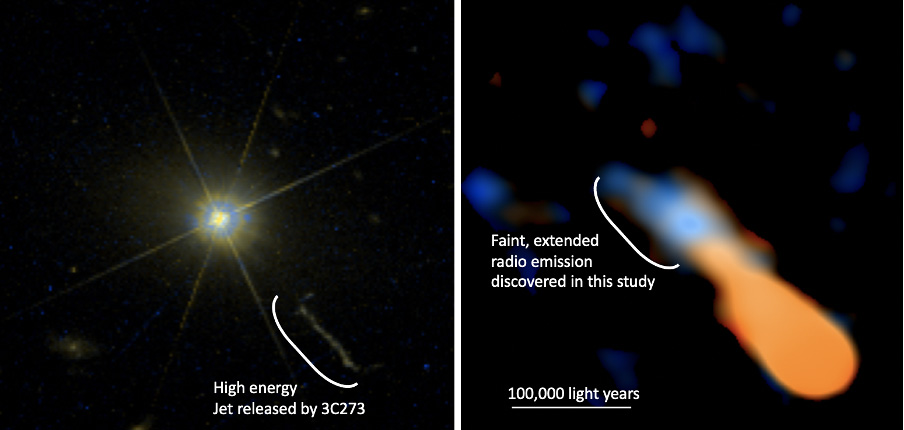 3C 273.On the left is the Hubble image, a high-energy jet is visible in the lower corner, on the right is an ALMA observation of radio emission (white-blue area surrounding the center of the hole) and a jet (orange area). Source: ALMA
Thanks to new surveillance technology, scientistsdiscovered faint radio emission extending tens of thousands of light-years above the host galaxy 3C 273. The researchers note that radio waves around quasars are typically associated with synchrotron radiation from high-energy events, such as starbursts or ultrafast jets emanating from a black hole.
Such radiation is characterized by a change in brightnessdepending on the frequency of observations. But the new discovery does not meet this principle - the weak radio emission detected by astrophysicists has the same brightness at all studied frequencies.
In their work, scientists showed that what they foundThe radio emission comes from hydrogen gas in the galaxy, which is affected by the core of 3C273. This gas is an important component for the creation of stars, but under the influence of the quasar's intense radiation, hydrogen ionizes, preventing star formation.
Astrophysicists note that for a long time remainedwhether a quasar's radiation could be powerful enough to rob a galaxy of its ability to form stars is a mystery. Analysis of the found radio emission shows that at least 7% of the light from 3C 273 is absorbed by hydrogen in the host galaxy, creating an ionized gas with a mass of 10-100 billion times the mass of the Sun. However, given the overall estimate of the amount of gas in the system, scientists believe that there is enough of it left to continue star formation.
This discovery provides a new way to study the problemswhich were previously solved using observations in optical light. By applying the same technique to other quasars, we hope to understand how a galaxy evolves through interactions with its central core.
Shinya Komugi, associate professor at Kogakuin University and lead author of the study
Read more
Monkeypox is becoming a global virus: why it is transmitted so quickly
Something strange is happening in the Universe: how to explain inconsistencies in the Hubble constant
Diagnosis in a minute: how IT is changing healthcare