In August 2017, astrophysicists observed a powerful explosive event called GW170817. It was
Just two days later, scientists set up a cosmicHubble telescope to observe the aftermath of the explosion. The neutron stars collapsed into a black hole, whose powerful gravity began to attract matter towards itself. This material formed a rapidly rotating disk that generated jets escaping from its poles. These jets collided with the expanding shell of explosive debris and captured particles of material.
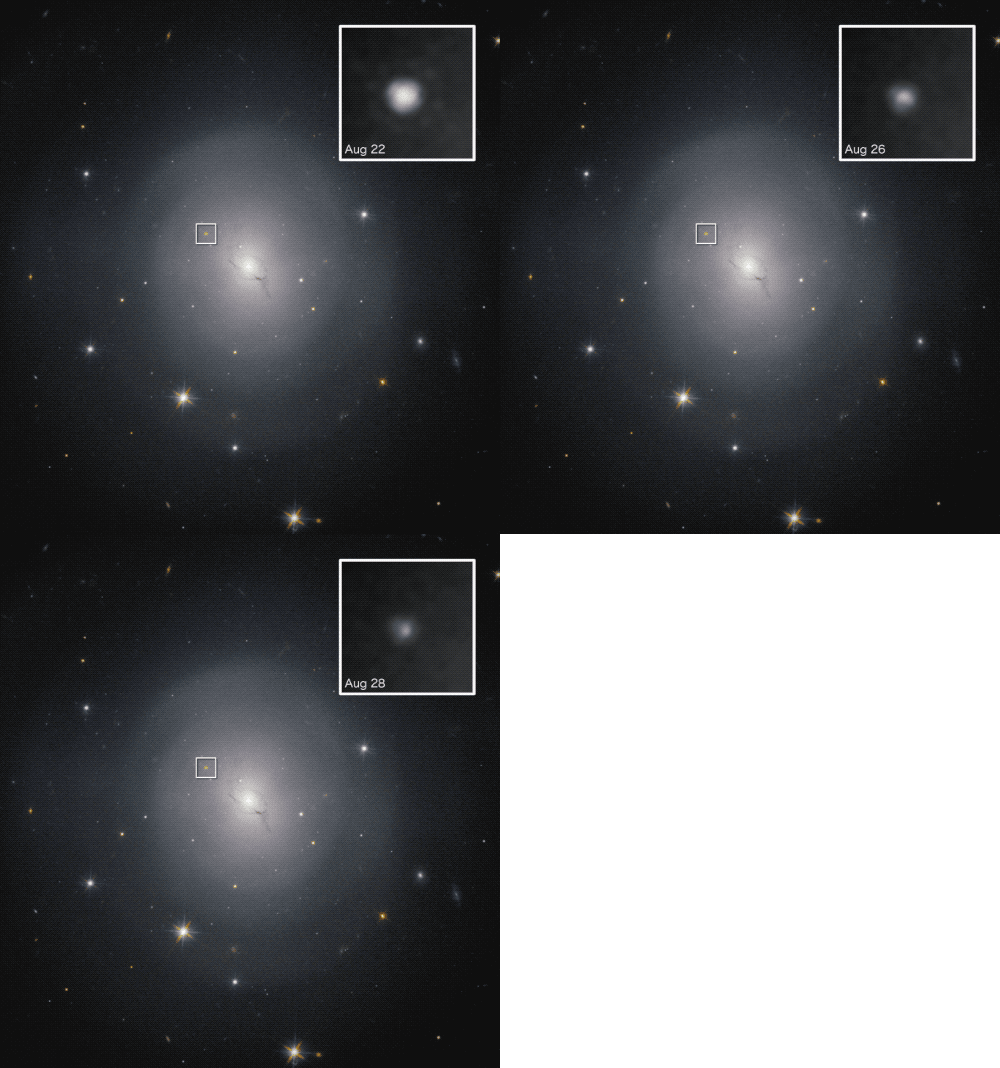 Observations of merging stars with the Hubble telescope. Image: Hubble Space Telescope, NASA and ESA, Public domain, via Wikimedia Commons
By combining various observations, scientists were able topinpoint the location of the explosion. Hubble measurements showed that the jet was moving at an apparent speed of seven times the speed of light. Radio observations show that after some time the jet slowed down to an apparent speed of four times the speed of light.
In fact, nothing can exceed the speedlight, scientists say. "Superluminal" movement is a visual illusion associated with the specifics of observation. Since the jet is approaching the Earth at almost the speed of light, the light it emits at a later time needs to travel a shorter distance. This is reminiscent of the situation in which particles of the jet material catch up with their own light (photons), all the while emitting new ones.
However, the actual speed of the jet calculatedscientists are also amazing. Particles ejected during the explosion move away from the black hole at a speed of at least 99.97% of the speed of light (299.7 thousand km/s).
Read more:
Created a compact nuclear reactor for safe energy production
Unusual structures found on the edge of the solar system. Only the Voyagers have been there.
Black hole 'spit out' torn star three years after swallowing
On the cover: an artistic illustration of a neutron star merger. Image: Elizabeth Wheatley (STScI)