According to a new study by researchers at the University of California, Los Angeles, water on the planet
Over for decades thatresearchers knew about the formation of planets, based on data about objects in the solar system. Although there is considerable debate about the formation of gas giants such as Jupiter and Saturn, it is widely believed that the Earth and other rocky objects formed from a disk of dust and gas that surrounded the star in its youth.
As ever larger objectscrashed into each other, the small planetesimals that eventually formed the Earth grew larger and hotter, dissolving into the vast magma ocean. It is believed that over time, as the planet cooled, the densest material sank in, dividing the Earth into three separate layers: a metallic core, a rocky silicate mantle and a crust. However, the discovery of new exoplanets has recently inspired scientists to take a new approach to modeling the “embryonic state of the Earth,” planetary scientists write.
“The discovery of exoplanets has given us much morean idea of how often newly formed objects are surrounded by an atmosphere rich in molecular hydrogen H2 during the first few million years of their growth. As a result, these hydrogen shells dissipate, but leave “fingerprints” in the composition of the young planet,” the study authors explain. They developed new models of the formation and evolution of the Earth. The goal is to understand whether the distinctive chemical signatures of our planet can be reproduced.
Using a newly developed model, scientistsdemonstrated that early in Earth's existence, interactions between an ocean of magma and a proto-atmosphere of molecular hydrogen may have resulted in some of the planet's characteristic features, such as an abundance of water and a general oxidation state.
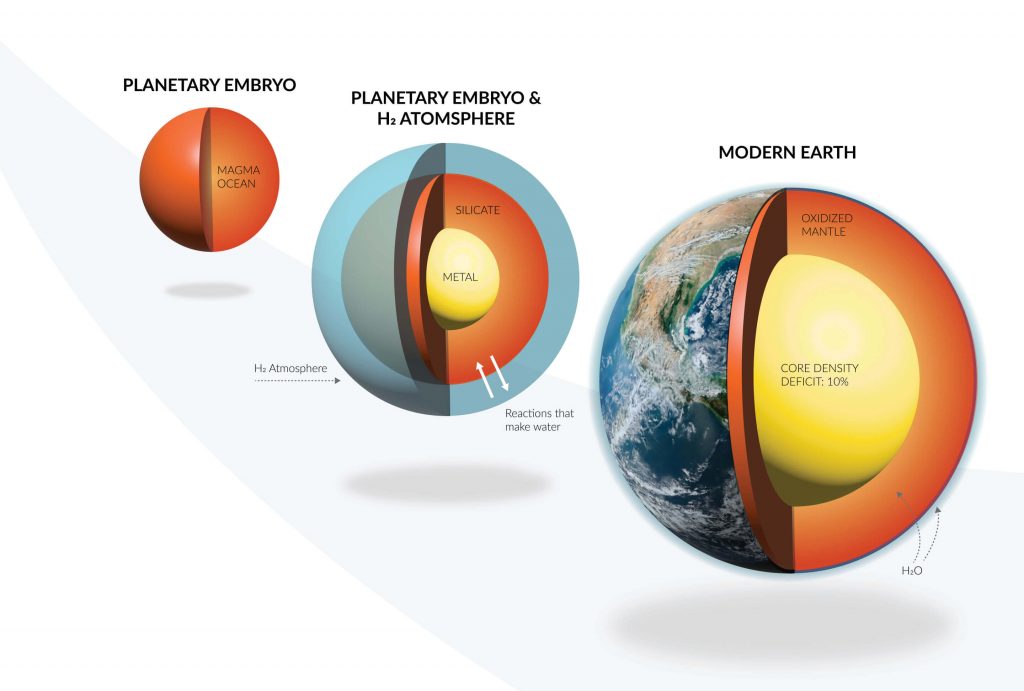 The illustration shows how someEarth's distinctive features, such as the abundance of water and its overall oxidized state, are potentially related to the interaction between the atmosphere of molecular hydrogen and oceans of magma on planetary earths.
Credit: Edward Young/UCLA and Catherine Cain/Carnegie Institute of Science
The researchers used mathematicalmodeling to study the exchange of materials between atmospheres of molecular hydrogen and magma oceans, analyzing 25 different compounds and 18 types of reactions—complex enough to provide valuable insights into the possible history of Earth's formation, but simple to fully interpret.
As a result, interactions between the magma oceanand the atmosphere on their simulated “baby” Earth led to the movement of large masses of hydrogen into the metal core, oxidation of the mantle and the formation of large amounts of water.
Read more:
Special diet triggers self-destruction of brain cancer cells in mice
Scientists have deciphered the mysterious manuscript of Ptolemy. It was hidden under other text
New image of Hubble puzzled scientists
Cover illustration: NASA Goddard Space Flight Center