Physicists from Moscow and Saratov have created hybrid networks of carbon nanotubes that conduct current well and
Scientists have used two types of nanotubes:
- single-layer - the walls of which consisted of only one layer of carbon atoms,
- multilayer - they can be represented as a set of cylinders of different diameters, nested one inside the other.
Another material that was used in the work- graphene. Its properties are similar to nanotubes, since it also consists of carbon. The only difference is that the atoms in graphene form a plane, while in nanotubes it is rolled into a hollow cylinder.
Our research has shown that high strengthand electrical conductivity of hybrid materials will allow their use in nanoelectronics, as well as as components of various bioelectronics devices, as they will help improve the accuracy and speed of their operation.
Olga Glukhova, Chief Researcher, Department of Mathematical Modeling, Saratov National Research State University
During their work, the authors made four types of samples to see how the connection with graphene would affect the properties of the nanotubes:
- The first method — a thin film of single-walled nanotubes was deposited onto a silicon substrate,
- The second method - a thin film of multilayer tubes was deposited on a silicon substrate,
- The third and fourth samples consisted of a mixture of graphene and one of the types of nanotubes.
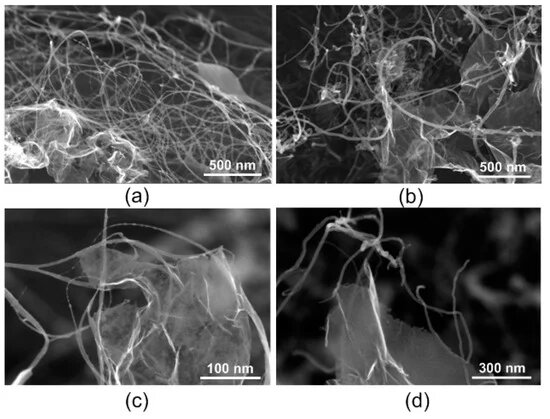
In the final stage, the authors used nanowelding,so that the materials are firmly connected by chemical bonds. As a result, it was found that hybrid nanostructures of multilayer carbon nanotubes and graphene had the highest electrical conductivity and strength.
Read more:
See the fastest hypersonic aircraft
The slowing down of the Earth's rotation caused the release of oxygen on the planet
What Happens to Cryptocurrency: From Rise and Fall to State Recognition