Chinese researchers have replaced the lenses used in classic computer vision systems with
The researchers note that in order toComputer vision now tends to use convolutional neural networks. This technology provides the required quality, but the huge amounts of data involved in image processing requires equipment that consumes a lot of electricity, and besides, the calculations cannot always be performed "in place".
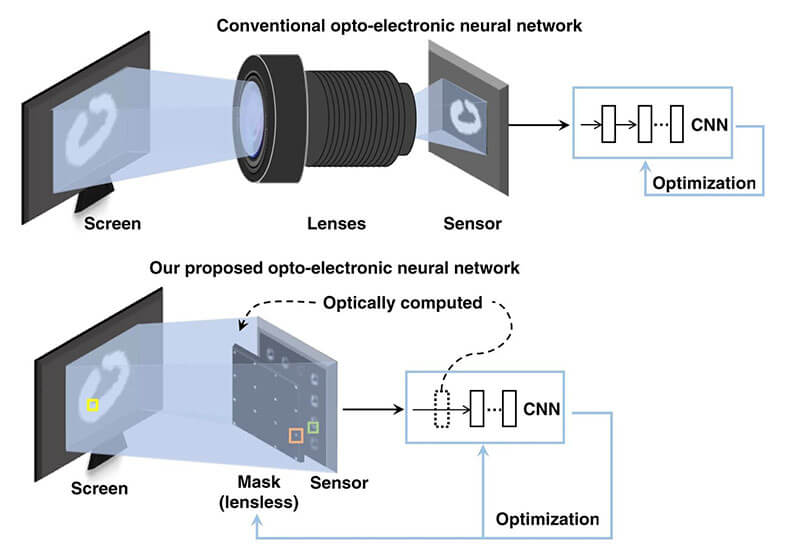 Traditional and new approach. Image: Wanxin Shi et al., Light: Science & Applications
The technology proposed by scientists in a new work,uses a passive mask inserted into the image light path to perform convolution operations in the optical field. This approach, as the scientists note, solves the problem of processing incoherent and broadband light signals in natural scenes. In addition, in the new system, the optical channel, image processing and internal network interact in such a way as to reduce the amount of computing and power consumption in the entire system, the authors of the development say.
The researchers tested their development forrecognition and classification of handwritten digits. The results showed that when using a single convolution kernel, the recognition accuracy can reach 93.47%. When the multi-channel convolution operation is implemented by placing multiple kernels on the mask in parallel, the classification accuracy increases to 97.21%. At the same time, compared to traditional lines of machine vision, the system consumes half the energy.
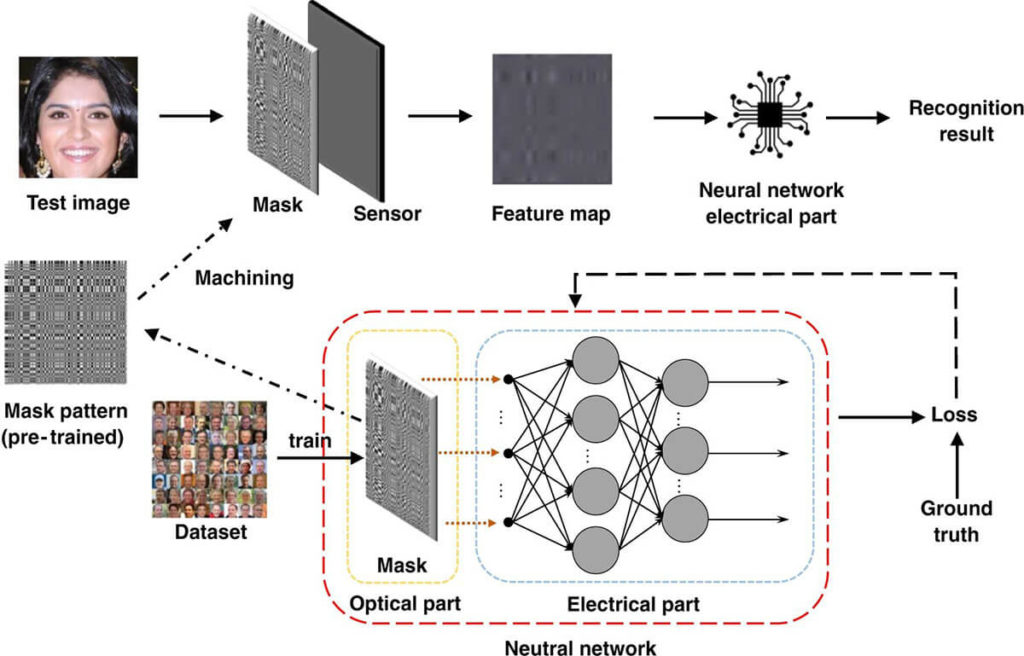 Image: Wanxin Shi et al., Light: Science & Applications
The researchers also note that the technologycan be used for face recognition, however, the face pictures themselves are not stored or processed in the system, which increases the confidentiality of data and protects privacy and privacy.
The developers believe that the new architecture will have many potential applications in many real world scenarios such as autonomous driving, smart homes and smart security.
Read more
Look at the "silent" drone with a new generation of ion propulsion
Uranus is a very strange planet. We explain why astronomers want to send a probe to it
Scientists propose to revise the foundations of quantum physics and show where they do not work