Recently, scientists conducted a study aimed at replicating the human ability to determine
The article highlights the benefits of developing robots that can interact with the environment through touch, not just vision and sound processing.
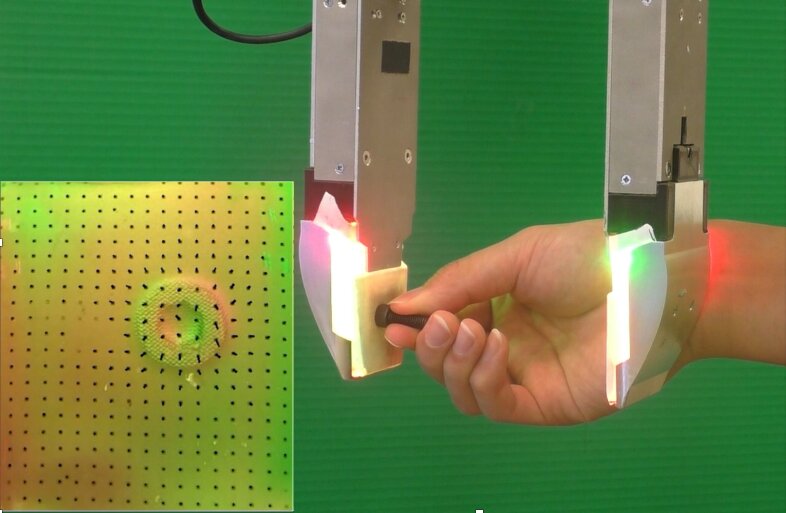
The goal of our work was to demonstrate that withWith high-resolution tactile sensing, known objects can be accurately localized even from the first contact. This is an important advance over previous work on tactile localization, since we do not rely on any other modes of external perception (e.g., vision) or previously collected tactile data associated with the manipulated objects.
Maria Bauza, one of the researchers
The new technique learns from simulation and does notrequires extensive data collection. Initially, the researchers developed a structure that simulates contacts between a given object and a tactile sensor, provided that the robot has access to data about the object with which it interacts (for example, about its three-dimensional shape, properties, etc.).
Next, the researchers used modernmachine learning methods for computer vision and representation learning to match real-world tactile observations collected by the robot to a set of contacts generated by the simulation process.
Essentially, the method developed by this groupresearchers can model contact information simply based on the three-dimensional shape of an object. As a result, no preliminary tactile data collected through careful study of the object is required. This allows the technique to generate pose estimates for an object from the first touch of the robot's tactile sensors.
Read more
Earth will reach critical temperature in 20 years
Abortion and science: what will happen to the children who will give birth
A plant that is not afraid of climate change has been named. It feeds a billion people