Organic conductors are carbon-based materials. Modern science has achieved that they are now
However, these structures suffer from reducedelectrical conductivity, which does not allow their use in popular mass gadgets. A group of researchers from the Institute of Scientific and Industrial Research and the Graduate School of Engineering Sciences at Osaka University have developed a new kind of molecular wire made from oligothiophene molecules with periodic twists that can conduct electric current with less resistance.
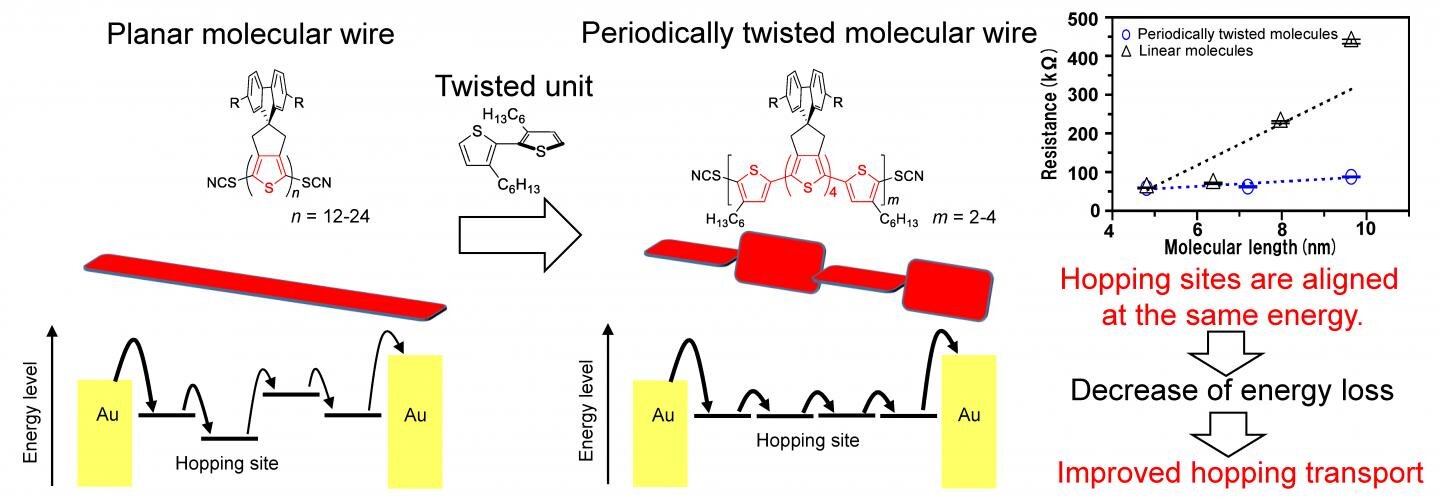 View of the chemical structure of intermittently twisted molecular wires.
Image: Osaka University
Molecular filaments are made up of molecules that areseveral nanometers, and also have alternating single and double chemical bonds. The orbitals that electrons can occupy around an atom or molecule can be localized or extended in space. In this case, the pi orbitals of individual atoms overlap, forming large "islands" between which electrons can jump.
Since electrons can most efficiently move between energetically similar levels, fluctuations in the polymer chain can create energy barriers.
The charge mobility and the overall conductivity of the molecular wire can be improved if the charge mobility can be suppressed by such vibrations.
Yutaka Ie, first author of the study
The team found that overall, creating moreshallow energetically close islands maximizes conductivity. This research will help improve the conductivity of nanowires that can be used in a wide variety of electronic devices such as tablets or computers.
Read more
Abortion and science: what will happen to the children who will give birth
Check out the most beautiful pictures of Hubble. What has the telescope seen in 30 years?
An artificial object was found in soil samples from the asteroid Ryugu. Like this?