Two newly discovered black holes are surprisingly close to Earth. According to a new study,
According to ESA, the two black holes are Gaia BH1 and GaiaBH2 are the closest to Earth that have been discovered so far. Gaia BH1 is located just 1,560 light-years from the solar system towards the constellation Ophiuchus, practically in Earth’s “backyard,” the scientists write. She is almost three times closer than the previous record holder. Gaia BH2 is located approximately 3,800 light-years from Earth, in the constellation Centaurus. Both objects are approximately 9-10 times more massive than the Sun and are located in the Milky Way galaxy.
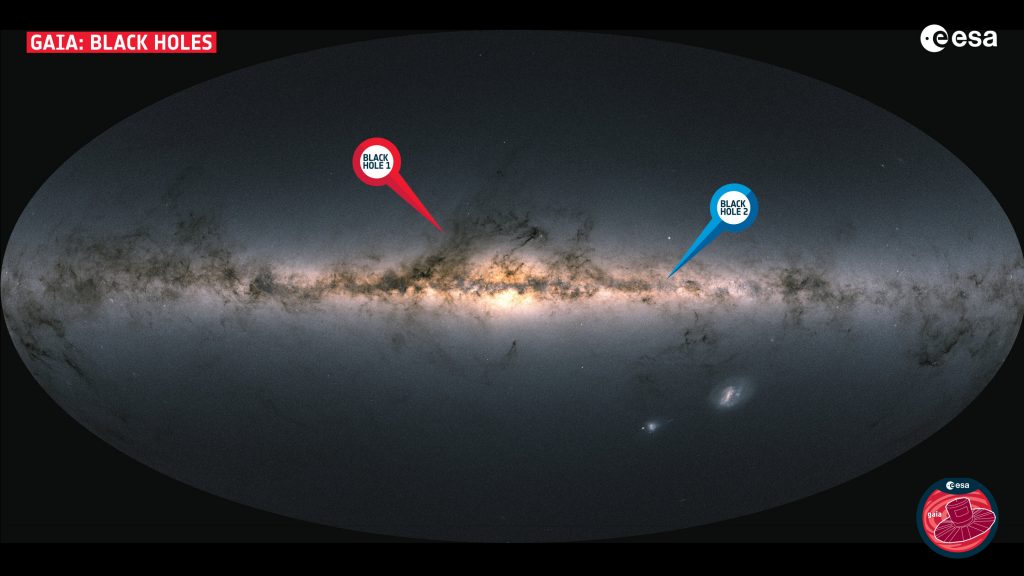 Credit: ESA/Gaia/DPAC; CC BY-SA 3.0 IGO, CC BY-SA 3.0 IGO
Features of Gaia BH1 and BH1 completely"dark". When an object or cloud of interstellar gas falls into a black hole, a burst of electromagnetic radiation appears. Astronomers record it and conclude about the presence of a black hole. Both holes turned out to be “dormant” or inactive.
Researchers discovered them, carefullytracking the movements of two Sun-like companion stars orbiting the cosmic giants. They hesitated a little when they traveled in space. This is how scientists realized that some object with high gravity, for example, another star, was attracting them to itself. But when researchers checked that region of space with telescopes, they didn't find anything similar. According to known physics, such a movement of stars made sense only if we were talking about black holes.
Although both black hole systems were discoveredat the end of 2022, astronomers are only now beginning to understand how unique they are. “What sets this new group of black holes apart from the rest is their large distance from their companion stars,” explains Karim El-Badry, an astrophysicist at the Harvard-Smithsonian Center for Astrophysics who discovered the new black holes. He added that these dormant black holes "probably have a completely different formation history than in the case of X-ray binaries."
Scientists hope that the next release of Gaia data, scheduled for 2025, will help discover more dormant black holes and learn how they formed.
Read more:
It turned out that photosynthesis does not work the way scientists thought. Now they want to hack it
Distant radio galaxy turned out to be a black hole, which is directed directly at Earth
Found a way to reduce weight and blood sugar. Scientists promise the effect of surgery
On the cover: the galaxy Centaurus A
Image Credit: NASA/CXC/SAO; optical: Rolf Olsen; infrared: NASA/JPL-Caltech; radio: NRAO/AUI/NSF/Hertfordshire Univ/M.Hardcastle