Too much background noise usually interferes with your work. But physicists did something incredible: they developed
How do conventional and microscopic motors work?
In everyday life peopleuse engines and motors that consume fuel for directed movement and thus perform useful work. In the microscopic world everything is more complicated. There, noise in the form of heat can ruin everything.
Thermal noise in the environment causesThe components of small cars “rock back and forth all the time,” the scientists explain. As a result, the tiny engine doesn't work as efficiently as it could.
What about information engines?
There is a special family of microscopicmachines known as information engines, which use noise to drive targeted movement. They use this information, reinforcing the “correct” manipulations of the machine. In simple terms, an information engine is a machine that converts information into work.
Physicists and engineers will find these usefultiny motors to develop new microscopic machines for nanotechnology applications. The main thing is to develop them so that they replace conventional machines.
The authors of the new study have taken this work further. They learned more about how information can be used in biomolecular machines.
What have the scientists done?
Scientists have built an information engineusing microscopic glass beads the size of bacteria suspended in water. The ball is held loosely in place by a laser beam that acts as a support underneath it. At the same time, water molecules gently push the ball due to natural thermal vibrations in the liquid. From time to time he “shakes”.
And here's the trick:When the ball rises against gravity due to thermal vibrations, the position of the laser support also changes. In this position the ball has more stored or gravitational potential energy. Like a ball that's about to drop.
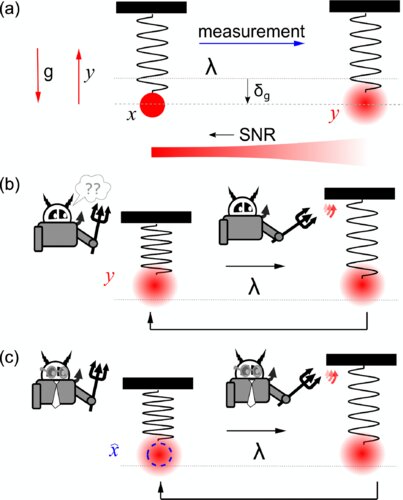 Schematic information engine. (a) The noise detector measures the position y of the ball actually located in
point x. A mechanism based on either (b) a noisy position measurement y or (c) a Bayesian position estimate X̂ (blue dotted circle). Credit: Physical Review Letters (2022). DOI: 10.1103/PhysRevLett.129.130601
Scientists didn't even have to “lift” the object;this happened naturally, due to the vibrations of water molecules. Thus, the engine converted the heat of the water into stored gravitational potential energy, using feedback about the ball's movement to adjust the laser trap. “The decision about whether and how much to raise the trap depends on the information we gather about the position of the bead. It acts as “fuel” for the engine,” scientists explain.
What is the difficulty?
This is how the system works, but to implement it correctlyThis strategy is difficult if there is too much measurement noise in the system. It is created by the brightness of the laser beam that is used to detect the ball. In such cases, the uncertainty of its position for each measurement may be greater than the movement of the object caused by the oscillating water molecules. As a result, measurement noise leads to erroneous feedback and, thereby reducing productivity.
Typical information mechanisms usefeedback algorithms that base decisions on the last measurement of the ball's position. But they can be wrong when the measurement errors are too large. Scientists just wanted to find out if there was a way around this problem.
Is there a solution?
They developed a feedback algorithm thatis based not just on a direct measurement of the ball's last position (which may be inaccurate), but on all previous measurements. This filtering algorithm therefore takes measurement errors into account when performing Bayesian estimation.
In Mathematical Statistics and Acceptance TheoryBayesian decision estimator is a statistical estimator that minimizes the posterior expectation of the loss function. Simply put, it maximizes the posterior mathematical expectation of the utility function. Let us recall that posterior probability is the conditional probability of a random event, provided that posterior data, that is, obtained after some experience, is known.
Thus, by combining a set of noisymeasurements using the ball dynamics model, it is possible to recover a more accurate estimate of its true position. This will significantly reduce performance losses.
"Bayesian" compromise
As part of the study, scientists clearlyshowed that an information engine that applies feedback based on these Bayesian estimates performs significantly better than conventional information engines when measurement errors are too large. Most typical information engines will simply stop in this case.
This surprised the scientists.When measurement errors exceed a critical threshold, the naive machine no longer operates as a purely informational machine. “The best strategy for her is to simply give up and do nothing,” the researchers write. But the Bayesian model does the job regardless of the magnitude of the measurement error, albeit a small one.
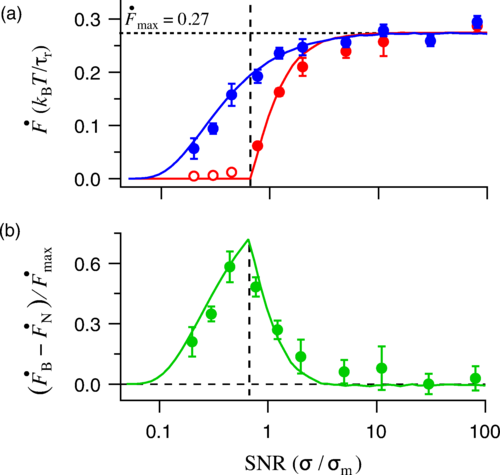 The performance of information engines.(a) Naive (red) and Bayesian (blue) data engine power output. Hollow red markers denote output power when α is 0. (b) Difference in output work extraction rate for Bayesian and naive engines, scaled by maximum speed.
Credit & Copyright: Physical Review Letters (2022). DOI: 10.1103/PhysRevLett.129.130601
Of course, for the ability of BayesianThe information engine has to “pay” to extract energy even with large measurement errors. Since such a mechanism uses information from all previous measurements, it requires more storage space and time to process the information.
And this is logical.Minimizing measurement errors increases not only the work extracted from the oscillations, but also the costs of information processing. As a result, scientists have found the ideal balance—maximum efficiency at an intermediate level of measurement error, when a good level of energy extraction can be achieved. At the same time, there are no costs for data processing.
Now scientists are studying how engine operation will be affected by noise that arises from factors other than heat.
Read more:
Why the Moon and not Mars: the main thing about the Artemis-1 mission and why it is needed
An ancient amulet rewrote the history of Europe's most mysterious language
The main theory of the origin of man was refuted: where did we come from