How many new particles have been discovered at the Large Hadron Collider?
The most famous discovery, of course, is
What are hadrons?
So what are these 59 new hadrons?Let's start at the beginning: hadrons are not elementary particles - physicists have known this since 1964, when Murray Gell-Mann and George Zweig independently proposed what is known today as the quark model. She presented hadrons as compound particles, consisting of new types of elementary particles - quarks.
Quarks are born free, but they are found only bound ...
Frank Wilczek,
Nobel Prize Laureate in Physics for the discovery of asymptotic freedom in the theory of strong interactions, 2004
The term "hadron" itself comes from the Greek“Hadros” is strong and reflects the property of hadrons to participate in strong interactions. These are short-range fundamental interactions that bind quarks inside nucleons and other hadrons. The strength of this interaction is far superior to the strength of the other three fundamental interactions - electromagnetic, weak and gravitational.
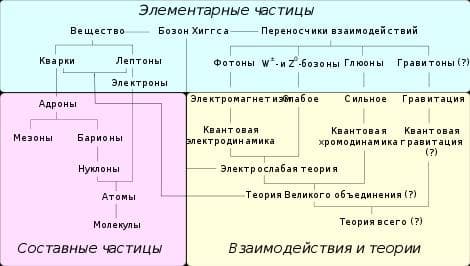 A brief overview of the various families of elementary and compound particles and theories describing their interactions. Elementary particles on the left are fermions, on the right are bosons.
Hadrons are related systems of quarks and antiquarks. There are two types of hadrons - baryons and mesons.
- Baryons (baryon charge B = 1) are particles composed of three quarks (qqq) and are fermions (J = 1/2, 3/2, ...).Baryons include, for example, the proton and the neutron.
- Antibaryons (B = -1) consist of three antiquarks (). Antiproton and antineutron belong to the group of antibaryons.
- Mesons (B = 0), consisting of a quark and an antiquark (q), occupy an intermediate position. Mesons have an integer spin and are bosons (J = 0, 1, 2, ...)
Quarks, on the other hand, are fundamental particles in the Standard Model.They have an electric charge that is a multiple of e/3 and is not observable in the free state.
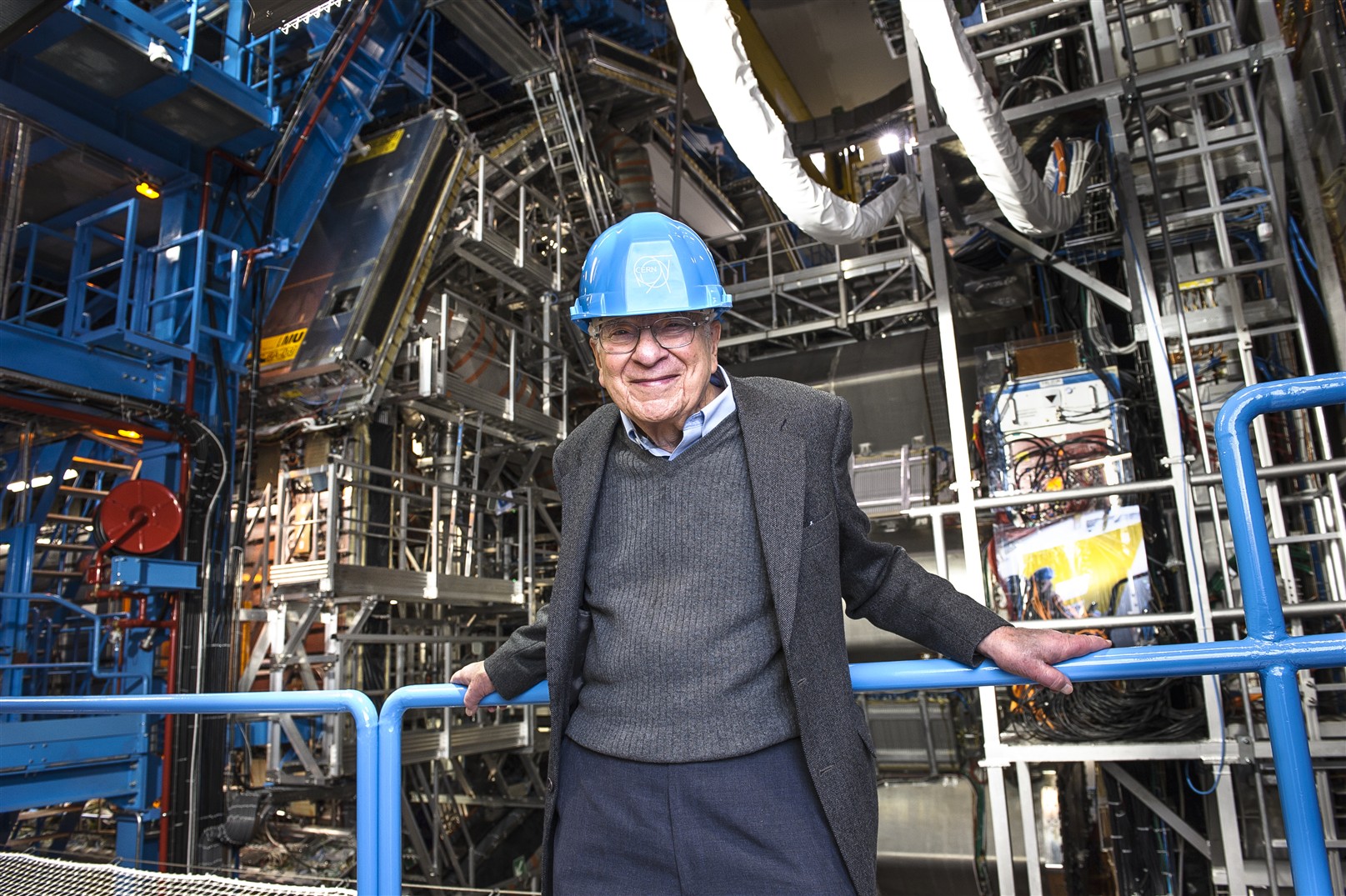 Professor Murray Gell-Mann at ATLAS Cave in 2012. Gell-Mann proposed the quark model and the name "quark" in 1964 and won the Nobel Prize in Physics in 1969. (Image: CERN)
How do new hadrons appear?
But just as researchers are still discovering new isotopes after 150 yearsAfter Mendeleev created the periodic table, the study of the possible composite states formed by quarks is still an active area of particle physics.
The reason for this lies in quantum chromodynamics.or QCD, a theory describing the strong interaction that holds quarks together inside hadrons. This interaction has several interesting features, including the fact that the strength of the interaction does not diminish with distance. This leads to a property that prohibits the existence of free quarks outside hadrons - color limitation. Such features make this theory very difficult from a mathematical point of view.
In fact, until now, the color limitation itself has not been proven analytically.And scientists still don't have a way to accurately predict which combinations of quarks mightto form hadrons.
What do we know about hadrons?
Back in the 1960s, there were already more than 100 known varieties of hadrons.They were found in accelerator experiments and in experiments with cosmic rays.The quark model allowed physicists to describe the entire "zoo" as different composite states of just three different quarks: up, down, and strange.All known hadrons can be described as either consisting of three quarks (forming baryons) or as quark-antiquark pairs (forming mesons).But the theory also predicted other possible quark designs.
Already in Gell-Mann's original article on quarksIn 1964, the idea of particles containing more than three quarks was considered possible. Scientists today know that such particles do exist. And yet, it took several decades to experimentally confirm the first four- and five-quark hadrons or tetraquarks and pentaquarks.
A complete list of 59 new hadrons discovered at the LHC is shown in the image below.
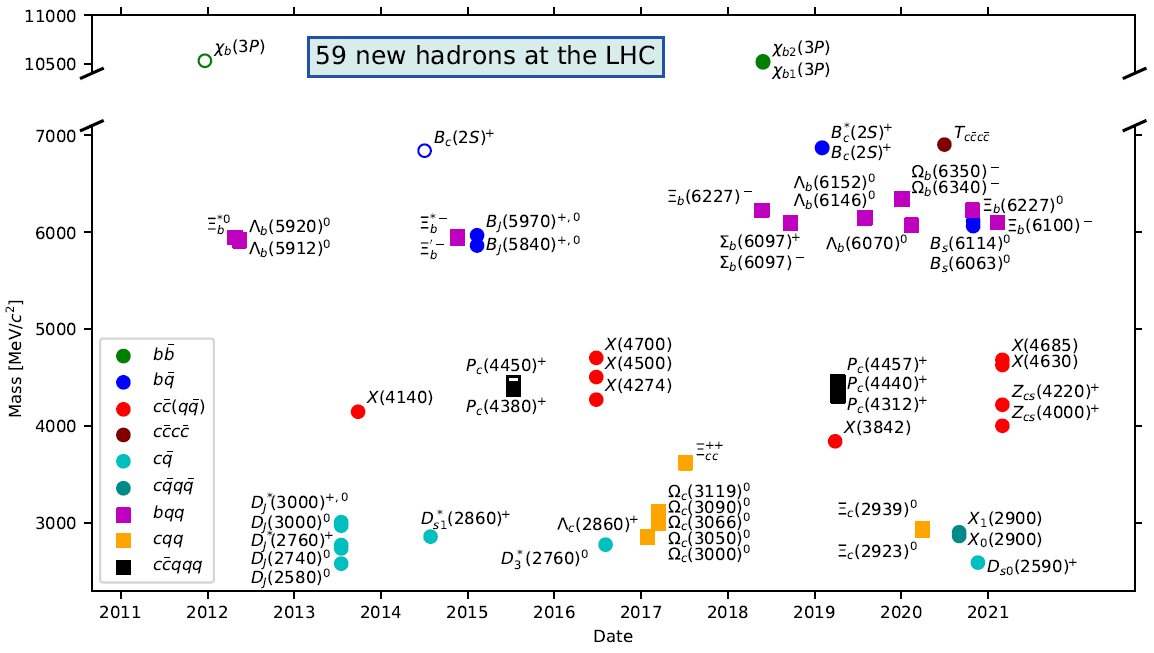 A complete list of new hadrons discovered at the LHC,disaggregated by year of discovery (horizontal axis) and particle mass (vertical axis). Colors and shapes indicate the quark content of these states. Credit: LHCb / CERN.
Some of these particles are pentaquarks, some are tetraquarks, and some are new (excited) states of higher energy baryons and mesons.
- Pentaquarks are a group of composite subatomic particles made up of five quarks.Their existence was proven using the Large Hadron Collider in July 2015.They are baryons, hadrons, fermions, and resonances.They give rise to a field of research in hadron spectroscopy — the physics of pentaquarks.
- A tetraquark is an elementary particle, a hadron, consisting of two quarks and two antiquarks.The spin of a tetraquark can only be an integer, so a tetraquark structure canhave only mesons.
- Baryons are a family of elementary particles: strongly interacting fermions consisting of three quarks.In 2015, the existence of similar particles of 5 quarks, called pentaquarks, was also proven.The main baryons include (as the mass increases): proton, neutron, lambda-baryon, sigma-hyperon, xi-hyperon, omega-hyperon.The mass of omega hyperon (3,278 electron masses) is almost 1.8 times the mass of a proton.
- Meson is a hadron with zero valuebaryon number. In the Standard Model, mesons are compound elementary particles composed of an equal number of quarks and antiquarks. Mesons include pions (π-mesons), kaons (K-mesons) and other, heavier mesons.
Initially, mesons were predicted to be particles that carry the strong force and are responsible for the retention of protons and neutrons in atomic nuclei.
Due to the presence of binding energy, the mass of the meson is many times greater than the sum of the masses of its constituent quarks.Baryons, together with mesons (the latter consisting of an even number of quarks), make upa group of elementary particles involved in the strong interaction and called hadrons.
The discovery of these new particles, together with measurements of their properties, still yieldsIn turn, this allows you to check the boundaries of the quark model.researchers to deepen their understanding of the strong interaction, test theoretical predictions, and fine-tune models.It is worth noting that this is especially important for research conducted at the LHC.The fact is that strong interaction is responsible for most of what happensThe better scientists understand the strong force, the more accurate it will beAs a result, the chances of seeing small deviations from theexpectations that may hint at possible new physical phenomena will rise.
The first hadron discovered at the LHC (LHC), χb (3P), was discovered by ATLAS, and the most recent include a new excited beautiful strange baryon observed by CMS and four tetraquarks discovered by LHCb.
Read more
Physicists have created an analogue of a black hole and confirmed Hawking's theory. Where it leads?
Abortion and science: what will happen to the children who will give birth
A nuclear rocket engine is being built for flights to Mars. How is it dangerous?
The Standard Model is a theoretical construction inphysics of elementary particles, which describes the electromagnetic, weak and strong interactions of all elementary particles. The modern formulation was completed in the mid-70s after the experimental confirmation of the existence of quarks.
A fermion is a particle or quasiparticle with a half-integer value of spin, the intrinsic angular momentum of elementary particles.