Scientists tested two options for the future mission. In the first of them, robots will work autonomously and
The mission includes four robots:two light rovers (LRUs), the Interact lunar rover and the Scout rover. The researchers note that the rovers can work together autonomously to complete their tasks. During testing, LRU1 assessed soil samples with its cameras and acted as a researcher. The second rover took on the role of "assistant": he collected and analyzed soil samples, analyzed their composition and provided the main robot with a Wi-Fi network.
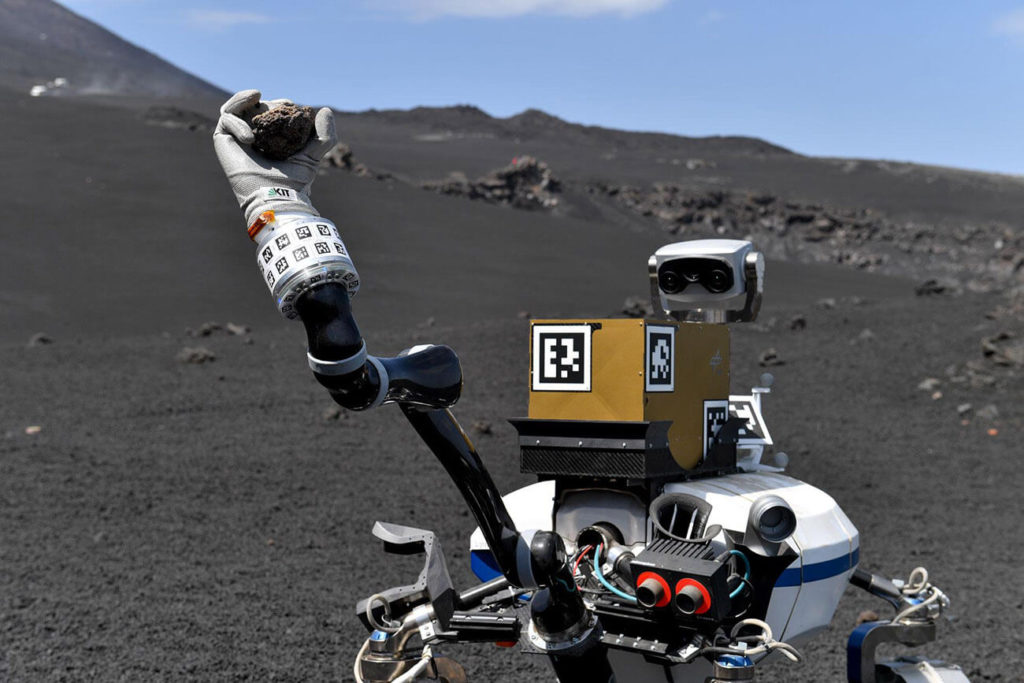 LRU2 picks up a stone sample. Image: DLR
Researchers note that for the mission to workspecialists from the Institute of Optical Sensor Systems of the Center have developed a device for laser spectroscopy. LRU2 directs a powerful pulsed laser beam onto the sample being examined. The material partially evaporates, allowing the device to detect various elements in the resulting plasma.
Collection of material on the lunar surface will alsoprovide Lunar Rover Interact. It features a camera and gripper that provide haptic feedback. With this technology, scientists on the ground will be able to get a tactile “feel” for rock samples.
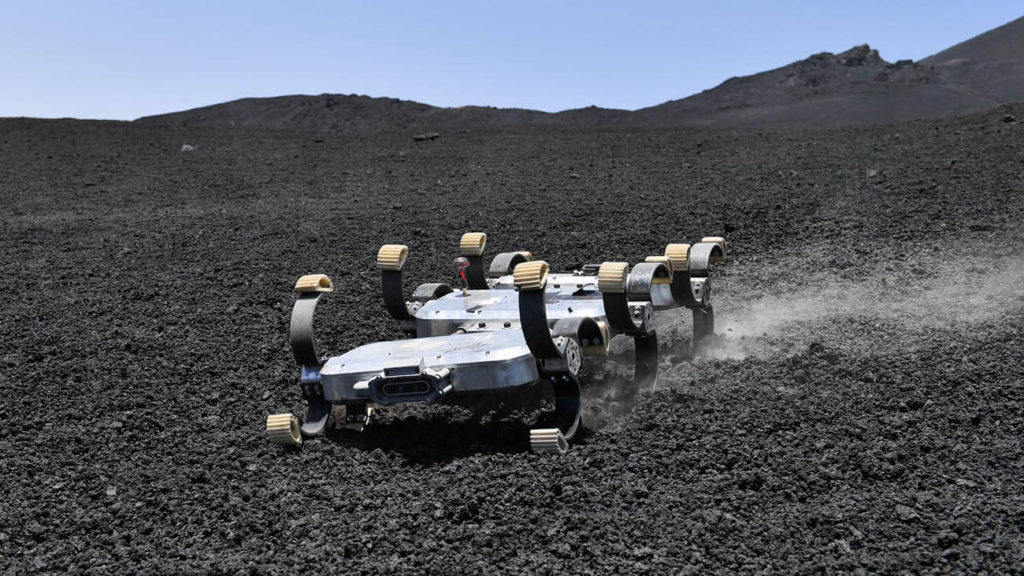 ATV Scout descends the slope of the volcano. Image: DLR
In addition, the mission also includes a drone,who performs the role of a “scout”. It explores the surrounding space and creates a map of the area that other devices can use.
Mobile robot teams will play an important role infuture space missions. Working in heterogeneous teams, robots complement and support each other through their different capabilities. They serve as extensions of human hands and eyes.
Armin Wedler, Project Manager at the German Aerospace Center
Images: DLR, CC BY-NC-ND 3.0
Read more:
A black hole in the galaxy proved Einstein right. The main thing
Astronomers have calculated when the planets will change their orbits and chaos will come
Engineers have created a cheap and durable hydrogen fuel cell