A team of astrophysicists led by Durham University used gravitational lensing to
For the analysis, the researchers usedthe effect of gravitational lensing, the curvature of the direction in which light travels due to a massive object located in the foreground. For the first time, a giant arc of a gravitational lens when viewing images of a survey of the galaxy Abell 1201 was noticed back in 2004 by Professor Alastair Edge of Durham University.
Exploring a supermassive black hole using gravitational lensing. Video: Durham University
19 years later, thanks to observations made withusing the Hubble telescope, and supercomputer simulations, the researchers were able to confirm the existence of a black hole and estimate its mass. During the analysis, the scientists simulated the passage of light past the black hole and compared it with real Hubble observations.
This is the first black hole discovered bygravitational lensing techniques. Most known supermassive black holes are in an active state, when matter attracted close to the black hole heats up and releases energy in the form of light. The new supermassive black hole belongs to the category of sleepers that are difficult to detect with traditional methods.
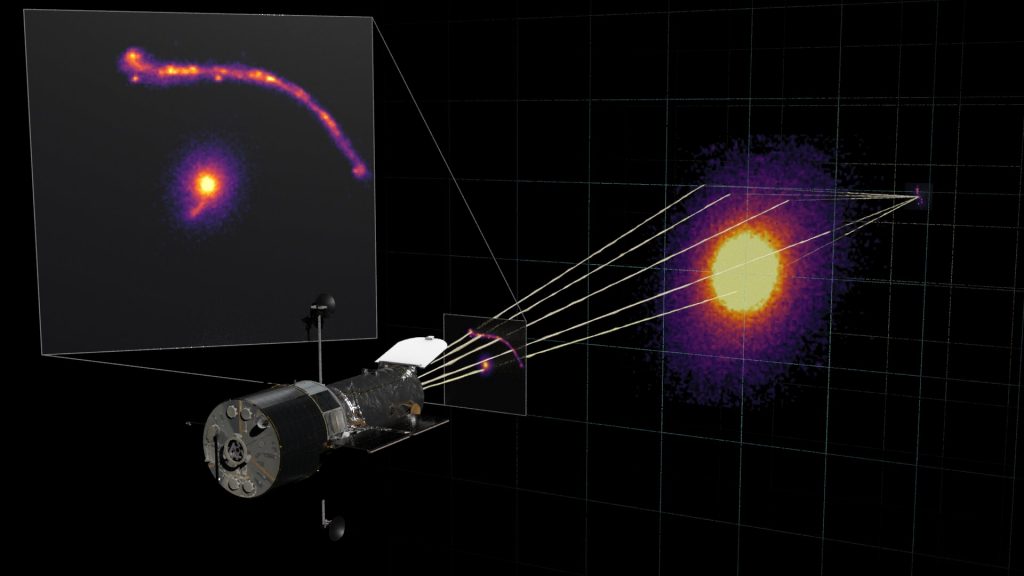
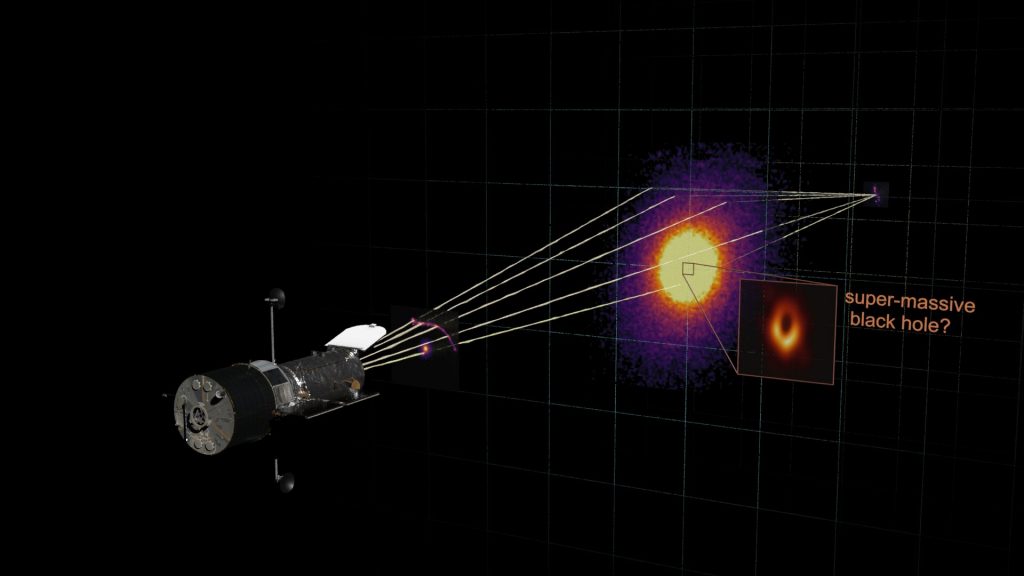
The bending of light from distant galaxies due to the gravity of a supermassive black hole. Images: Durham University
Researchers believe that additionalobservations using powerful telescopes and analysis of the gravitational curvature of light will help find more massive dormant black holes and understand how such structures gain mass.
Gravitational lensing makes it possible to studyinactive black holes, which is currently not possible in distant galaxies. This approach could allow us to detect many more black holes outside of our local universe and show how these exotic objects have evolved in cosmic time.
James Nightingale, researcher at Durham University
Read more:
Biologists discover how cancer cells elude the immune system
The key theory of quantum physics has finally been proven. Main
Named products that protect the brain from dementia, and when to use them
On the cover: an artistic illustration of a supermassive black hole. Image: ESA/Hubble, Digitized Sky Survey, Nick Risinger (skysurvey.org), N. Bartmann