Researchers at the Australian National University are using nanoscale resonators to
Conventional light microscopes are capable of studyingonly objects no larger than one ten-millionth of a meter, the scientists explain. More complex studies require the use of ultra-high resolution microscopy or electron microscopy, which are expensive and slow technologies.
Researchers use resonators toincrease the frequency of light oscillations in an optical microscope and, accordingly, observe smaller objects. Rays of light, which we perceive as different colors of the rainbow, are electromagnetic waves that vibrate at different frequencies: from low (red) to high (violet).
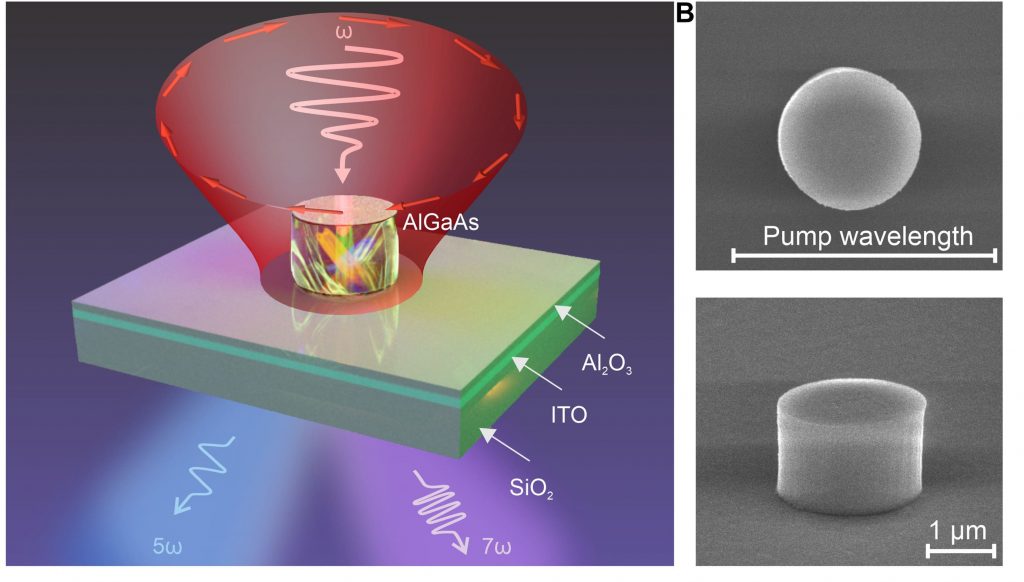 Changing the radiation frequency using a resonator. Image: Anastasiia Zalogina et al., Science Advances
The researchers suggest increasing the frequency toextreme ultraviolet: waves with such a high frequency have a shorter wavelength and, accordingly, can "show" tiny objects. In a series of experiments, the researchers demonstrated that a tiny, shaped aluminum gallium arsenide (AlGaAs) resonator increased the frequency of radiation detected by cameras and other instruments by up to seven times.
Researchers note that these sourcesextreme ultraviolet radiation can be used, for example, in the semiconductor industry. In the production of tiny chips, they can monitor and diagnose any problems in real time. In addition, they can be used to study the structure of cells, viruses and other tiny biological structures.
Read more:
Bears separated in childhood reunited: the zoo told how it all went
Light in the early universe: a new theory changes the way it was
See what happened to Mercury when it got as close as possible to the Sun