Like other quantities, the second is just a relative concept that is based on an agreement about
In 1875, 17 leading countries of that time, amongwhich were, including, Austria-Hungary, the Russian and Ottoman Empires, France, Germany, the United States and Brazil, signed the Meter Convention - an international treaty that ensures the unity of measurement standards in different countries. To develop uniform principles and conduct reference measurements, states created the International Bureau of Weights and Measures.
At the 27th Conference on Weights and MeasuresRepresentatives of different countries agreed that the modern definition of the second ceases to satisfy the required accuracy of measurements and requires revision. The roadmap provides that at the next meeting in four years, countries will have to choose a new, more accurate reference system and change the wording of the second.
First measurements of a second
For centuries, people have measured time bythe rotation of the earth. From the ancient Egyptians to the Greek astronomers and Babylonians, mankind gradually changed the accuracy of measurements, which required new units of time, and with the development of technology, their unification and synchronization.
The very first mechanical watches that appeared inXIV century, there were not even minutes. The dials were divided into halves, thirds, quarters, and sometimes even into 12 parts of an hour, but never into 60. The first mechanical watches showing minutes appeared towards the end of the 16th century. At the same time, unlike sundials, which showed apparent time, mechanical watches switched to average time.
The fact is that the orbital motion of the Earth aroundThe sun leads to uneven length of the day. Apparent solar time uses the time between the two times our star is at its zenith as its definition of day. In this case, fractional parts (hours and minutes) are determined based on the movement of the Sun.
In fact, when measured based onalternative systems, for example, the number of movements of the pendulum in a mechanical clock, it turns out that the duration of such days is different. The length of a solar day varies throughout the year, and the cumulative effect causes seasonal deviations of up to 16 minutes from the average.
The first clocks showing seconds appeared insecond half of the 16th century. Earliest known spring clock with a second hand: dated to around 1560–1570. At the same time, all the first analogues were insufficiently accurate.
In 1656, the Dutch scientist Christiaan Huygensinvented the first pendulum clock. It had a pendulum just under a meter long, which gave it a one-second swing, and a trigger mechanism that ticked every second. It is believed that this was the first watch that could accurately show time in seconds.
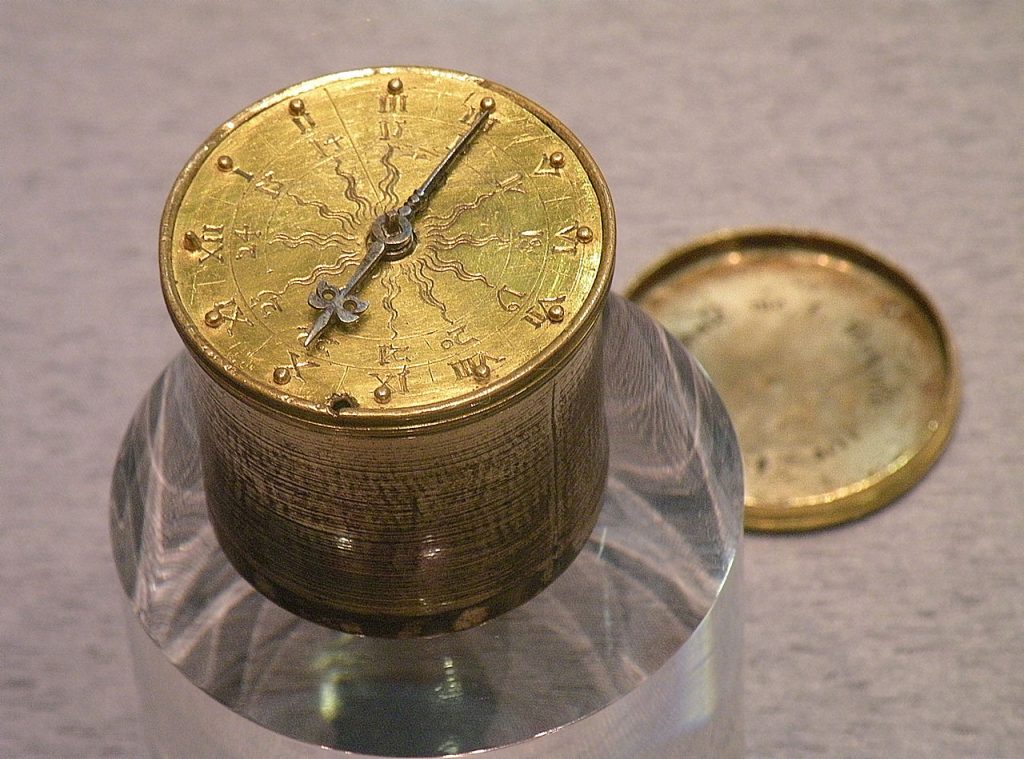 Henlein pocket watch, early 16th century. Image: Germanisches National Museum
From a fraction of a day to the Earth's orbital rotation and atomic measurements
By the end of the 19th century, the accuracy of measuring secondsreached such heights that they formed the basis of the international metric system of the ISS, which was fixed by the General Conference on Weights and Measures in 1889. The meter was approved as the basic unit of length, the kilogram for weight, and the second for time. The latter was defined as 1/86400 of the average solar day.
Since the Earth's orbit around the Sunmore stable than the rotation of a planet around its axis, this definition was later changed and expressed in terms of a fraction of a year: 1 ⁄ 31,556,925.9747 of a year. At the same time, to further reduce uncertainty, an ephemeris time scale was used, calculated based on the position of the orbits of planets and stars in 1900.
In 1967, after decades of research,scientists abandoned the Earth's rotation method and redefined time, instead measuring the motions of particles within an atom. In particular, the current definition uses the natural frequency resonance of caesium-133 to calculate. From that moment on, the second is determined by a fixed numerical value of the frequency of vibrations of the cesium atom.
How does atomic time work?
Early atomic time scales consisted ofquartz clocks with frequencies calibrated using atomic clocks alone. They are based on a system of atoms that can be in one of two possible energy states.
A group of atoms in one state undergoesmicrowave radiation. If the radiation has the right frequency, a number of atoms will move to a different energy state. The closer the frequency is to the natural vibration frequency of the atoms, the more atoms will switch states.
This allows very precise frequency tuning.microwave radiation. Once the microwave radiation is tuned to a known frequency, it can be used as a timing generator to measure elapsed time.
International Atomic Time isa time-weighted average of more than 450 atomic clocks in more than 80 national laboratories around the world. This approach allows us to avoid distortions associated with gravitational time dilation.
Hours in different institutions are regularly comparedwith each other using satellite communications and GPS. The Bureau International des Poids et Mesures (BIPM, France) combines these measurements to calculate a retrospective weighted average that forms the most stable possible time scale.
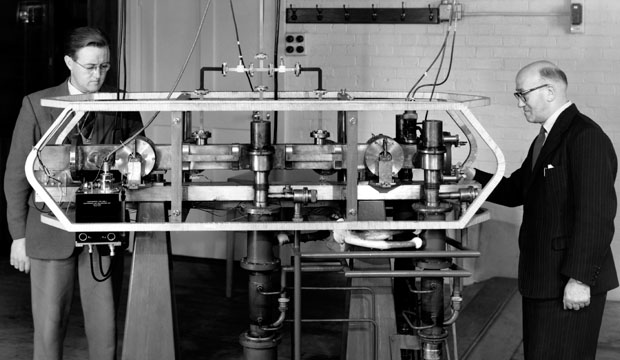 The world's first atomic clock. Image: National Physical Laboratory, Public domain, via Wikimedia Commons
What do they want to change?
Further development of technology allows even morefurther improve the measurement accuracy. For example, as an alternative to the classical cesium clock, physicists suggest using an optical clock. These clocks use the higher frequency "ticking" of elements such as strontium and ytterbium, allowing them to break down time into even smaller chunks.
The difficulty so far lies in the fact that the officialtime cannot be generated using clocks alone. Metrologists must average the readings of hundreds of hours around the world. For cesium clocks, time can be transmitted using microwave signals, but such radiation is too low frequency to transmit the ticking of an optical clock.
On the contrary, transmission of signals through the air toOptical wavelengths are not as simple as sending microwaves because molecules in the air easily absorb light, dramatically reducing signal strength. Additionally, turbulence can direct the laser beam away from the target.
However, changes in this direction areprogress, for example, recently Chinese scientists presented the results of their work on the synchronization of optical clocks at a distance of 117 km. This is seven times the previous record. Further development in this direction will help improve the accuracy of determining the second by 100 times or more.
By decision of the Conference on Weights and Measuresparticipants are encouraged to continue developing alternative methods for measuring and synchronizing time. Based on them, proposals for a new standard and transition period will be formulated by the next meeting in 2026.
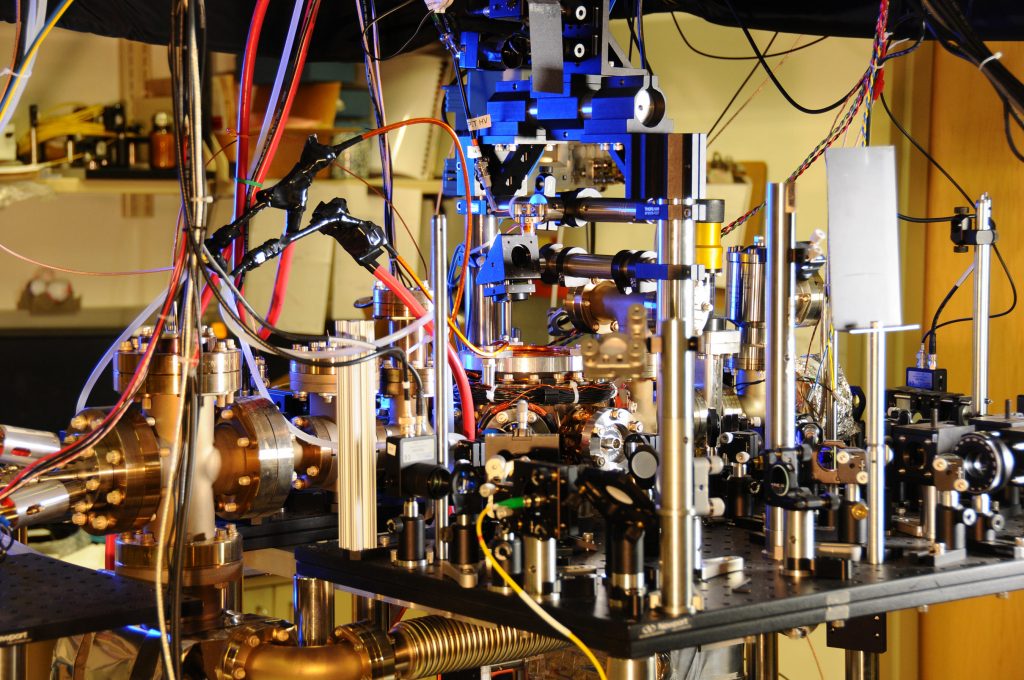 Ytterbium optical atomic clock. Image: NIST
Leap second
If this is still a question of the new standardlittle uncertainty, then another change that will affect the provisional standards is finally accepted. Already in 2035, the world should abandon leap seconds.
The point is that in the transition to precise measurementtime based on atomic clocks, scientists have found that the average day is not equal to 86,400 standard seconds. The difference is only a few milliseconds, but accumulates over time.
The solution was leap seconds:one second corrections were applied in late December or June on an ad hoc basis. The changes were planned to ensure that the timekeeping system we use, Coordinated Universal Time (UTC), never differs by more than 0.9 seconds from atomic time.
Since such changes were one-timecharacter, "leap" seconds created great difficulties for software, energy and satellite systems. First, it's hard to predict exactly when the next leap second is needed, so program developers can't prepare for orderly, regular insertions. Therefore, various networks have developed their own inconsistent methods for including the leap second.
Moreover, modern global computingsystems have become more closely interconnected and more dependent on super-accurate timing, sometimes down to billionths of a second. Adding an extra second increases the risk that systems responsible for telecommunications networks, power transmission, financial transactions and other vital businesses will fail or fail to synchronize.
To avoid this problem, scientists have adopteda decision to phase out these inserts from 2035. Since 1972, over the past 50 years, the difference between UTC and international atomic time has been only 37 s, with 10 s added immediately and another 27 s inserted later. Scientists propose to fix the difference that will be accumulated by 2035 and not change it for at least the next 100 years.
Read more:
A magnetic storm is about to hit Earth
The true meaning of mummification is revealed: all this time, scientists were wrong
Named the main danger of the lunar mission "Artemis"