HiRISE mission researchers have published a new image of the surface of the Red Planet. The camera lens got hit
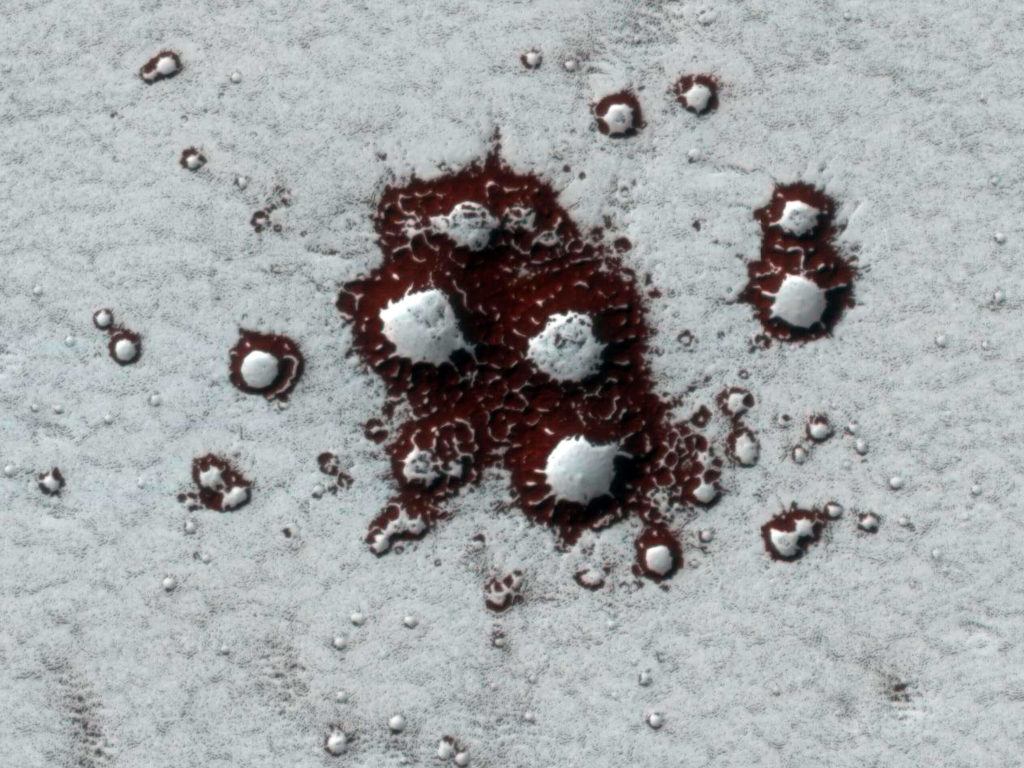 A cluster of craters on the surface of Mars. Image: NASA/JPL-Caltech/UArizona
The resemblance to a rash is reinforced by the fact thatmost of the craters near the south pole are solitary and look like pores on human skin. The unusual color of the cluster is due to seasonal carbon dioxide ice that covers the layered rock deposits near the south pole.
Accumulations of craters, as a rule, are formed,when an approaching space rock collapses in the Martian atmosphere. At the same time, as a recent study showed, it is not the size of the object that causes decay, but its fragile structure. The meteorite must already be “weakened” on approach for the atmosphere to complete this process.
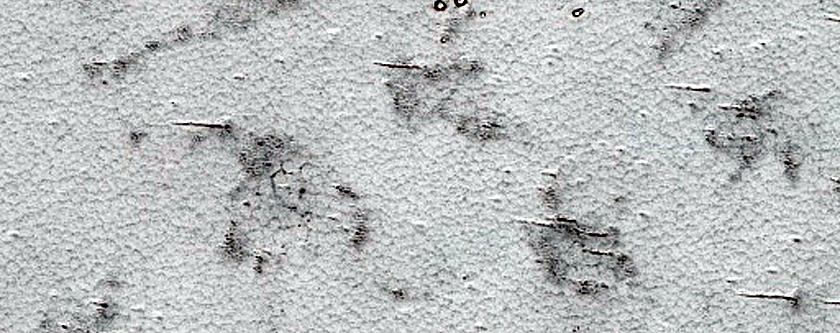 A wide shot of an area near the south pole of Mars. Image: NASA/JPL-Caltech/UArizona
Researchers note that time and historythe formation of this cluster of craters is not known. But analysis of the size, location, and other properties of craters suggests that they were formed in this way: due to the impact of an object that fell apart in the atmosphere into several parts.
HiRISE is a camera installed on boardspacecraft Mars Reconnaissance Orbiter. It is the largest telescope sent into deep space to date. The camera can take images with a resolution of up to 30 cm per pixel when the satellite is located at an altitude of 300 km above the surface of Mars.
Read more:
Chinese reusable spacecraft launched a mysterious object into orbit
An ancient stone from a cemetery, which is 1,500 years old, “broke” the history of the Celts
Scientists have seen what is on the territory of the Mayan capital. The find surprised them.