Martian meteorites are parts of the surface of Mars that were ejected into space as a result of
One of the most famous and important for scienceis the Martian meteorite ALH84001, discovered in Antarctica in 1984. It contains orange-colored carbonate minerals that precipitated from salty liquid water on the surface of Mars 4 billion years ago. Its study allowed researchers to determine that early Mars had water in liquid form.
However, during that study, scientistsfaced the problem of meteorite contamination with terrestrial molecules and Antarctic snow. Therefore, scientists were unable to determine exactly how much carbon and nitrogen it contains, including due to technical limitations.
In the course of the new work, chemists from JAXA conductedre-study of ALH84001 using new methods of analysis of samples of Martian rocks, which allow you to separate earthly materials from the original, Martian.
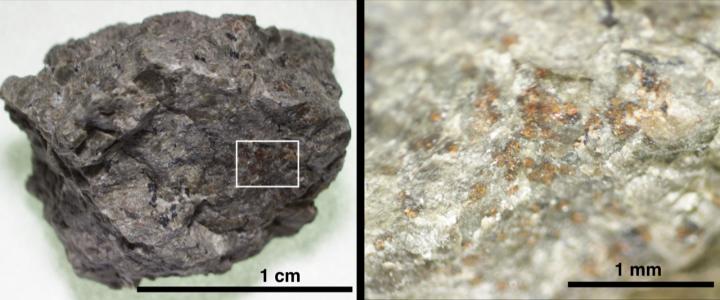
As a result, researchers were able to discover inmeteorite nitrogen-containing organic compounds, whose age is about 4 billion years. Multistage checks showed that the materials are indeed of Martian origin. This means that life could exist on the planet in the first few hundred million years.
Previously, Hi-Tech spoke in detail about the joint mission of NASA and the ESA, whose main goal is to deliver unpolluted samples of Martian rock to Earth.