The Orionids are a meteor shower that rains brightly on Earth in mid-autumn every year.He
Orionids burst into the Earth's atmosphere at a speedabout 66 km/s. Rapidly moving objects can leave glowing trails formed by hot debris. Such "fingerprints" remain in the sky on a moonless night from a few seconds to a couple of minutes. In addition, the largest of the meteors can form bright luminous balls in the sky.
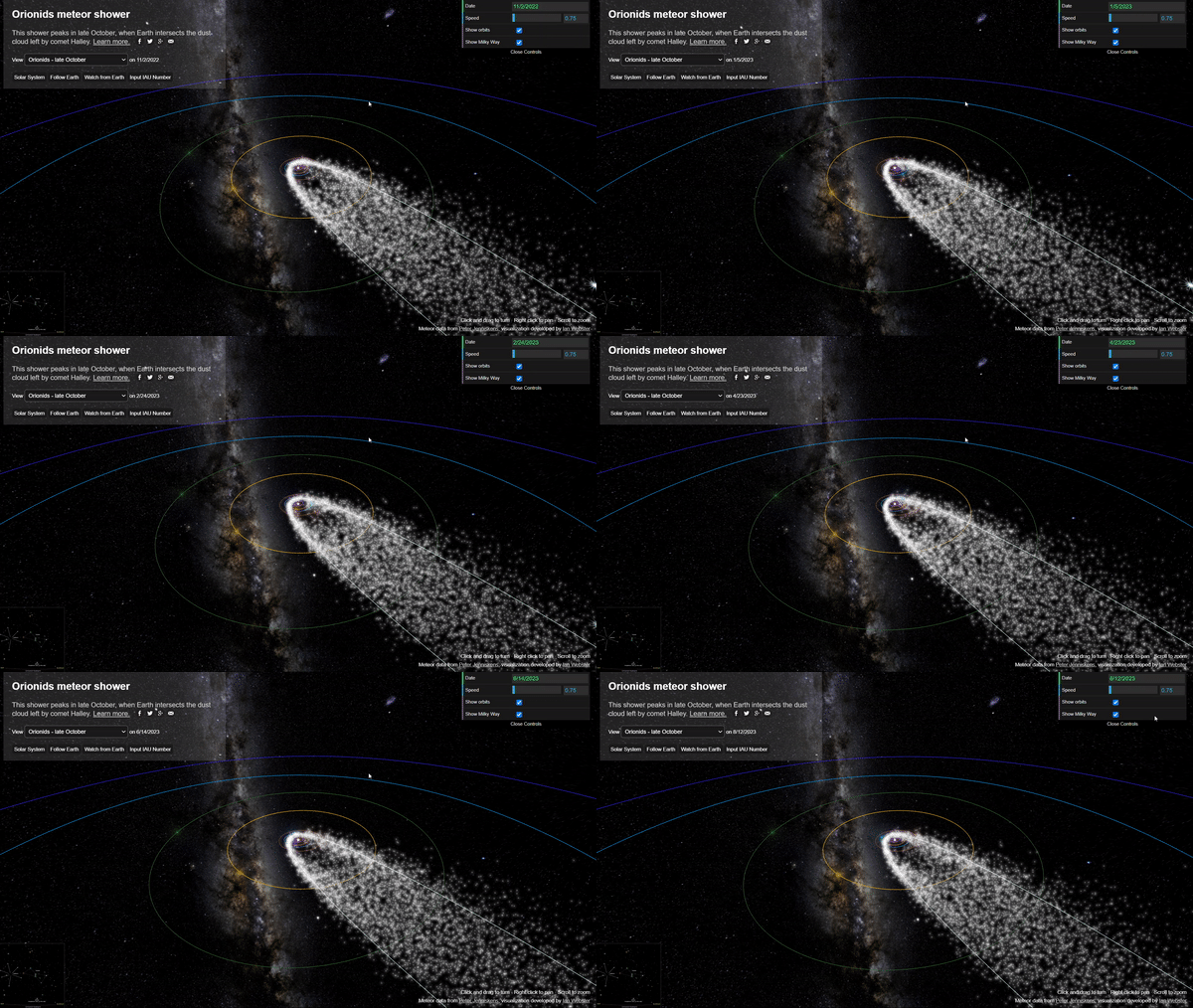 Orionid stream. Image: Meteorshowers.org
How did the Orionids form?
Every October the Earth passes through the debrisHalley's comets approaching the sun. The orbit of our planet crosses the trail of a distant wanderer twice a year. In May, a stream of cosmic dust moving away from the Sun forms the eta Aquarid stream, and in October, approaching meteors create the Orionids.
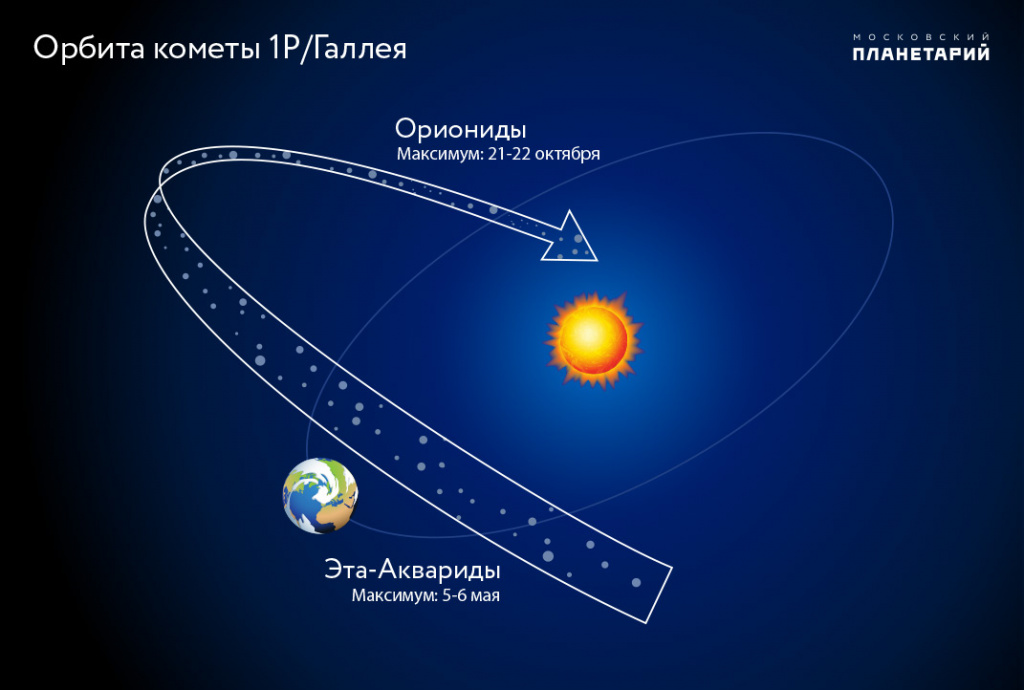 The intersection of the orbits of Halley's comet and the Earth. Image: Moscow Planetarium
Pieces of space rock and iceinteracting with our atmosphere and forming the Orionids come from 1P/Halley. When a comet approaches the Sun, its core heats up and it throws particles of ice and stony dust from its surface into the surrounding space. When such particles collide with the Earth's atmosphere, they become meteors, burning up in the atmosphere of our planet.
The passage of the Earth through the dust stream,left behind by Halley's Comet approaching the Sun lasts for several months, but meteor activity tends to be low until mid-October as we approach the center of the space wanderer's orbit. In 2022, the maximum activity will occur on October 21. At this time, the average number of bright trails is expected to be around 20 per hour.
Comet Halley
Halley's Comet is one of the most famous cosmic objects.It is the first comet for which an elliptical orbit has been calculated and the rotation period has been determined.Studying historical records, the English astronomer Edmund Halley compiled the first catalogue containing known observations of comets.
The researcher drew attention to the strangecoincidence of the paths of comets observed by Apian in 1531, Kepler in 1607 and Halley himself in 1682. The astronomer assumed that it was the same comet and calculated its next appearance in 1758. The prediction was confirmed - Halley's comet really revolves around the Sun with a frequency of 75-76 years.
Halley last approached the Sun in 1984year. This event became one of the most intense in the history of observations: the development of astronomical instruments and astronautics made it possible to send a research mission to the space wanderer. For example, the Soviet satellites Vega-1 and Vega-2 approached a comet, determined the structure of its nucleus and the process of coma formation.
In addition to a large amount of comet datafilled outer space with new fragments that made meteor showers brighter. The next “recharge” is expected only in 2061: according to calculations, Halley will reach perihelion (the point of the orbit closest to the Sun) on July 27, 2061.
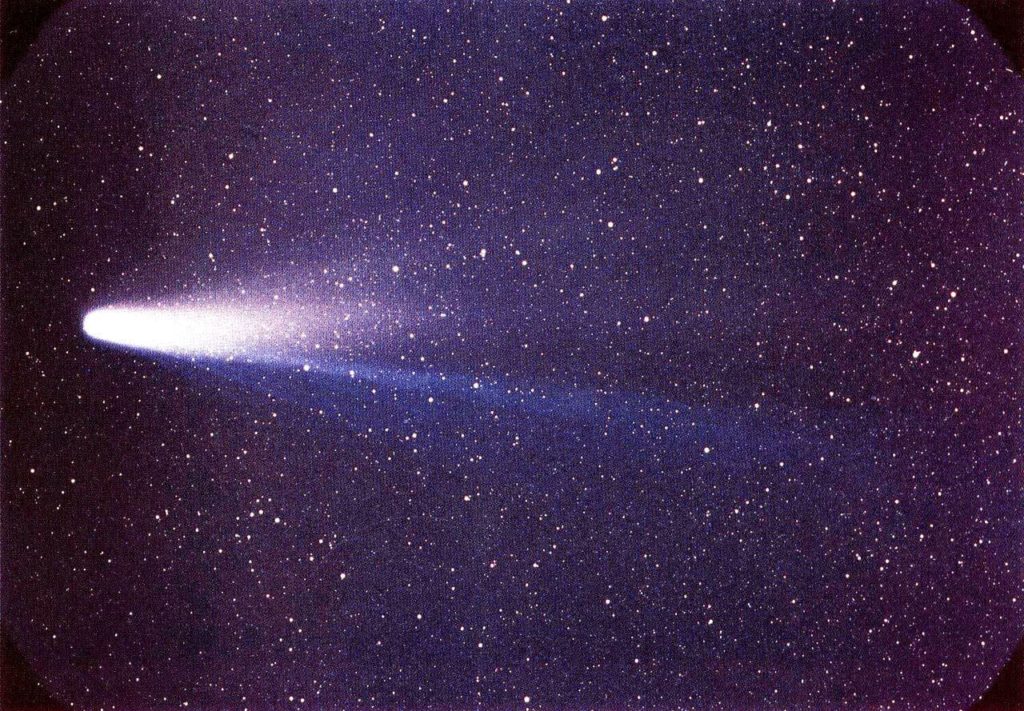 Comet Halley March 8, 1986. Image: NASA, W. Liller
How to find meteors?
The Orionids are not visible immediately after sunset: at this time, they hide behind the horizon, appearing in the sky at about 10 p.m.But the best time for observation is from 01:00 to dawn.At this moment, the radiant(the point from which the meteors appear to be emanating from the observer) is more than 30° above the horizon.
A bright moon can interfere with observations, but this year astronomers and amateurs are in luck: the Earth's satellite is approaching a new moon, which will beOctober 25, and therefore on the night of maximum activity it will beIt is only 15-20% illuminated.
The Orionids are named after the constellationOrion, in which the radiant of the stream is located. During maximum activity, the "source" will be to the east of the constellation, about 10° northeast of the bright orange star Betelgeuse (Alpha Orionis). This distance is approximately equal to the area covered by the clenched fist of the outstretched hand.
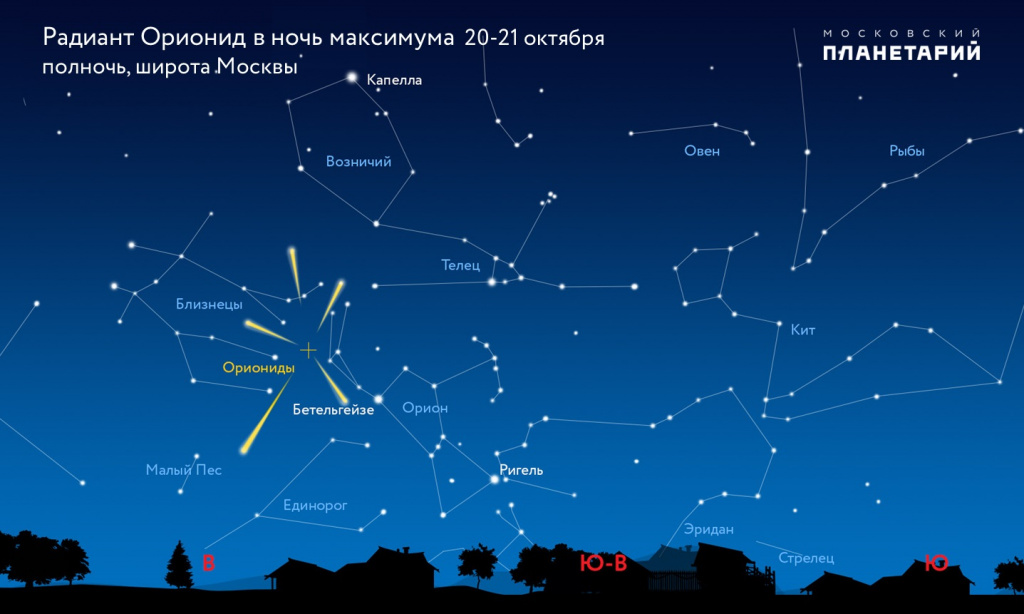 The Orionid radiant in the night sky. Image: Moscow Planetarium
Where and how to watch?
The best way to watch meteors is to lie incomfortable chaise lounge with the back inclined at a slight angle. You can look vertically upward, but more meteors are visible in the lower half of the atmosphere because you are looking through more of the atmosphere.
You don't have to look to see the Orionidsonly towards the constellation of Orion, NASA experts recommend - meteors will be visible in different parts of the night sky. It's actually best to view the Orionids from 45 to 90 degrees from the radiant. From this angle, they will appear longer and more spectacular. If you look directly at the radiant, the meteor trails will appear shorter.
Experts of the International Astronomical SocietyIt is advised to look south over the horizon. In this case, in addition to the Orionids, it will be possible to observe several other less active streams emanating from the constellations Taurus, Gemini and Leo Minor.
The Taurids will move slower than a comet's streamHalleys, and the Gemini and Leo Minor meteors will be as fast but less bright than the Orionids. These are small streams, but even in them it will be possible to consider up to 2 meteors per hour. At the same time, the Taurids this year can give rise to fireballs - large and bright objects.
Human eyes need some time toadapt to the dark, so do not expect discoveries in the first minutes. At the same time, the number of stars that are visible in the sky is a good indicator of the right place. The more of them, the less artificial light and cloudiness interfere, which means that there is a greater chance of seeing star rain.
Finally, if you're unlucky and the sky is at nightthe observation was too cloudy, you can try the next night: the researchers believe that a lot of shower activity will continue for several days.
Read more:
NASA revealed the origin of Haumea - the most mysterious planet in the solar system
Living organisms have made Mars uninhabitable
The liver can work for more than 100 years: scientists told how this is possible
On the cover: Brocken Inaglory, CC BY-SA 3.0, via Wikimedia Commons