They are older than most of the readers of this article, but stillin the ranks: the first in the years of their youth and
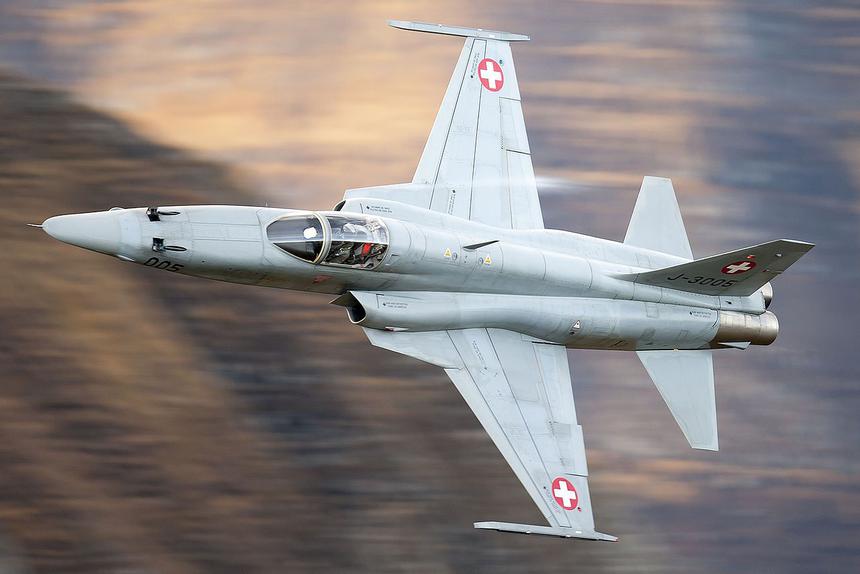
Table of contents
- 5th place - Su-17 (Su-22)
- 4th place - Northrop F-5
- 3rd place - Mirage III
- 2nd place - McDonnell Douglas F-4 Phantom II
- 1st place - MiG-21
Once these planes were weapons of the coldwar, although, of course, they did not have to fight to the fullest (fortunately). Most of the cars in the top belong to the third generation fighters, when the cars were able to go beyond the speed limit of Mach 2, and they also received powerful radars and medium-range air-to-air missiles.
We selected those machines that one way or anotherare in the service or have left it historically not long ago. We have arranged this top according to the increasing parameters of age and intensity of use - let's see what kind of cars and why they are remarkable.
These are not the only centenarians in historyfighter aviation, but the most iconic. Yes, of course, they owe their longevity in the ranks mainly to the poverty of their current or last owners than to any supernatural characteristics. But you know - and figs with him, what does it change?
5th place - Su-17 (Su-22)
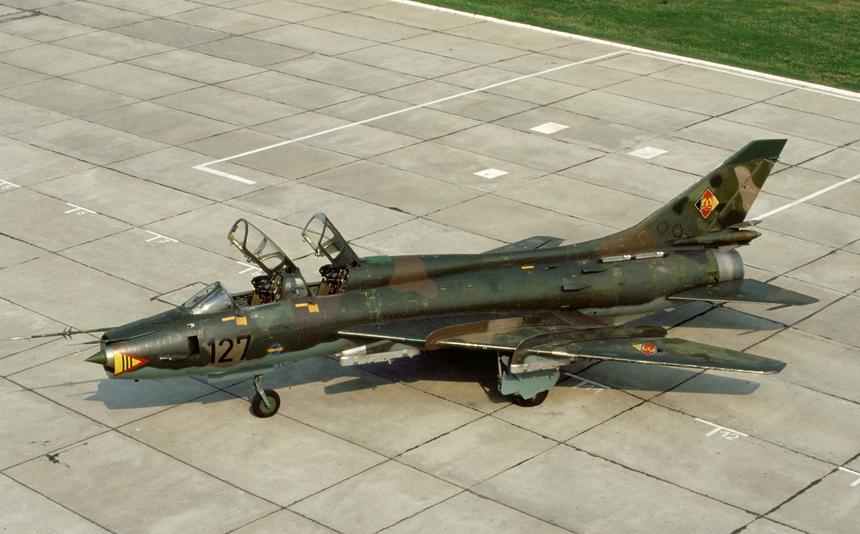
Su-17
The youngest in the selection, the first Sovietfighter with variable sweep wing. Variable sweep was a necessary measure at that time - a straight wing has better lift and controllability at low speeds, but at the same time, at supersonic speed, such a wing creates increased drag, that is, it greatly limits the car in speed.
Increased sweep - on the contrary, reducesdrag coefficient, but the car is poorly controlled at low speeds, and this is critical during takeoff and landing. The design of the measured sweep solved the dilemma, although it also had disadvantages in the form of a more complicated design, an increase in mass, and an additional risk factor in case of breakage.
Su-17 is a fighter-bomber.Like many in the third generation, this is a multifunctional aircraft. But its main task was to use a tactical nuclear bomb, and the design was sharpened for a pitch-up maneuver (dive on the contrary - a sharp climb) or "half-loop". The fighter went into a pitch-up and dropped at an angle close to 90˚, and then continued to maneuver to get away from a powerful blast wave.
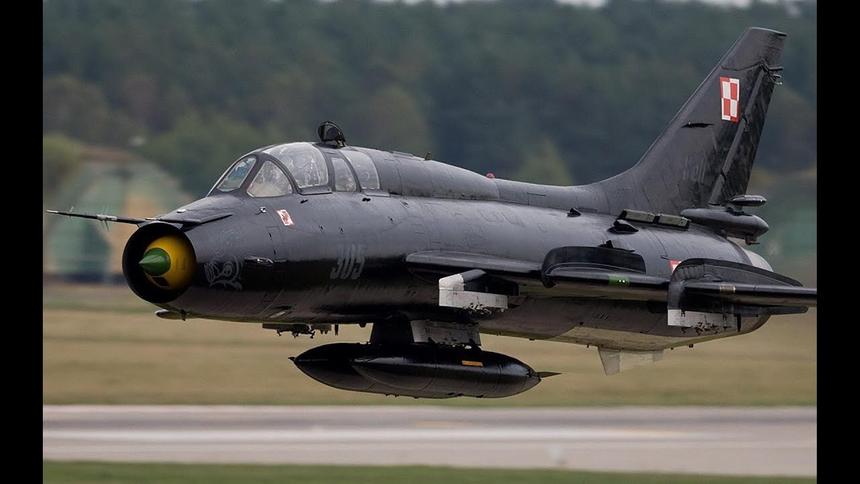
Upgraded Su-22 of the Polish Air Force
In fact, the Su-17 had a variable body kit, includingconventional weapons - air-to-air, air-to-ground missiles, free-falling and adjustable bombs, cluster munitions and cannon containers. That is, it was both a fighter (but de facto it was not used in this capacity), and a tactical bomber, and an attack aircraft, depending on the situation.
The high speed made him feelrelatively safe to air defense, which at that time was represented by both cannon weapons (almost useless in relation to the Su-17) and early generations of missile air defense, because of which the Su-17M was equipped with the first anti-radar missiles - a powerful airborne radar could detect a source of radiation and send an X-28 missile to it, making this Drying also a means of breaking through air defense.
Su-17 in various modifications (including simplifiedexport Su-20 and Su-22) took part in almost all military conflicts after 1970. The Yom Kippur War (1973), the Iran-Iraq War, the African squabbles, Afghanistan, and even a little bit of the First Chechen War. In the 21st century, there was a civil war in Libya, and, of course, a war in Syria, where the Syrian army continues to fight on such a machine today.
-
First flight - August 2, 1966
-
In service since 1970
-
Current operators are Poland, Vietnam, Syria, Libya
4th place - Northrop F-5
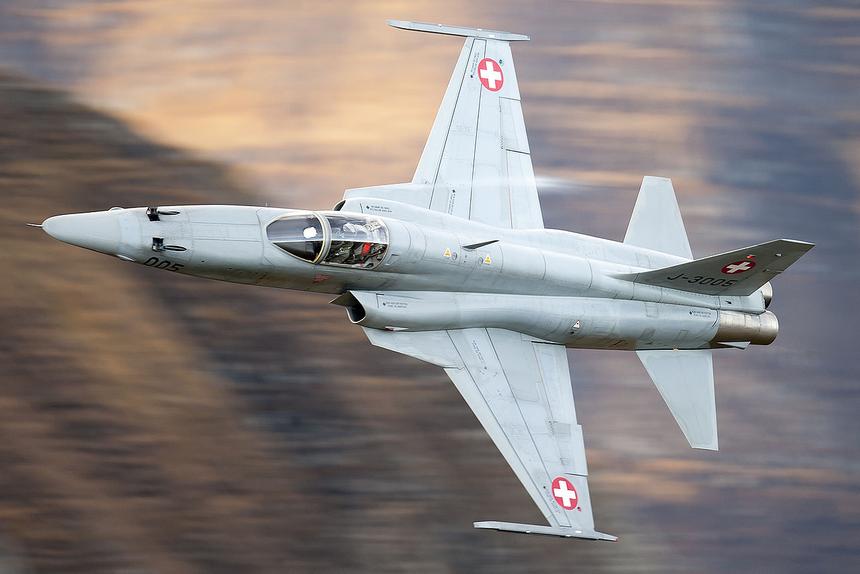
F-5
American light fighterarmed the allies and satellites of the United States, who did not have their own aircraft industry. It was, in essence, a response to the appearance of the Soviet MiG-21 light fighters, which quickly showed excellent combat capabilities.
The F-5 had excellent maneuverability and controllability, which was a great advantage for low-skilled pilots, who could now quickly master the machine and fight it successfully.The platform made it possible to use the entire main range of weapons for American fighters.
F-5 equipped with two autocannons 20 mm x 250shots for each. Next come the AIM-9 air-to-air missiles, modifications of which are still in service with the United States - this is the world's first mass-produced missile with an infrared (thermal) homing head. This option made it possible to fight enemy aircraft with minimal participation of the pilot - the missile itself goes to the target, so after launch you can switch to the following tasks (because the enemy will obviously not be up to you at this time).
But, of course, it is also a fighter-bomber- up to 9 free-fall bombs of 250 kg or heavy Mk-84 of 908 kg with a concrete-piercing option. AGM-12 missiles with a cluster warhead for working on the ground, and, finally, incendiary bombs with napalm.
The peak of his combat career came in the Vietnam War,where the F-5 of various modifications became the basis of the South Vietnamese Air Force. There, the F-5 did not prove to be very successful as a fighter, it was more often used for reconnaissance and point bombing. They preferred to evade the battle with the MiG-21 more often, because the American machine was inferior to the Soviet one in maneuverability and the quality of airborne radars.
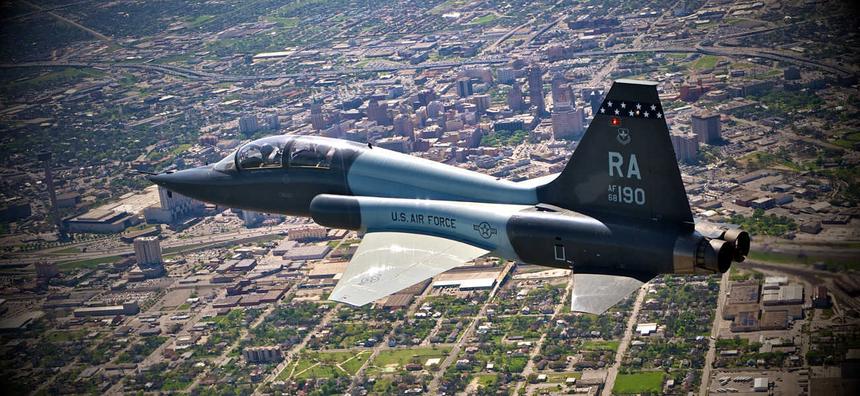
Training T-38 Talon
However, the combat track record of the machine,probably the widest in the selection - Africa, Asia, South America, Europe (Turkish-Greek conflict of 1974). Cheap, unpretentious, economical, easy to learn, the F-5 became a popular car in third world countries, allies of the United States, who did not buy Soviet equipment.
- In service - Taiwan, Thailand, Tunisia, Morocco, Philippines, Chile and, suddenly, Switzerland. And this is not the whole list, as soon as about 20 more countries are equipped with it.
The US itself continues to use thismachine, but in a significantly revised version of the Northrop T-38 Talon - in the role of a training vehicle for the US Air Force. So even today on a website like Flytradar you can see T-38s with cadets over American training bases.
-
First flight - July 30, 1959
-
In service since 1962
3rd place - Mirage III
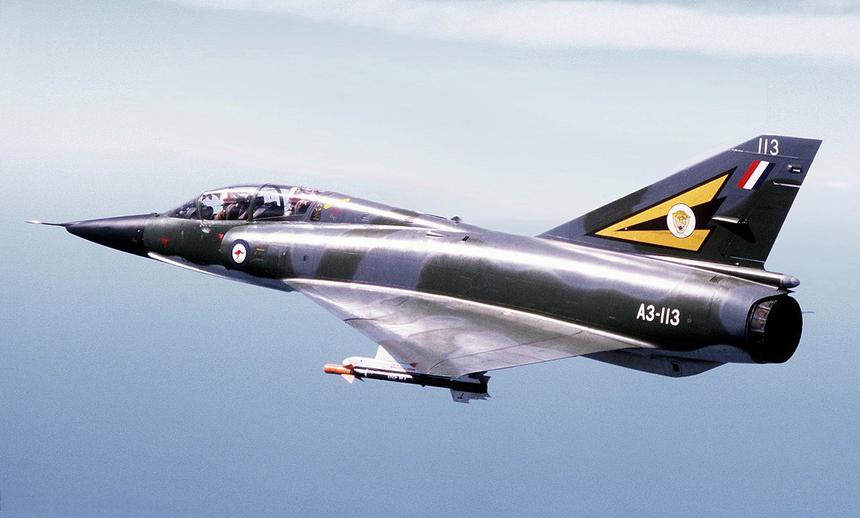
Mirage III
Dassault Mirage III - the first large-scaleEuropean supersonic fighter. If American fighters in all sorts of analogies can be portrayed as Apple iOS, and Soviet fighters as Google Android, then this is Windows Phone. This fighter is famous for its unusual design - almost a rocket with a delta wing, it does not have elements with an elevator in the tail, so the elevator and rudder perform one wing in different modes.
By and large, this is the most versatilethe car in our today's selection is a reconnaissance, fighter, bomber, attack aircraft and interceptor. Mirage III is often even referred to as a second generation car, because the concept has come a long way from idea to execution, but since the beginning of the 60s it is still a full-fledged third generation.
It was these Mirages that became the most famous fighters for gaining air supremacy, they were flown by many aces of the second half of the 20th century. The Israeli Air Force was especially distinguished on these aircraft.
In terms of armament here, in general, reluctance to repeat -cannon (2x30 mm, 125 rounds each), bomb and missile. Despite the fact that France under de Gaulle left NATO and was generally in strained relations with the United States, the Mirages could easily be equipped with both French and American missile weapons, so repeating in this case is doubly unnecessary.
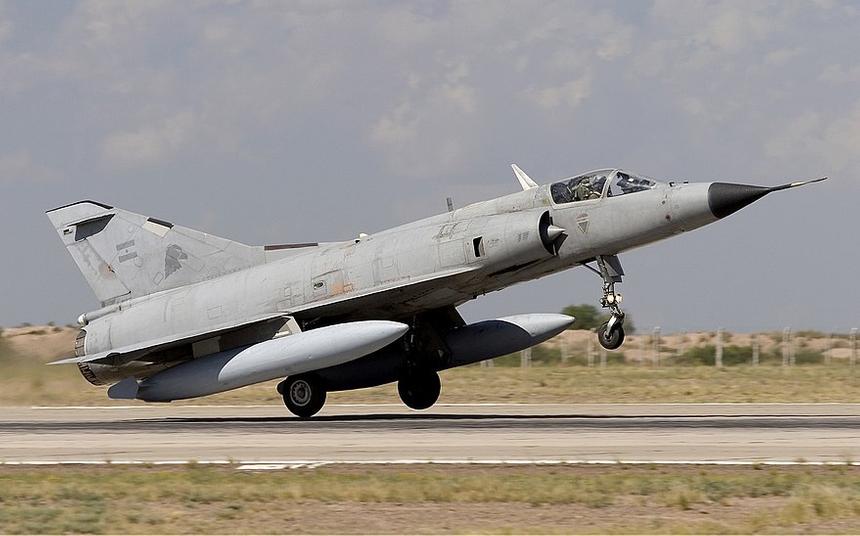
Well, one more photo of the Mirage, so you don't get bored
Combat use began widely with the Six-Daywars of 1967. Then the Israelis achieved 15 victories over the MiG-21, losing 5 Mirages. In addition, they successfully opposed the British Hunter fighters. True, during this conflict, serious shortcomings of the machine were revealed - the Mirage was rather weak as a bomber, and it also lacked thrust-to-weight ratio (thrust-to-weight ratio, which affects speed gain) - this was not very good for an aircraft that was also positioned as an interceptor.
Mirages also distinguished themselves a lot in the Pakistani Air Force, inSouth Africa and the Falklands War, but in the 70s the fighter began to fall behind, and his glory began to fade. Nevertheless, the modernization of radar equipment, navigation systems and engine made it possible to remain a formidable machine in capable hands.
-
Today, 87 modernized under a special program are in service with the Pakistan Air Force.
-
First flight - November 17, 1956
-
In service since 1961
2nd place - McDonnell Douglas F-4 Phantom II
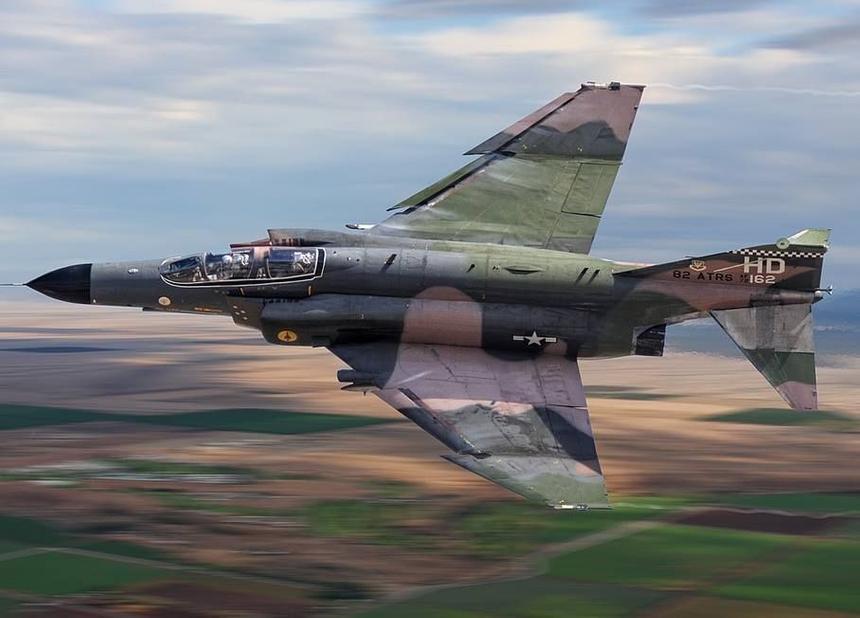
Douglas F-4 Phantom II
Two-seat fighter-bomberUS Navy, already during the testing of pre-production samples it set many records, but in its main profile it was closer to the Su-17, although the opposite is more correct: the Su-17 is in many ways the answer to the Phantoms.
His main combat mission was to workguided missiles on the ground within sight, a speed above Mach 2 allowed it to enter and exit combat mode at will (at high speeds it was almost invulnerable to cannon air defenses). This made it the most important combat tool of the early period of American involvement in the Vietnamese Civil War.
But the music didn't play for long.with the increase in the number of divisions of the S-75 and MiG-21 air defense missile systems, unpunished flights stopped and a serious war began. The F-4s were not particularly afraid of the MiG-17 and MiG-19, while the F-4 was inferior to the Soviet MiG-21 in terms of speed in real combat due to the lower wing sweep and greater drag.
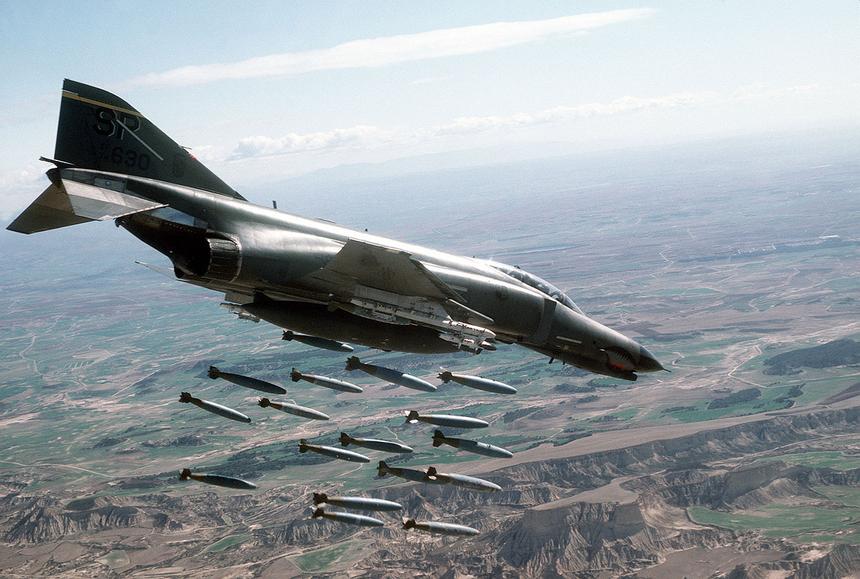
F-4 target with 500lb bombs
Another big problem was the completelack of cannon armament - in the early 60s, with the development of air-to-air missiles, the question arose of the expediency of cannons and machine guns on fighters. The USSR, by the way, also made the MiG-21 without a gun in one of the series. But otherwise, one 23 mm cannon was so-so in comparison with, for example, two "thirty" on the Mirages. But in Vietnam, the F-4 often had to get involved in highly maneuverable battles at close range.
But Phantoms are not completely defenseless prey either.were - during that war they hit 277 enemy aircraft, although the Vietnamese themselves count the loss of 69 aircraft from the F-4, of which 39 are the same MiG-21s (again, in war as in war). The truth, as is usually the case, is somewhere in between. Military statistics are like fishing - some overestimate, others underestimate.
122 lost from fighters of all typesPhantom. And this, even if we take into account the Vietnamese data on the losses of their vehicles, the ratio is very good for a fighter-bomber, where the bomber is the main profile, and the fighter is more of an option.
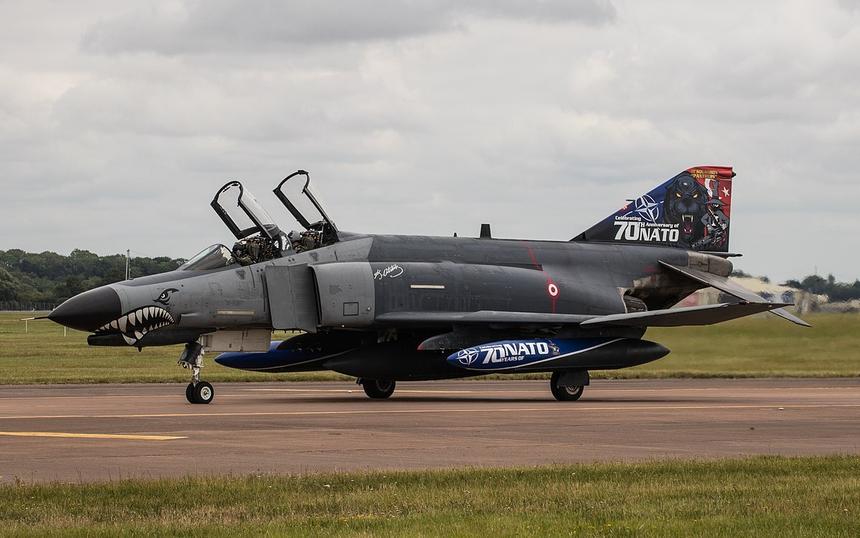
Turkish Phantom
But they had a chance to fight in all other conflicts where his Soviet counterparts fought. Especially conflicts involving Turkey, whose modernized F-4s fought in Syria, but more often as scouts.
-
In service - Turkey, Iran, Greece, South Korea.
-
First flight - May 27, 1958
-
In service since 1961
1st place - MiG-21

MiG-21
Popmech
Probably the most legendary car in the collection -"Kalashnikov" among fighters, and indeed the most massive in the class. Until recently, it was the record holder for the duration of serial production (now it has been replaced by the F-15). The design took into account the rich experience of the war in Korea, which resulted in an incredibly successful design.
The airframe used a delta wing, as didon the Mirages, but at the same time there was also a tail - it gave the car good stability, having little effect on the rate of climb. Compared to the F-5, it was just as easy to learn, but it proved to be much more effective in combat. Like most in the selection, he had many options for performing tasks.
Main armament - one 23 mm gun, could have4 S-24 air-to-ground missiles or 2 unguided missiles, air-to-air missiles and up to 1500 kg of bomb load. The function of the bomber was nominal, but in the end he had to work a lot as an attack aircraft.
Participated in most wars since the mid-1960s anduntil today, but the most significant for him were Vietnam and the Arab-Israeli showdown. The appearance of the MiG-21, after the Americans relaxed, not expecting anything worse than the MiG-17 or MiG-19, was quite a shock, especially for the South Vietnamese Air Force, which did try to avoid meeting with fellow countrymen at new moments (despite rumors and the famous song, the Vietnamese themselves flew the MiG).
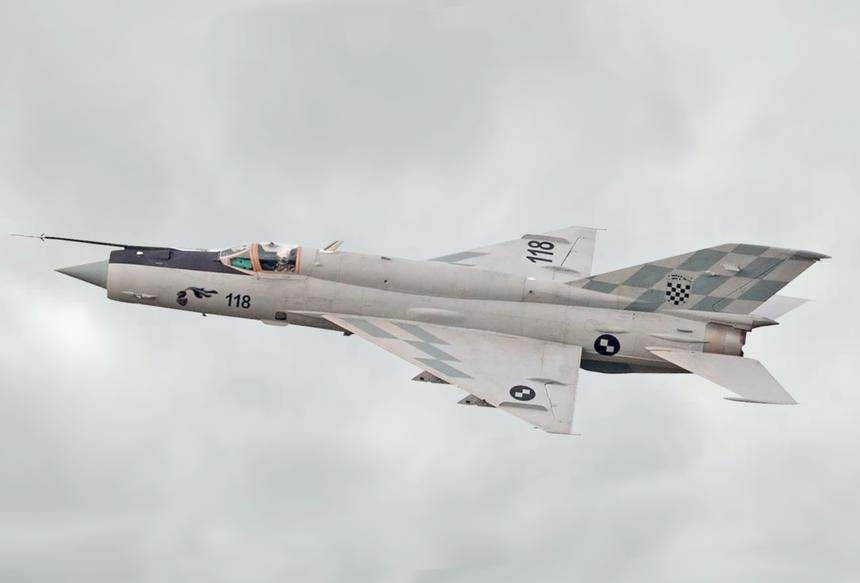
Croatian MiG-21bis
Americans after the loss of 1000 aircraft (thoughfor all possible reasons, although the MiG-21 tried very hard in this part) in 1969 they opened the TOPGUN school in California. There they trained naval aviation in non-standard air combat tactics, where the F-5s, similar in characteristics, were portrayed as MiG-21s. At the final stage of the war, it was the MiG-21s that became the best means against the B-52 bombers.
But the Arab-Israeli conflicts are no longer soThey definitely paint the MiG-21 as a formidable machine. The low level of the pilots of the USSR allies had an effect - although the machine is easy to control and master, it does not negate flight skills and tactics. However, the Israeli “aces” also suffered from the Soviet “advisers” - “instructors” - in war as in war.
The last war is the current one in Syria.In the 90s, several companies at once offered projects for upgrading the MiG-21, mainly updating the electronic stuffing and reaching the “well, almost fourth generation” standard.
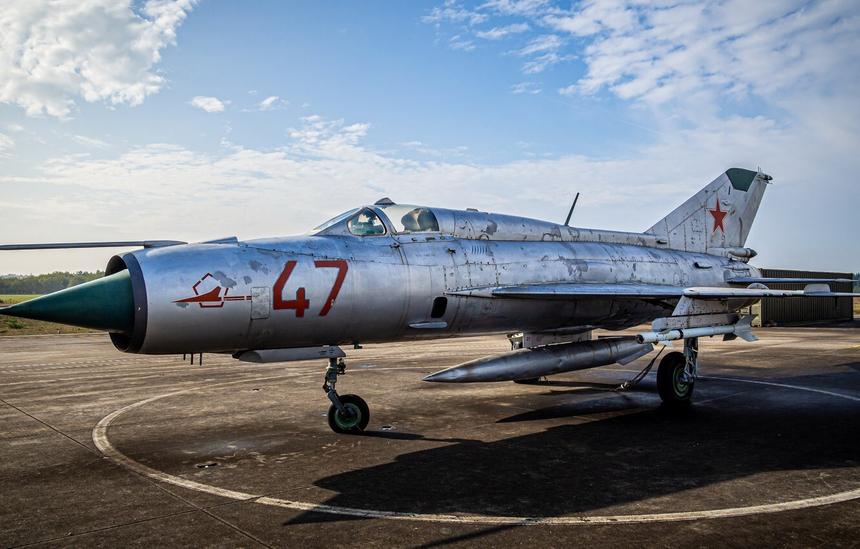
textured MiG
-
Today in service - India, Egypt, Syria, Croatia, Angola and a dozen more countries. China still uses a copy under the designation J-7.
-
First flight - June 16, 1956
-
In service since 1959