A team of scientists led by researchers from China has discovered the earliest gibbon fossil.
Scientists examined samples of teeth and skullfossil gibbon, including the upper jaw of an infant who was less than 2 years old at the time of death. Using the size of the molars as a guideline, the scientists calculated that the members of this species were similar in size to modern gibbons, and their body weight was about 6 kg.
The teeth and lower face of Yuanmoupithecus are verysimilar to the jaws of modern gibbons, but in some respects the fossil was more primitive. This indicates that he was the ancestor of all living species of great apes, paleontologists say.
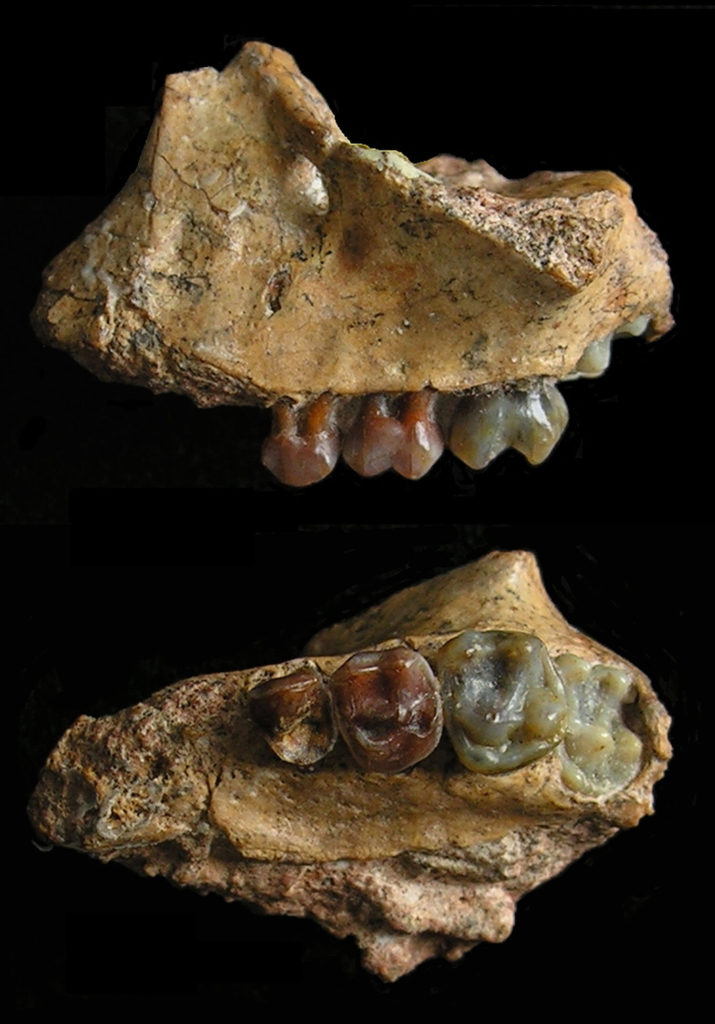 Fossils of the jaws of a young monkey. Image: Terry Harrison, NYU's Department of Anthropology
Researchers say fossilsancient representatives of great apes are very rare. Most of them represent individual teeth or fragments of jawbones found in southern China and Southeast Asia. At the same time, the age of most of the finds does not exceed 2 million years.
Finding preserved bones of Yuanmoupithecusxiaoyuan reveals the evolution of all gibbons 5 million years in depth. The researchers hope that future research will go even further: the great apes diverged from a common ancestor about 17 to 22 million years ago.
Read more:
The space plane will deliver cargo to the ISS and land at a regular "airport"
A swarm of galaxies orbiting a single hyperluminous star was found in the early universe
Physicists explain Hawking's 'cosmic mismatch': how it will change science
On the cover: excavations in southwest China. Image: Terry Harrison, NYU's Department of Anthropology