Private military companies are increasingly involved in conflicts, and even the notorious Russian Wagner is withdrawing from
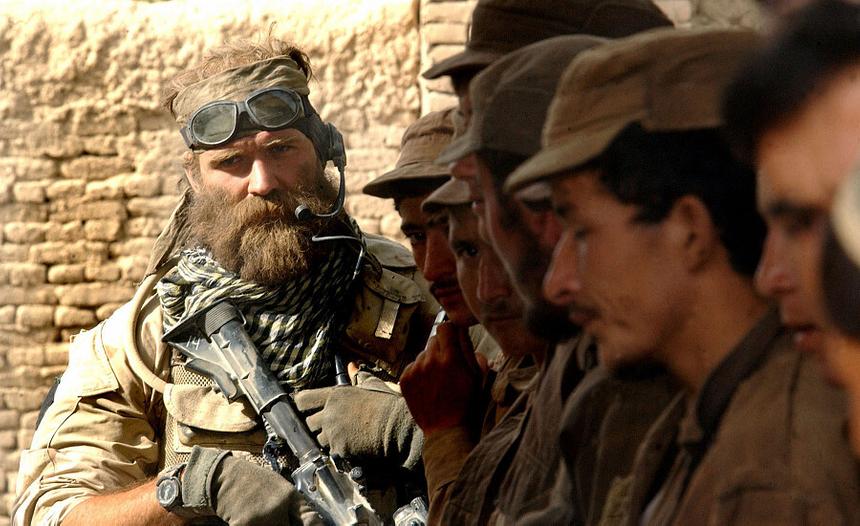
Table of contents
- New wars - new needs
- How television and corporations affected the military
- From wild geese to PMCs
- Mercenary King Bob Denard
- Mercenaries in white collars
- Blackwater scandals, intrigues, investigations
- PMCs in Russia and what does Wagner have to do with it
- Why PMCs are better than the regular army
In general, the phenomenon of mercenarism in military affairs canrival even that of the oldest of professions. Therefore, talking about PMCs as a phenomenon of recent decades is a strong misconception. Strong and young men, bored near a plow or a potter's wheel, left their native villages in search of adventure and good luck back in ancient times.
Often some warlike tribes turnedwar almost into the main way of its existence. The Greeks were hired by the Persians, Xenophon himself, the first military historian of antiquity, went through with the mercenaries all the hardships of the war in Asia Minor between Cyrus the Younger and King Artaxerxes II. The Germans went as mercenaries to the Romans as tribes and became on the borders of the empire protection from their own less obedient fellow tribesmen.
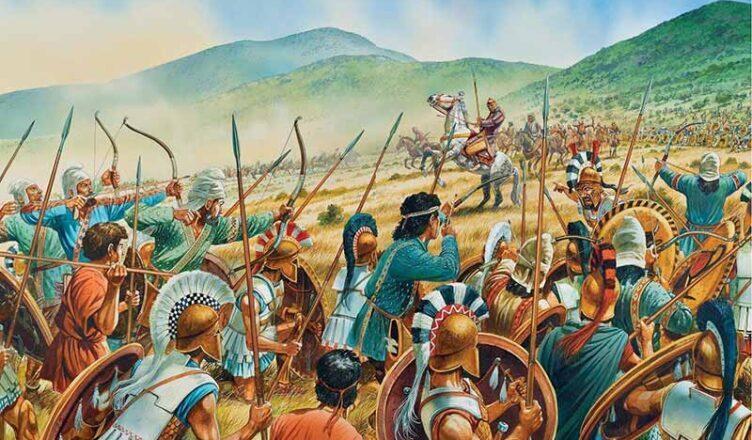
The hoplites not only defended their policies, they got involved in any troubles in the Mediterranean, and in Persian civil strife too
In modern history, mercenaries were the basis of Europeanarmies from the 15th to the 18th century, until decent powers began to acquire national armies. War from a highly professional sphere gradually turned into a duty, and then completely became the civic duty of any man, and in some places, women too. The power of firearms and artillery grew, which is why the army recruited more and more cannon fodder, as well as huge reserves for large wars, which became a conveyor belt of death and injury.
The army is always influenced by social andeconomic relations, as soon as society changes, the servicemen also change. Industry has turned the peasants and handicraftsmen into factory floor proletarians who have been trained in repetitive operations in separate production or assembly cycles. In the same way, a soldier turned into a proletarian of war, trained to handle a rifle or maintain equipment, to be a cog in an impersonal mass of his own kind.
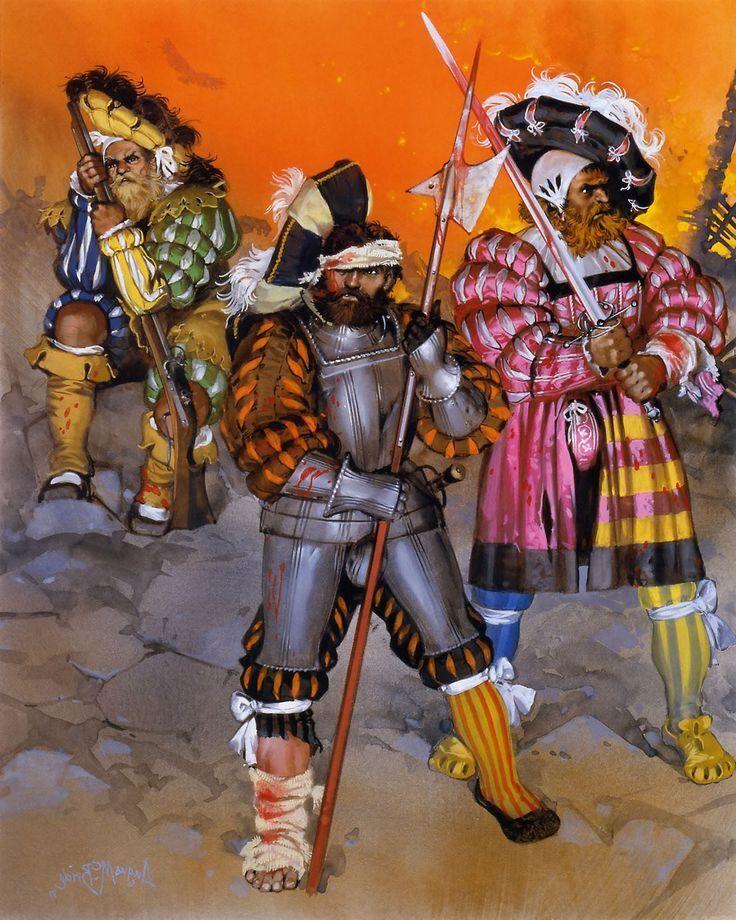
German landsknechts of the 15th-16th centuries – symbol of mercenaryism of all times and peoples
New wars - new needs
After World War II, Europeans cooled downin a showdown with each other, because technology has developed so much that in any conflict there was a chance to exterminate neighbors or disappear from the globe as an entire country. The Cold War and related conflicts on the periphery of the planet forced states to have on hand not a crowd of auto mechanics or clerks dressed in uniform, as was the case before, but a compact, mobile and, most importantly, well-trained group of seasoned warriors.
This was especially evident in the Vietnam War, whereconscripts and reservists, trained according to the patterns of World War II, had to fight in the style of special forces - patrol the jungle, identify camouflaged weapons caches and bases with underground tunnels, carry out raid operations, arrange themselves or run into ambushes in the tropical thicket, and constantly climb mountains.

A young marine. Da Nang, Vietnam, August 3, 1965
The United States, of course, had special forces, but for the newvarieties of war such specialists were sorely lacking. Ordinary foot soldiers or marines (marines) were often not so strong in health as to easily overcome acclimatization and endure tropical sores. In general, the war demanded much more than average army physical training, hiking and survival skills in the wild. For military operations, special observation, caution, tactical ingenuity and, finally, simply high moral and volitional qualities were needed. In a mass army, this is almost impossible to achieve.
How television and corporations affected the military
An unexpected factor in the second half of the centurybecame the media. In countries with, albeit often conditional, freedom of speech, journalists were looking for something “fried” in order to bite the government and the high command more painfully. They washed people's dirty laundry in public, highlighting the failures of operations, corruption in the army, and hazing.
Public opinion was given food for thought- what kind of war is this, why are we fighting in it, why are our guys dying? Surely not for the sake of the bloated generals "scooping" money from the military budget with a hairy paw on the sly? Is it not for the profit of corporations that lobby their interests, forcing the army, whose task is to protect the country, to fight for resources, markets or protection of trade routes?
Indeed, transnationalcorporations that forced the government to protect their interests, because they keep a large part of the state budget with their huge taxes. In one African country, a coup was made and the mines were nationalized - "our mines, Mr. President, do something!". In the next Peskostan, Islamic terrorists attack the oil rigs of a company of national importance, pirates seize dry cargo ships and take the crew hostage, and bypassing this strait is too expensive - this will increase transportation rates.
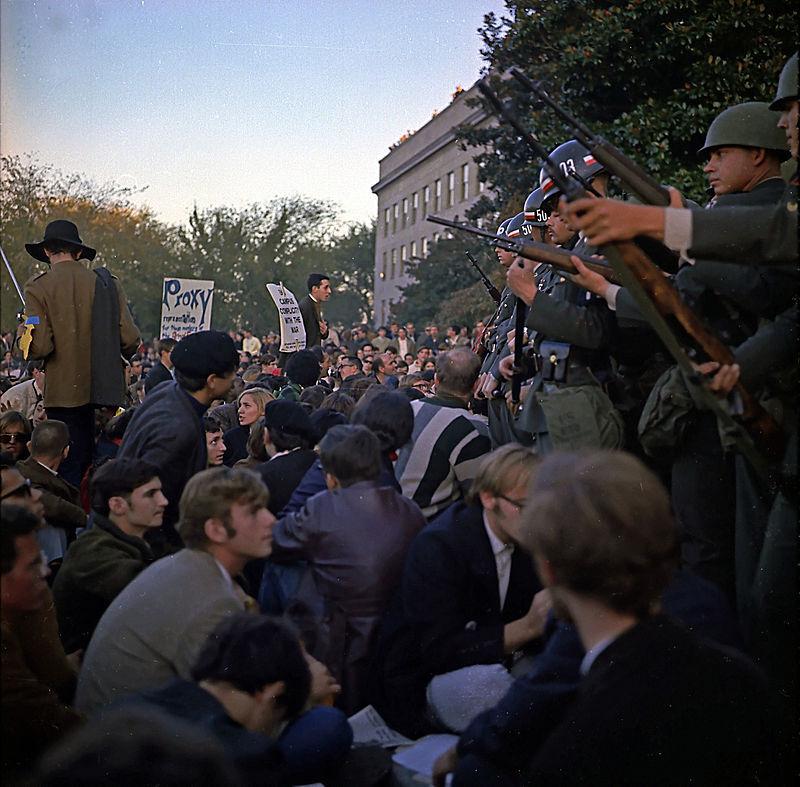
The famous "March on the Pentagon", anti-war demonstration of 1967
At the same time, the population fiercely criticizes the sendingtheir husbands and sons to fight for the sake of such interests. Mass anti-government protests threaten to change presidents and governments. The state is trying to sit on two chairs in one place, with predictable results. The market created new problems, but the market solved them.
From wild geese to PMCs
Mercenary King Bob Denard
After World War II, a special kind appearedmercenaries, who were then nicknamed "wild geese" (Wild Geese). Already during the war in French Indochina, veterans of the German Wehrmacht, the British SAS, and even Russian collaborators who had avoided falling into the clutches of the NKVD could fight hand in hand in the Foreign Legion. No one was interested in the past of the "wild goose" - his combat experience, skills and price of services were important.
Bob Denard was a typical representative of histime - French patriot of the decline of the empire, anti-communist. Having ended up behind bars after an unsuccessful attempt on the left-liberal politician, who demanded to reduce military spending and dissolve the colonies, Denard became interested in the country's special services, and he suffered a hard time. He was most famous for his participation in the war against the Congolese followers of Patrice Lumumba (after whom the RUDN University in Moscow is named) of the Simba movement in 1964-1965.
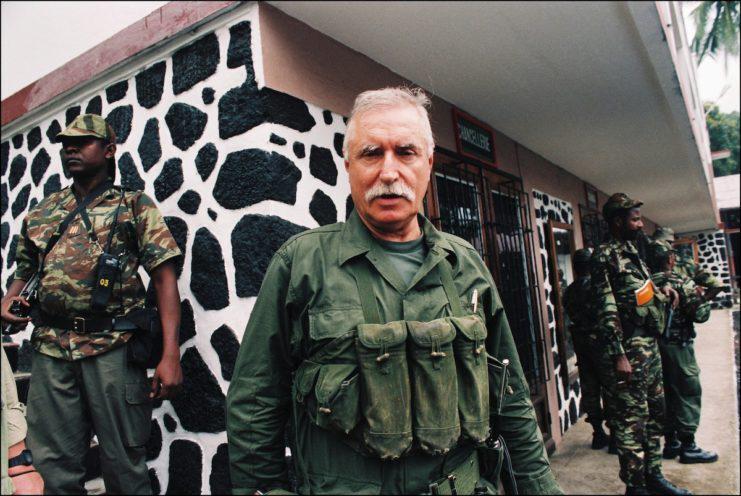
Bob Denard in 1995
Anne Nosten
After participating in a series of troubles in the Congo, Denard withdevoted only to him and money, he participated in the Portuguese landing in Guinea in 1970, served the presidents of Gabon and Benin in their fight against left-wing rebels, a little later he was redeployed to the Comoros, having on the tail of the pursuit of a number of intelligence services and scumbags from all over the Third peace.
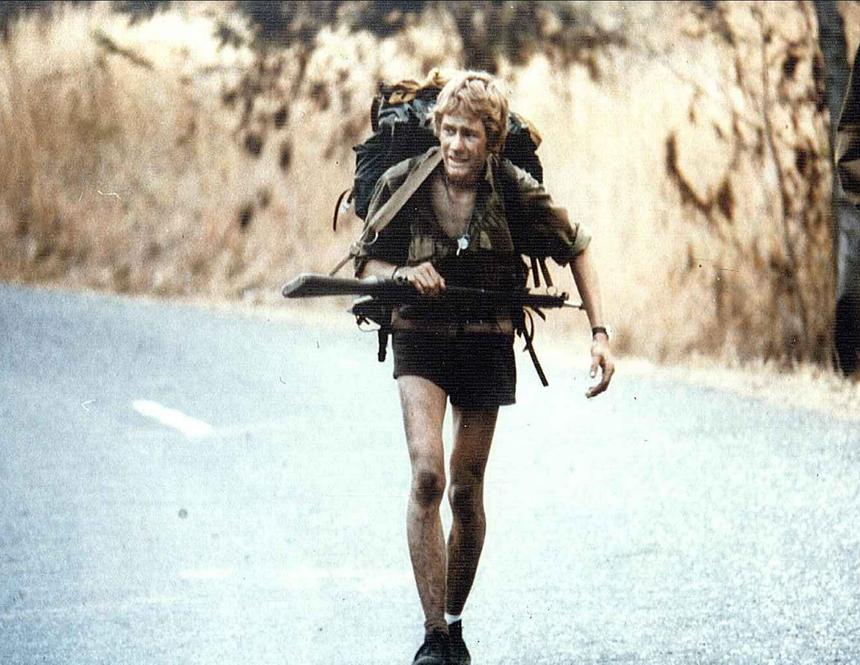
Scout of Selous on the march, short shorts have become their signature uniform
It was then that the stereotypical movie image of a mercenary appeared - a strong guy, well over 30 or older, dotted with scars and tans, silent, which does not mean that he has nothing to tell.
Selous Scouts were often mixed into this caste.the times of the war between the white settlers of Rhodesia and the black rebels, and sometimes outright terrorists on the payroll like Carlos “The Jackal”, who helped Islamic fanatics and red radicals, who fought either against world Zionism or for it (her day is a life sentence in France).
The impression "Wild Geese" left about themselvescontradictory: on the one hand, immoderate cruelty and outright war crimes, on the other hand, the protection of the white population from massacres, and their methods often did not differ from those of their opponents.
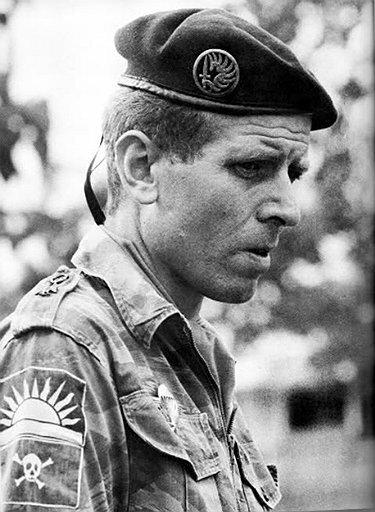
German Rolf Steiner is a typical wild goose of his era, these people did not look like Rambo at all
Mercenaries in white collars
As the "dashing nineties" in post-Soviet Russia withher brothers, eventually the end came, so the "wild geese" with their walk-field died out. Governments were less and less willing to mess with unreliable and sometimes inadequate self-activity, personalities like Bob Denard were replaced by people with a good commercial streak and a talent for management - such an undeveloped and promising market could not go unnoticed.
The first private military company was created by the samethe man who stood at the origins of the legendary British CAC - David Stirling in 1967. And it was called Watchguard International (International Watchdog, or sentry), basically providing work for bored pensioners of the SAS regiment. And the company was also engaged in military consultations for generals and officers of the armies of post-colonial countries, so soon its specialists worked all over the world. Until 1972, when the government learned that Stirling was involved in the story of the overthrow of the then young dictator Gaddafi in Tripoli.
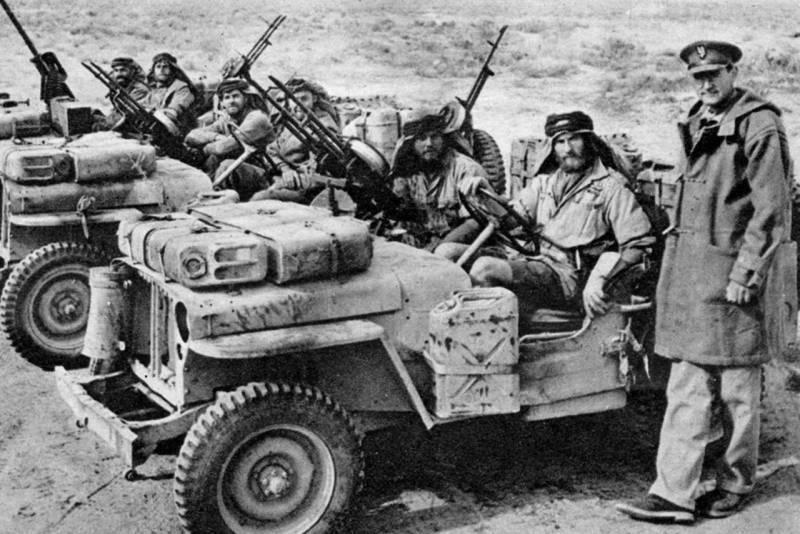
David Stirling and his team
The first company to go beyondconsultations, became the scandalous and also British office "Keenie-Mini" (Keenie Meenie Services or KMS), also created by special forces veteran and SAS commander Mike Wingate-Gray and his officers in 1977. At first, the company was engaged in the services of the protection of dignitaries, but soon moved to the services of police and special forces training. Kini-Mini trained security forces in Sri Lanka against Tamil Eelam rebels and the Nicaraguan Contra opposition. At the same time, the office began to supply the material and technical base and train helicopter pilots.
The Kini-Minnies did not last long and wereliquidated already in 1987. Nicaraguan rebels have committed a number of terrorist attacks, and Sri Lankan government special forces have been involved in massacres of civilians. Further more. Kini-Mini operated under the hood of the CIA, it also helped with the supply of expensive equipment and other things, and in addition to officially known work, the office's specialists were engaged in training Afghan Mujahideen in mining and working with portable anti-aircraft systems. But after that, their activities were curtailed.
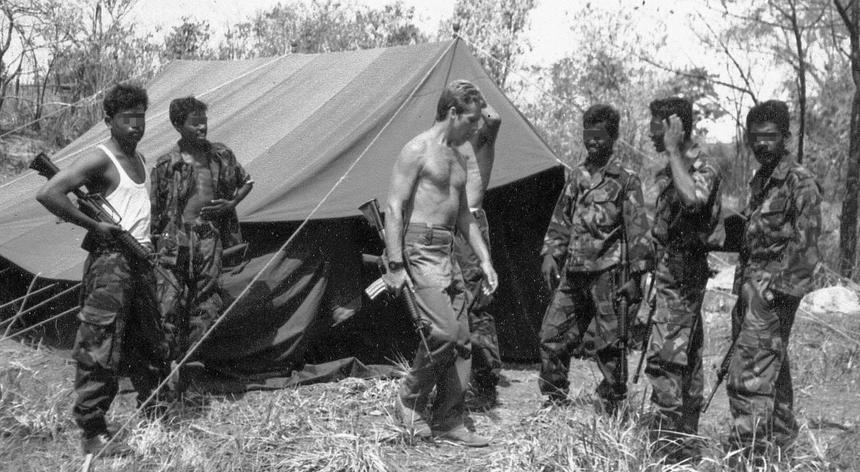
Kini-Mini employee at a training camp in Sri Lanka
Photograph courtesy of Journalists for Democracy Sri Lanka (JDS)
Blackwater scandals, intrigues, investigations
In the late 1980s - early 1990s, PMCs were already growing asmushrooms. Moreover, there is only one formula, like a blueprint: a retired special forces officer with pals registers a security or consulting company, after a while certain Chekists come to them, and away we go! Military Professional Resources, Securicor, Saladin Security, Sandline International - this is an incomplete list of large PMCs that exist to this day, fortunately, with the collapse of the socialist bloc, the number of hot spots doubled. But the American PMC Blackwater received the greatest fame, including scandalous fame.

Erik Prince, the creator of the first private military empire, almost bought the Antonov Design Bureau and half of the Ukrainian military-industrial complex to it in 2020
Young SEAL Erik Prince, 27,received a small inheritance from his father and decided to organize his own security office with this money. He bought land in the south of Virginia in a swampy place for a training base, where in the old days there were peat developments, which is why he decided to name his company Blackwater (Black Water). The beginning of the 2000s brought work, the era of al-Qaeda, the Taliban (groups banned in the Russian Federation) and the war in Iraq began. Very quickly, Blackwater switched from security tasks to direct participation in hostilities - escorting cargo on particularly dangerous routes, patrolling, and even targeted special operations.
The US government liked to have a parallela structure for which it is not necessary to purchase weapons and equipment, to train (however, many PMCs are retired US military). And most importantly, you can pay for this military force when you need it. The capitalization of Blackwater grew exponentially, soon it had branches around the world, its own aircraft, including strike aircraft, as well as warships. The company even had its own "daughters" involved in the development of their own equipment, equipment and weapons. In addition, PMCs took on the hiring of non-combat personnel, and such employees allowed the government to save a lot of money - they were not covered by the benefits of military personnel.
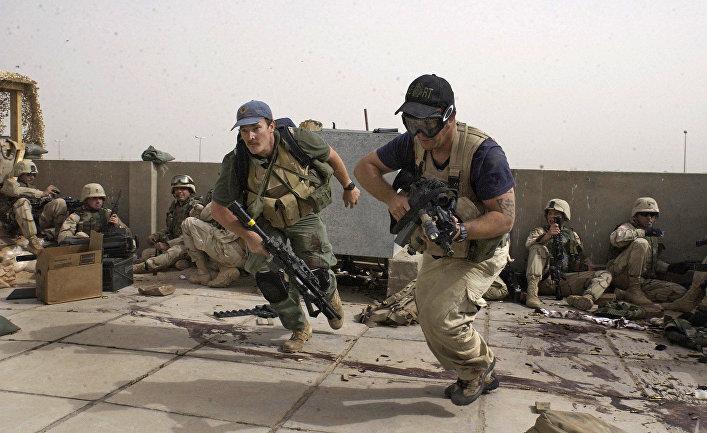
Blackwater employees in front of an army unit
© AP Photo, Gervasio Sanchez, FILE
The fly in the ointment was the growing scandals.The guys at Blackwater were of a different breed than the military. Their discipline was structured differently, they looked down on the military, had large salaries and liberties, they felt like supermen, for whom the law was not written, behind whom there was no military tribunal and they lived by different rules.
The first bell rang in 2006, Blackwater Jeepthrough the fault of the driver, he crashed into a military Humvee, after which the PMC fighters pointed their weapons at the American soldiers and held them “face to the ground” until they drove their car away. In the same year, an employee of the company shot dead the security guard of the vice president of Iraq, being drunk as hell, after which he avoided any criminal prosecution and went home.
The crowning achievement of Blackwater's black career was 16September 2007, when PMC employees guarding a government convoy opened fire on civilians. According to various sources, a woman with a passenger in a car did not respond to numerous police signals to give way, including with warning fire. As a result, they opened fire on the car and used stun grenades. In the resulting confusion, a shootout ensued between the guards and the Iraqi police, resulting in 17 killed and 18 wounded.
The UN report contained information that part ofBlackwater employees fired on civilians for no reason, even after the fire on them had ceased. A wave of indignation both in Iraq and in the United States itself forced the UN to begin regulating the actions of PMCs at the level of international law. Blackwater itself had to rebrand after a series of scandals, becoming Xe Services LLC, and today the company is called Academi.
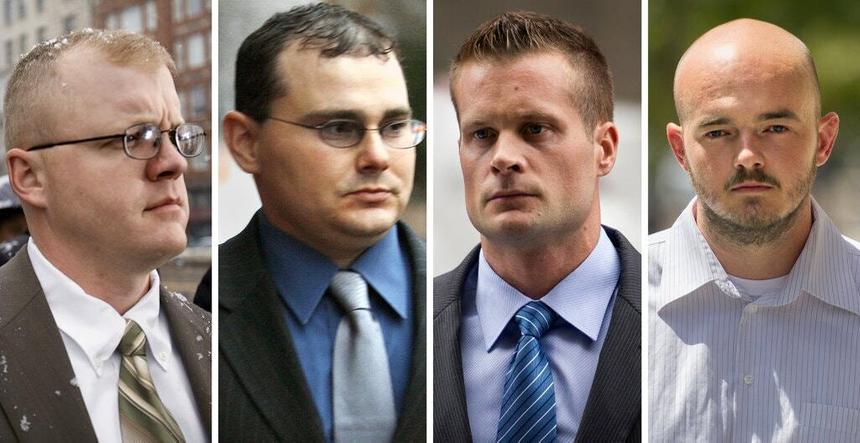
Blackwater employees convicted of massacre in Baghdad, the defendants received from 30 years to life
Cliff Owen/Associated Press
PMCs in Russia and what does Wagner have to do with it
The world first learned about Russian PMCs in 2013.when the company Slavic Corps, registered in Hong Kong, appeared in Syria. Under its roof in Syria were 267 Russian citizens, united in a tactical group of two companies. From the already almost naked Syrian army at that time, they received mortars without mines that found their grandfathers near Berlin, rusty infantry fighting vehicles that were barely operational, and two Grad launchers with 10 missiles.
The Russians entered the battle in the vicinity of Es-Sukhnaunder the cover of Syrian artillery, they decisively knocked out Islamic militants from a dominant height, defended themselves there at night, and during the day, without waiting for reinforcements, retreated to the base.
The FSB became interested in the guys, in RussiaSuch services have not been legally regulated. Therefore, in October 2014, the leaders of the Slavic Corps, Vadim Gusev and Evgeny Sidorov, sat down for three years under an article for mercenarism (and this was the only sentence under such an article in Russia for all time).
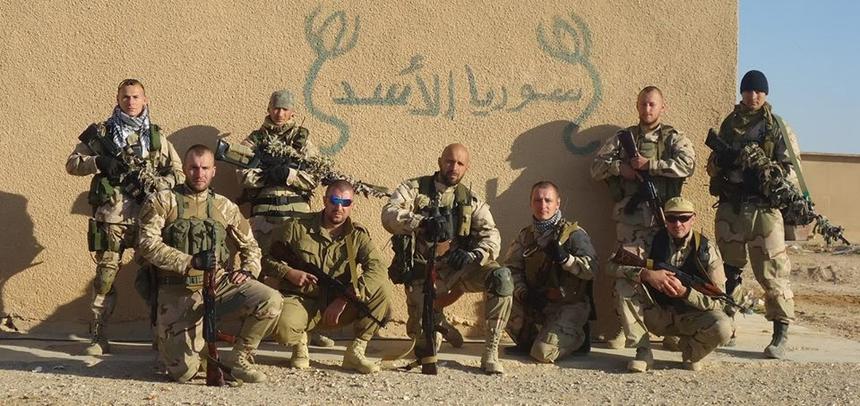
Presumably, the fighters of the Slavic Corps
defense.ru
But the experience turned out to be interesting, since 2014 Russiaitself joined in a series of hybrid wars, so that the PMC format was in demand at the right time. Since 2015, information about a certain citizen of the Russian Federation D.V. began to appear on the network. Utkin, associated with the "Slavic Corps", and who had the call sign "Wagner" - according to rumors, because of his passion for the aesthetics of the Third Reich (such "hobbies" are generally super-popular among mercenaries of any countries). In 2014, his wards appeared in Ukraine, and the name "Wagner Group" or "Wagner", apparently, was forever assigned to this semi-mysterious organization today.
Wagner received real fame already in Syria, whereby 2018, the number of the group, according to various sources, ranged from 2,000 to 4,000 people of Russian or Ukrainian citizenship. There were videos of Russian-speaking fighters in Syria without the identification marks of the Russian army, and international publications published articles about them one after another, but it was unrealistic to distinguish between truth and fiction. Without official reporting, it was difficult to talk about the operations in which the mercenaries actually participated and the losses they suffered.
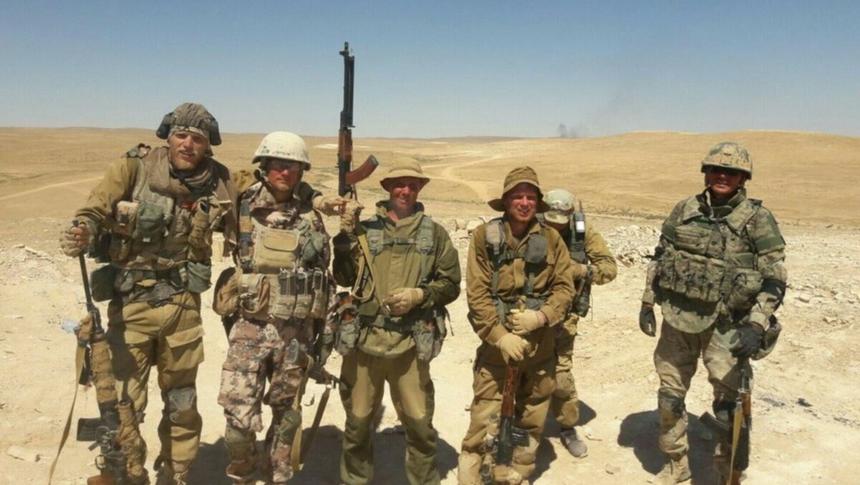
There is no confirmed information about who is in this photo, but the "Wagnerians" presumably look something like this
At first glance it might seem that, according toIn essence, the Wagner PMC is not a PMC at all, but rather a secret division of the Russian Armed Forces to perform tasks in particularly painful, from a political point of view, regions. There is no information about the registration of this business, to this day there is no legislative regulation of it.
At the same time, since 2018, the Wagner brand has appeared inCAR (Central African Republic), and then in Libya, where the mercenaries fought side by side with the local general Haftar. In Mozambique, the Wagnerites took away the contract from the South African PMC Black Hawk, the monopolist of the African market before, and also in Sudan. At the same time, the owner of Black Hawk Dorling mentioned in an interview that Wagner is heavily dumping, since Russian competitors hardly know the region, do not have the necessary connections, and the fighters receive five times less salary than in his company, which indicates their qualifications. .
At the end of September 2021 to the Russian PMCThe Mali authorities contacted - the French, who were carrying out a peacekeeping mission to protect against Islamists, considered their work on the ground completed. Participation of "Wagner" in operations in this country may be able to fully introduce them to the global market.
Why PMCs are better than the regular army
In the end, what can we say about PMCs? What kind of activity is this and are they needed? In my opinion, PMCs have a number of advantages:
one.This is a commercial organization. It is spared from being overgrown with dense general and officer bureaucracy. This significantly reduces the level of corruption inherent in all the major armies of the world, and not just Russian.
- PMCs are consciously professionalswith high qualifications.Companies sell the result, not the process; it is not profitable for them to send poorly trained contract soldiers or completely green conscripts to slaughter, and then write exculpatory reports and shift the blame onto each other.
- PMCs are a haven for seasoned military men who find it difficult to adapt to civilian lifeowing to which these people are employed.In addition, this is a way to “under the hood” of especially adventurous and risky citizens, directing their destructive energy into a controlled channel, because due to their temperament it is often difficult for them to find themselves in traditional forms of service in the army or police.
- PMC, being again unloaded from bureaucracy,have the ability to more quickly apply and manage operations. At other times they are freed from contracts andtenders, they purchase only what is needed and when needed in terms of weapons and equipment. If you need to change or buy new machines, they will simply buy them, and will not stretch out this process for years.
In a sense, PMCs are the armies of the future,because major powers no longer start world wars on several fronts, which means it is no longer very advisable to maintain classical armed forces in the form in which they have existed for the last decades.
But local conflicts, with regional andethnic specificity, often without clear political and strategic goals, they do not go anywhere, and, judging by recent events, they will only expand. At the same time, regular armies, if you pay attention to the last 50 years, have not learned how to cope with such tasks. Their scope will remain heavy weapons and maintaining military infrastructure in case of larger problems.
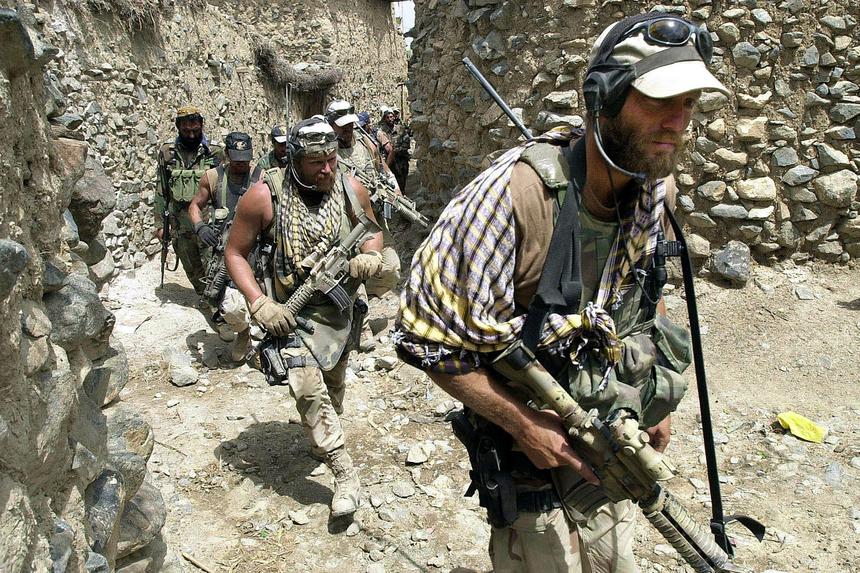
This is not a PMC, this is an American special forces in the suburbs of Kabul, today in the guise of combat special forces there are less and less signs of belonging to the regular army
Getty Images
PMCs, of course, still have disadvantages -moral qualities of a number of employees and related crimes, participation in extremely dubious transactions, arms trafficking. However, the process of their legalization can no longer be stopped - the largest PMC in the world today, the transnational company G4S (headquartered in London) has on its staff emergency specialists, firefighters, IT engineers for maintaining security systems and surveillance, and its number 7 times larger than the British army.
This also includes PMCs such as KelloggBrown & Root, which is responsible for engineering, construction and service projects, or the Russian RSB-group, which is involved in mine clearance and repair of military equipment.
Fighter, join the ranks of our Telegram readers!
Subscribe to