A research team led by the Institute of Marine Sciences of Andalusia (ICMAN) found that the world
Antarctic penguins inhabit remote andrugged areas along the Antarctic Peninsula and on the islands of the South Atlantic. To measure the iron production of the birds, the researchers mapped the colonies using a drone and also measured the concentration of faeces in one of the colonies. Further chemical analysis showed a high concentration of iron in guano: it is about 3 mg/g.
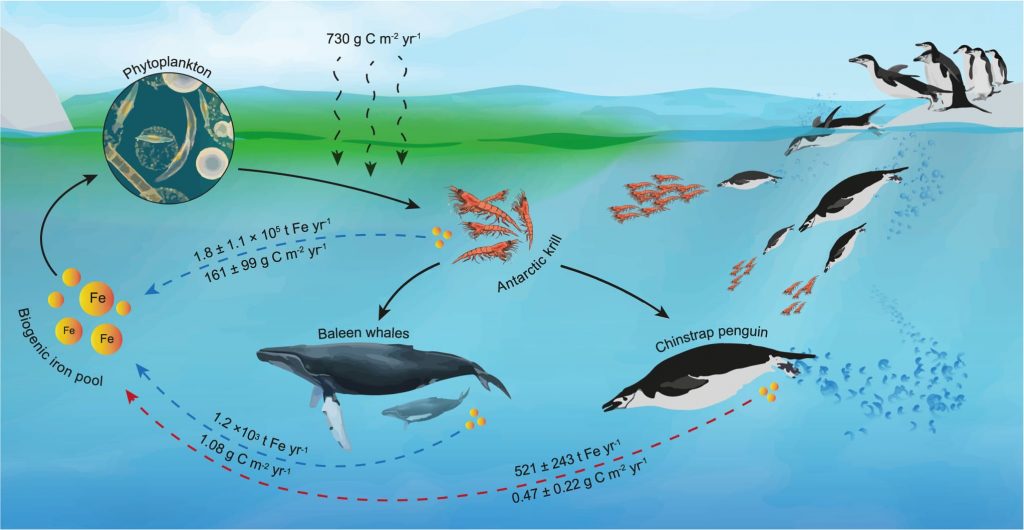 The iron cycle in Antarctic waters. Image: Oleg Belyaev et al., Nature Communications
Since the global population of Antarcticpenguin production has halved over the past four decades due to rapid environmental change, the authors estimate that these animals currently produce only about 521 tons of iron per year, about half of what it was in the 1980s.
Iron is vital to the Southern Ocean:it provides nutrients to the phytoplankton that many larger species feed on. In addition, this metal plays a key role in carbon sequestration, as abundant photosynthetic phytoplankton provide the Southern Ocean with an increased ability to absorb carbon dioxide from the atmosphere.
Researchers note that although the Southern Oceancovers only 6% of the planet's surface, it helps regulate the global climate and stores trapped carbon in deep sea sinks. A decline in the population of chinstrap penguins (and possibly other species to be explored in the future) could further exacerbate the situation and accelerate warming, the researchers add.
Read more:
Look at the highest resolution map of Mars: 110,000 frames and 5.7 trillion pixels
"Sea" of quarks inside one proton: what does an elementary particle consist of
New image of Hubble puzzled scientists
On the cover: chinstrap penguins. Photo: Oleg Belyaev Korolev