Researchers from Lund University have tested the effect of speech on people's perception of robots.
In previous experiments, scientists have studiedhow the misbehavior of a humanoid robot's eye affects its perception by humans. It turned out that this leads to a decrease in trust in all cases, except for the case when the robot made a mistake. The only difference between all these cases was that when a mistake was made, the robot spoke.
To test the hypothesis, the researchers re-performed the same experiment they had done in their previous work, but the robotParticipants in the experiment were shown a video of a mute and talking robot that performed actions or made mistakes.During the conversation, the robot told some facts about one of a number of objects that were presented to him.
After watching this video, the participants werea series of questionnaires have been proposed designed to assess their trust in the robot, as well as their perception of intelligence, attractiveness, and how alive the robot appears.
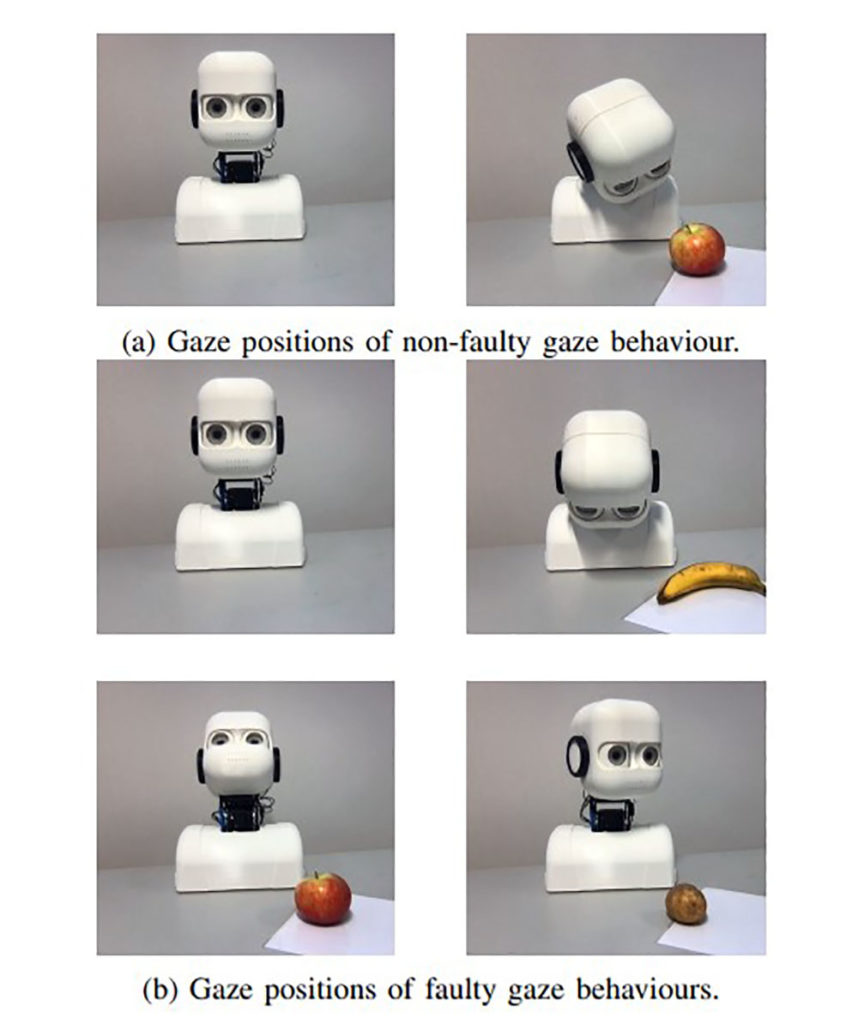 Images of the robot from the experiment: (a) correct behavior, (b) incorrect behavior. Image: Krantz et al., arXiv
The experiment involved 227 people.The results of the responses showed that, in general, serviceable robots were the most trusted. But when the malfunctioning robot was able to speak, the participants reported that they trusted it almost as much as they trusted the functioning robots.
The authors of the study suggest that the respondentsperceive speech as an indicator of intelligence, and that is why the level of trust in such robots is higher. In future work, they plan to test how perception is influenced by other factors, such as pupil dilation and gaze.
Read more:
The space plane will deliver cargo to the ISS and land at a regular "airport"
A swarm of galaxies orbiting a single hyperluminous star was found in the early universe
Physicists explain Hawking's 'cosmic mismatch': how it will change science