The Perseverance rover mission is part of the larger Artemis space program.
Mars rover Perseverance Rover Science. Finding life and preparing people for life on Mars
Main goals: studying the suitability of Mars, looking for signs of past microbial life, collecting and caching samples, and preparing for future human missions that would eventually lead to the colonization of Mars.
Scientific strategy for the research programMars mission is to search for signs of life on Mars. The Mars 2020 rover contributes to this strategy as well as the program's four long-term science goals:
- Determine if life ever existed on Mars
Mars 2020 Perseverance rover missionfocuses on ground-based exploration of the Martian environment, looking for surviving biosignatures in rock samples that formed in ancient Martian environments with conditions that could be conducive to microbial life. This is the first mobile mission to look for signs of past microbial life. Previously, rovers first focused on the fact that Mars once had habitable conditions. - Describe the climate of Mars
Past Martian climatesare the focus of the mission of the Perseverance rover. The rover's instruments are looking for evidence of an ancient habitat where microbial life may have existed in the past.
- Characterize the geology of Mars
The Perseverance Rover is designed to explorerocks to learn more about the geologic processes that have created and altered the Martian crust and surface over time. Each rock layer on the Martian surface contains a record of the environment in which it was formed. The rover is looking for evidence of rocks that formed in the water that hold evidence of organics, the chemical building blocks of life.
- Prepare for human exploration of Mars
Perseverance rover demonstrates keytechnologies to harness natural resources in the Martian environment for life support and fuel. It also monitors environmental conditions so mission planners better understand how to protect future explorers.
This scientific goal is related to the nationalspace policy of sending people to Mars in the 2030s. Much like Earth's history of lunar exploration, robotic missions to Mars are providing critical understanding of the environment and testing innovative technologies for future human exploration.
All goals refer to the potential of Mars as a placefor life. Even if the rover does not reveal any signs of a past life, it will someday pave the way for human habitation on Mars. Rover Perseverance also conducts other scientific research related to its four objectives. For example, he monitors the weather and dust in the Martian atmosphere. Such research is important for understanding daily and seasonal changes on Mars and will help future explorers better predict Martian weather.
When will Perseverance land on Mars? How long will the mission take?
The landing is expected on February 18, 2021, the flight to Mars will last 7 months. The exploration will take at least one Martian year (about 687 Earth days).
Astrobiology.MissionMars 2020 NASA will hunt for microscopic fossils
NASA's Perseverance Mars rover will land directly inJezero Crater. NASA chose Jezero Crater as the rover's landing site because scientists believe the area was once flooded with water and was home to an ancient river delta. More than 3.5 billion years ago, a river bed spilled through the crater wall and formed a lake.
Scientists believe that the water delivered clayeyminerals from the surrounding area into the crater lake. It is likely that microbial life could have existed in Jezero during one or more of these wet periods. If so, evidence of their remains may be found in bottom or coastal sediments.
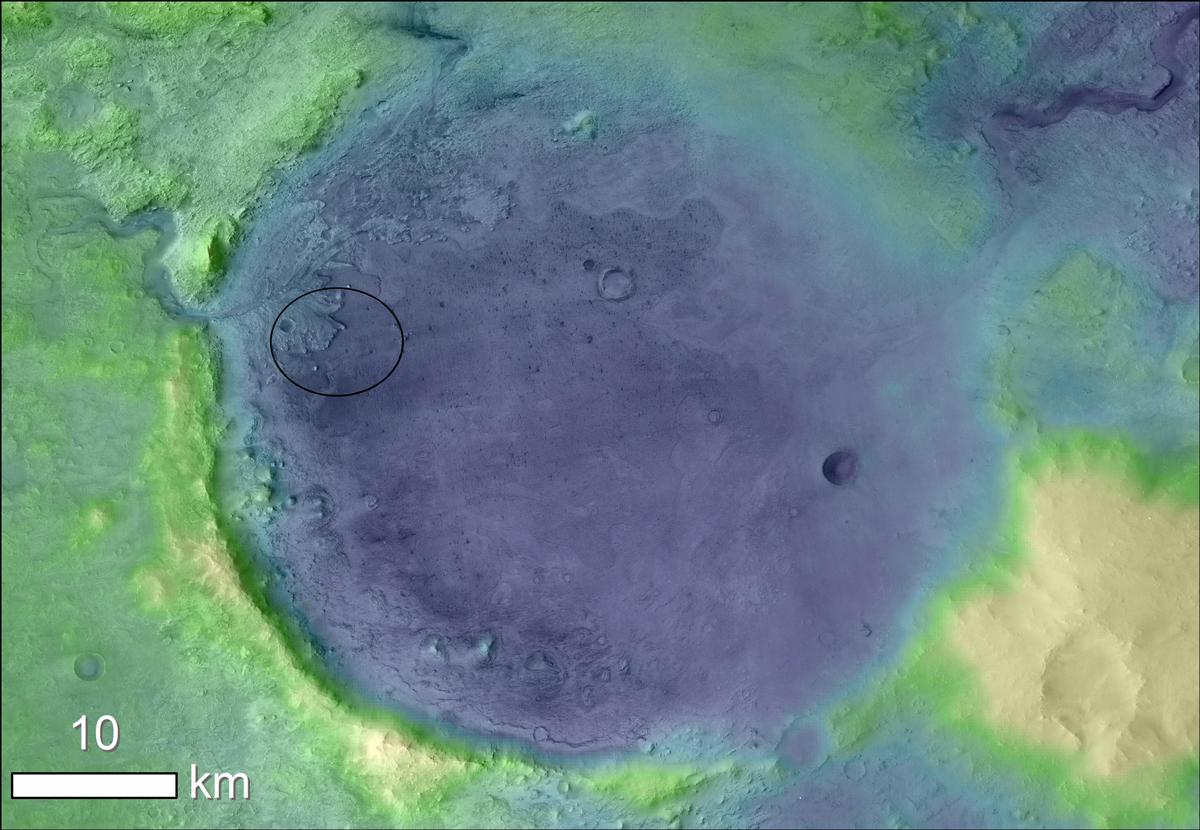 Ancient shore of Lake Jezero: the lighter colors represent higher elevation in this image of Jezero Crater on Mars, the landing site of NASA's Mars 2020 mission. The oval indicates the landing ellipse where the rover will touch Mars. The image of Jezero Crater, the landing site of the Perseverance rover, was captured by NASA instruments. They regularly take pictures of potential landing sites for future missions. Image courtesy of NASA / JPL-Caltech / MSSS / JHU-APL / ESA
 This shot of Jezero Crater, the landing sitePerseverance rover was captured by NASA instruments that regularly capture images of potential landing sites for future missions. NASA chose Jezero Crater as the landing site for the Perseverance rover because scientists believe the area was once flooded and was home to an ancient river delta. Image courtesy of NASA / JPL-Caltech / MSSS / JHU-APL
On ancient Mars, water carved channels andcarried sediments to form fans and deltas in lake basins. Examination of spectral data from orbit reveals that some of these deposits contain minerals that indicate a chemical change in the water. Here in the Jezero crater delta, the sediments contain clays and carbonates.
On Earth, carbonates help formstructures that are hardy enough to survive as a fossil for billions of years. Including in the form of seashells, corals and some stromatolites - stones formed on this planet by ancient microbial life along the coastlines, where there was a lot of sunlight and water.
The possibility of stromatolite-like structures on Mars explains why the concentration of carbonates that trace the Jezero coastline makes the area so attractive to scientists.
What does the Perseverance rover take with it on a mission to Mars?
- SHERLOC is a Raman and luminescence habitat scanner for organics and chemicals.
- The Ingenuity Mars Helicopter is the first helicopter that NASA will attempt to fly into the atmosphere on Mars.
- Samples of spacesuits for future astronaut travel to Mars and the Moon.
- Meteorite from Mars, whose known propertieswill act as a calibration tool to compare rover instrument performance. This will give additional confidence to any discoveries the robot may make.
SHERLOC. Gather materials, will check the suits and return the meteorite from Mars home
Scanning habitat usingRaman scattering and luminescence for organic and chemical substances has a nickname: SHERLOC. Mounted on the rover's robotic arm, SHERLOC uses spectrometers, a laser, and a camera to look for organic matter and minerals that have been altered by the aquatic environment and may be signs of past microbial life.
Its main task is small-scale detection of minerals, organic molecules and potential biosignatures.
What do you need to know about the device?
- SHERLOC works day or night.
- He doesn't require touching. Perseverance places SHERLOC approximately 5cm above its data collection target. This technique does not pollute the investigation site.
- SHERLOC has a magnifying glass, like Conan Doyle's detective, to see small details.
- SHERLOC collects evidence. It uses ultraviolet laser light to detect organic chemicals in much the same way that modern crime scene investigators search for evidence.
The name of the device SHERLOC was inspired byArthur Conan Doyle's character, Sherlock Holmes, a fictional detective who solved crimes using scientific observation. SHERLOC also observes and measures. It will look for possible evidence of past life on Mars. Dr. John H. Watson was Holmes' partner in solving mysteries. The device has a WATSON camera, and it also helps solve mysteries about life on Mars.
SHERLOC will take small pieces of space suits with him to test how they withstand the harsh Martian environment.
The fact is that NASA is preparing to send the firstwoman and the next man to the moon, part of a broader strategy to send the first astronauts to the surface of Mars. But before they get there, they'll face a critical question: What should they wear on Mars, where a thin atmosphere allows more radiation from the Sun and cosmic radiation to reach the surface?
Experienced spacesuit designer Amy Rossat NASA's Johnson Space Center in Houston is developing new suits for the Moon and Mars. It is the samples of her prototype spacesuit that will go to Mars.
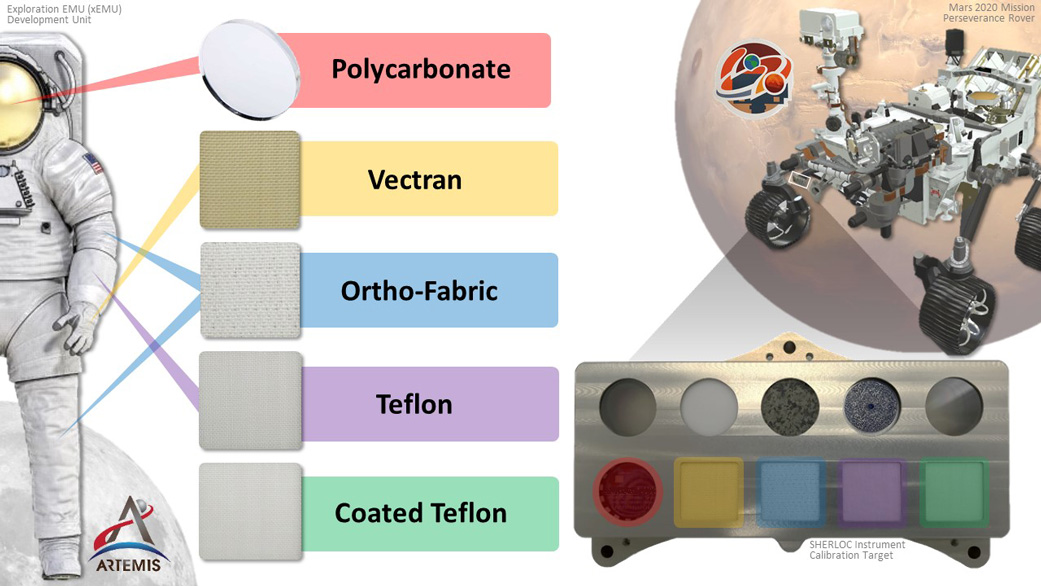 This figure shows an illustration of a prototypeastronaut suit on the left along with the suit samples included in the calibration target, bottom right, belonging to the SHERLOC instrument aboard the Perseverance rover. They will be watched to see how they withstand the intense radiation from the Martian surface.
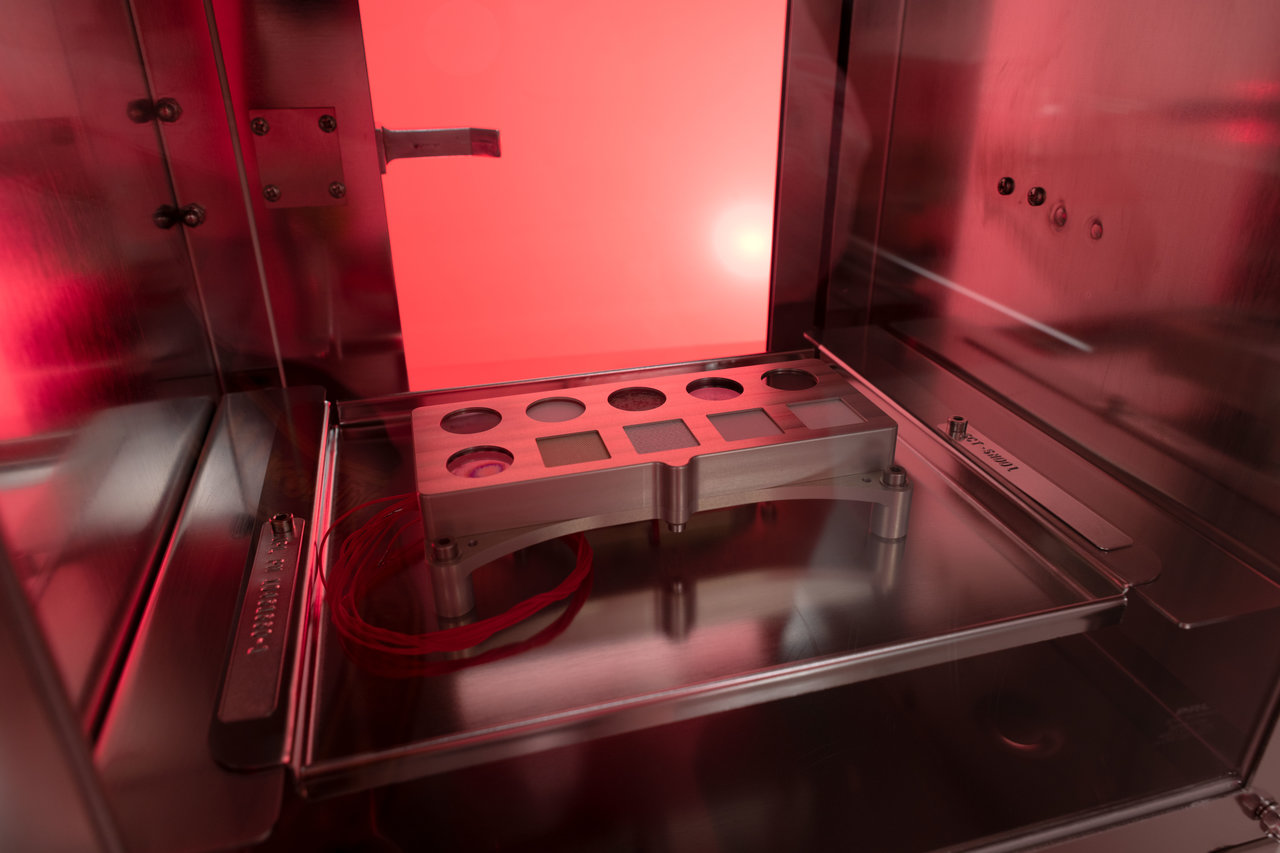 Mars 2020 SHERLOC Calibration Target: targetcalibration forscanned Mars 2020 habitat with instrumentRaman and Luminescence for Organic and Chemical Substances (SHERLOC). Credit: NASA
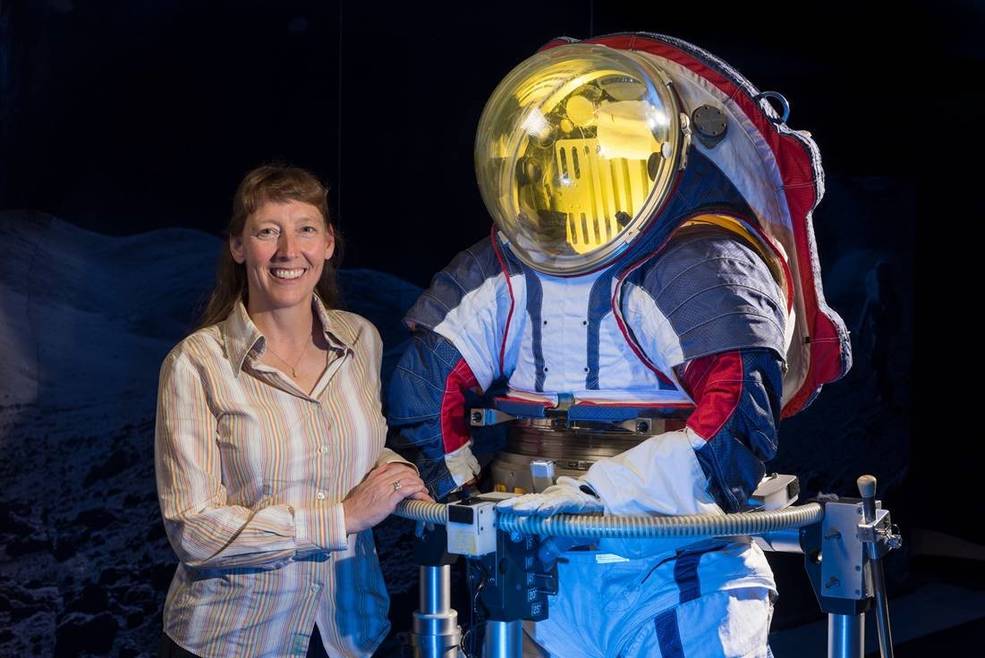 Spacesuit designer Amy Ross of NASA's Johnson Space Center endorses the Z-2, a prototype spacesuit. Credit: NASA
While the rover will explore the craterJazero, collecting rock and soil samples for a future return to Earth, five small pieces of suit material will be studied by the SHERLOC instrument. The materials are embedded along with a fragment of a Martian meteorite into its calibration target.
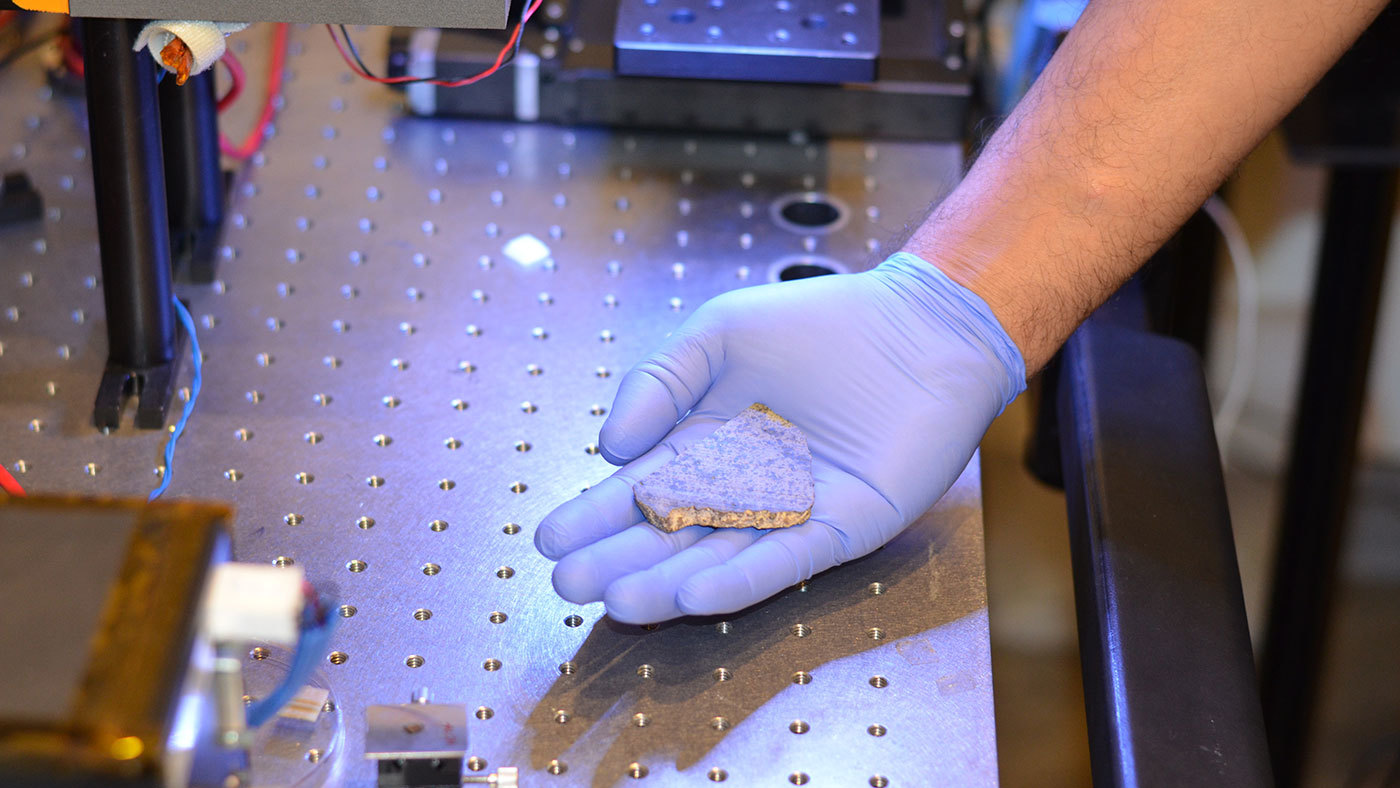 Rohit Bhartia of NASA's Mars 2020 mission storesa piece of a meteorite that scientists have established came from Mars. This slice will likely be used here on Earth to test a laser instrument for the NASA Mars 2020 rover; a separate slice will travel to Mars on a rover. Image courtesy of NASA / JPL-Caltech
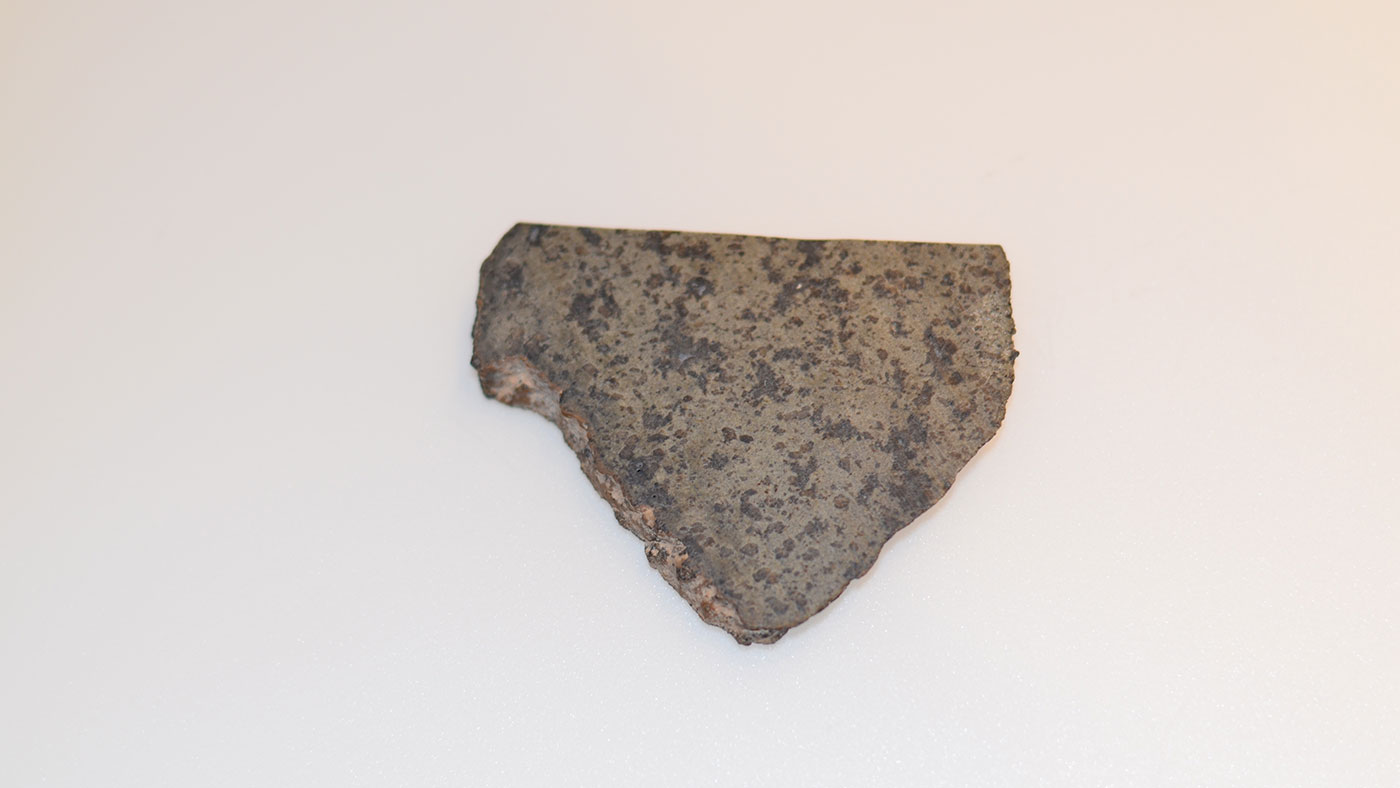 Close-up of a fragment of a meteorite that scientistsidentified came from Mars. This slice will likely be used here on Earth to test a laser instrument for the NASA Mars 2020 rover; a separate slice will go to Mars on a rover. Click on image for full image and caption. Image courtesy of NASA / JPL-Caltech
Scientists use these technologies to make sure the instrument is set up correctly by comparing readings on Mars to baseline readings they received on Earth.
Helicopter Ingenuity. Can we fly on Mars?
The laws of physics might say that it is almostimpossible. NASA's Mars 2020 mission will present a technology demonstration that will test a light helicopter that will perform a controlled flight to Mars. The Ingenuity chopper weighs about 1.8 kg, but it has enough ambition.
The Wright brothers showed that with the help ofexperimental aircraft possible powerful flight in the Earth's atmosphere. With the Ingenuity helicopter, scientists will try to do the same on Mars, said Howard Grip, chief chopper pilot at NASA's Jet Propulsion Laboratory (JPL) in Southern California.
 A portrait of persistence and ingenuity(artist's concept). In February 2021, NASA's Perseverance Mars 2020 rover and NASA's Ingenuity Mars helicopter (shown in artist's concept) will become the agency's two newest explorers on Mars. Both were named by students in an essay competition. Credit: NASA / JPL-Caltech
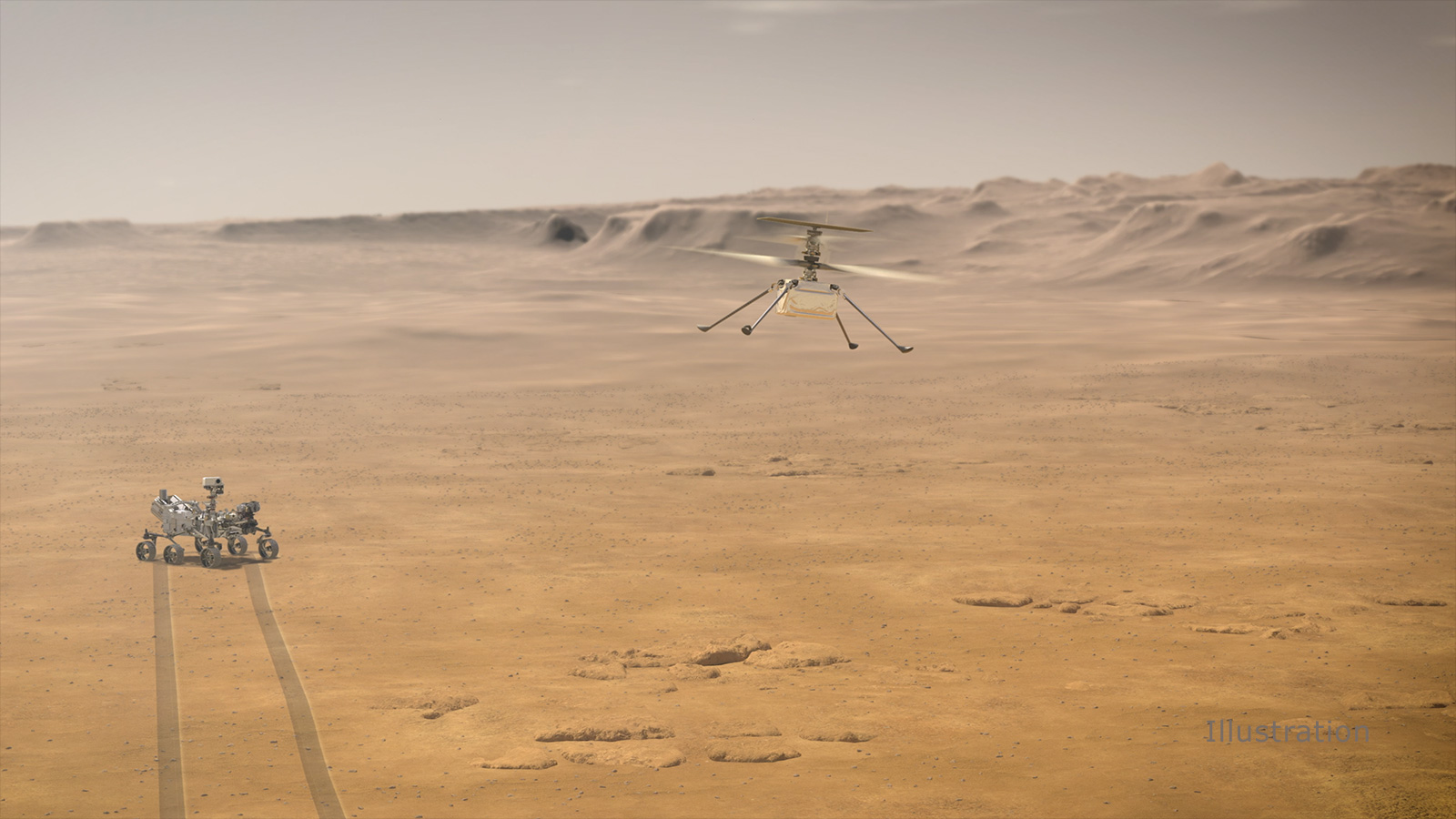 When NASA's Mars Ingenuity helicopterwill try to make its first test flight on the Red Planet, the agency's Perseverance Mars 2020 rover will be nearby, as seen from this artist's concept. Credit: NASA / JPL-Caltech.
Here's what you need to know about Ingenuity
-
Ingenuity - it's flight test
Verthe tolette has four specially madecarbon fiber blades that rotate in opposite directions at about 2,400 rpm - many times faster than a passenger helicopter on Earth. It also features innovative solar cells, batteries and other components. Ingenuity does not carry scientific instruments and is a separate experiment with the Mars 2020 Perseverance rover. -
It will be a difficult task
What prevents a helicopter from flying on Mars?Mars' atmosphere is 99% less dense than Earth's, so the Ingenuity helicopter must be lightweight, with rotor blades that are much larger and spin much faster than required for a helicopter of the same mass on Earth.
At Jezero Crater, where Perseverance will landIngenuity, temperatures drop to -90°C at night. However, the Ingenuity team on Earth has tested the helicopter in Martian temperatures and believes it should work on Mars. As expected, the cold causes the structure of many parts of the chopper to expand.
Additionally, flight controllers at JPL will not be able tocontrol the helicopter using the joystick. Commands must be sent well in advance, with engineering data returning from the spacecraft long after each flight. At the same time, Ingenuity will have enough autonomy to make its own decisions about how to fly to a waypoint and keep itself warm. -
Ingenuityis a fitting name for a robot that is the result of extreme creativity
High school student Vaneeza Rupani from the state.Alabama originally submitted the name Ingenuity for the Mars 2020 rover before it was named Perseverance. But NASA officials decided it was a more appropriate name for the helicopter, given how much creative thinking the team put into the mission. -
Ingenuityhas already demonstrated technical achievements</ p>
JPL engineers tested increasingly advancedhelicopter models in special space simulators. In January 2019, the actual helicopter that flies the Perseverance rover to the Red Planet passed its final evaluation. Failure of any of these steps would warrant the experiment.
-
Team Ingenuitywill count on one mission success at a time
The Ingenuity team has a list of milestones they must complete before the chopper can take off and land in the spring of 2021.
The stages include the following tasks:
- survive launch from Cape Canaveral, transportation to Mars and landing on the Red Planet,
- safe separation from Perseverance,
- keep yourself warm in cold Martian nights,
- recharge yourself using your solar panel.
When all stages have been completed, Ingenuitywill make its first flight attempt. If all goes well, the Ingenuity team will undertake four more test flights over a 30-Martian day (31-Earth day). - Ingenuity's success will change Mars exploration
Ingenuity is intended for demonstrationtechnologies necessary for flight in the Martian atmosphere. If successful, these technologies could enable other advanced robotic vehicles that could be included in future robotic and human missions to Mars. They may offer a unique vantage point not provided by current orbiters.
For the very first flight, the helicopter will take off toa few feet off the ground, hovering in the air for 20-30 seconds and landing. This will be a milestone: the very first flight in the super-powerful atmosphere of Mars! Thereafter, the team will undertake additional experimental flights with increased distance and higher altitude. After the helicopter completes the technology demonstration, Perseverance will continue its scientific mission.