Physicists from Purdue University have proposed an unconventional way to generate light from entangled photons.
The researchers proposed a method for generatingentangled photons at extreme ultraviolet wavelengths. In their theoretical calculations, physicists have shown that by exposing helium to light, one can cause a two-photon decay of a metastable atomic state. As a result, the atoms emit two photons entangled in energy and time with a bandwidth equal to the total energy interval of 20.62 eV.
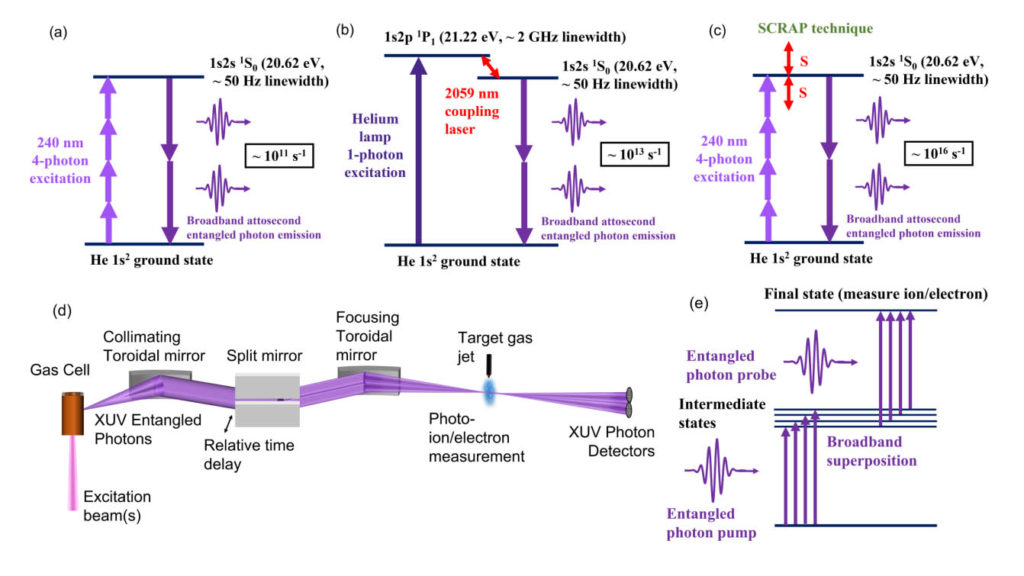 Operating principles and installation diagram. Image: Wang et al., Phys. Rev. Research
Entanglement is a strange phenomenon in quantumphysics, when two particles are connected to each other regardless of the distance between them, the scientists explain. In this case, the measurement of one of the particles automatically determines the state of the second.
Entangled photons in our work are guaranteedarrive at a given location within a very short interval of a few attoseconds if they travel the same distance. This correlation in their arrival times makes them very useful for measuring ultrafast events.
Niranjan Shivaram, assistant professor of physics and astronomy, Purdue University
Observation of processes occurring inside atoms,requires sensitive instruments. Modern attosecond laser pulses provide a resolution of about 40 attoseconds (40×10-18 s). With the help of entangled photons, it will be possible to create "images" with a resolution of several attoseconds or even zeptoseconds (10-21 s).
Read more:
The ancient Vikings suffered from a dangerous disease. It is caused by a parasite from Africa
Plant on Mars produces oxygen at the rate of an average tree
The largest human organ was recreated in the laboratory. It is twice as strong as ours.
Cover image: Cheryl Pierce, University Purdue