A group of physicists from Germany and Spain reported the discovery of a method for highly precise control of light with
Scientists have created a chip equipped with tinywaveguides - “conducting paths” for light quanta, waveguides. They are about 30 times thinner than a human hair. The light source was quantum dots built into the chip.
These quantum dots are islandsa few nanometers in size inside waveguides that emit light in the form of individual photons. Quantum dots are built into our chip, and we don't have to first generate individual photons with another source and couple them to waveguides.
Hubert Krenner, professor of experimental physics at the Wilhelm University of Westphalia and co-author of the study
When the device is operating, the focused laserThe beam uses a quantum dot to generate single photons in a photonic waveguide fabricated on a single-crystal film of gallium arsenide (GaAs) and aluminum gallium arsenide (Al0.2Ga0.8As). Two comb electrodes generate nanosonic waves, causing distortion of the waveguide crystal lattice. The left transducer produces a sound wave that adjusts the color of the emitted photons at gigahertz frequencies. The right acoustic transducer generates another nanosound wave, which separates the photons by color.
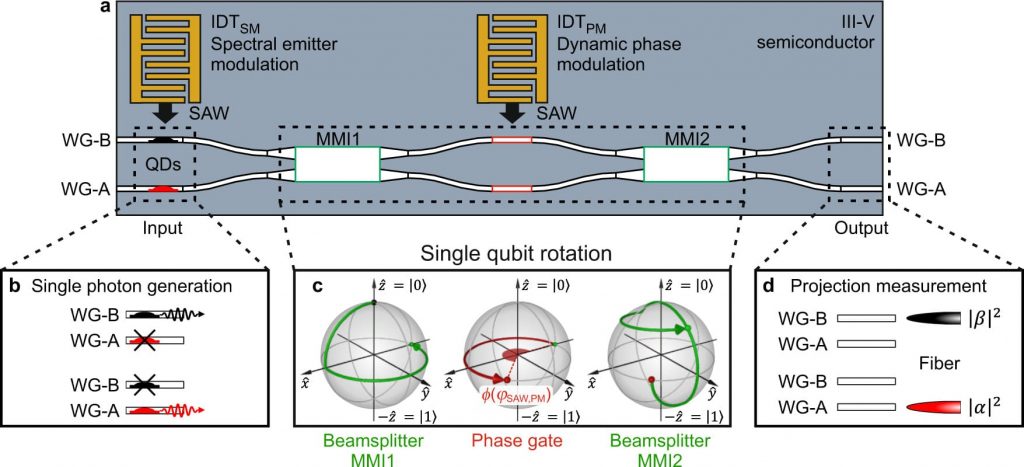 Scheme of the device (a), generation of single photons(b), driving single photons (c), and measuring the rotated state of the superposition by collecting and detecting output signals (d). Image: Dominik D. Bühler et al., Nature Communications
The researchers note that in a series of experimentsthey were able to generate individual photons on a chip the size of a thumbnail and then use sound waves to control them with precision never before possible. Similar mechanisms have already been used for "classical laser radiation", but for the first time they were used to control individual light quanta, the scientists add.
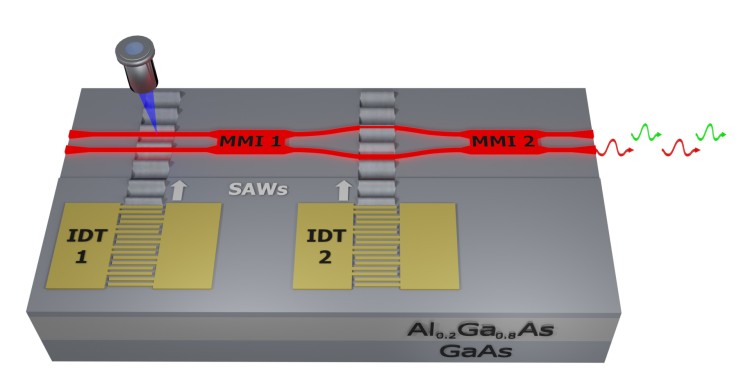 Artistic illustration of a chip.A focused laser beam (left, blue) uses a quantum dot to generate single photons in a photonic waveguide (red) fabricated from a single-crystal film of gallium arsenide (GaAs) and aluminum gallium arsenide (Al0.2Ga0.8As). Two comb electrodes generate nanosonic waves that distort the crystal lattice of the waveguides. The left transducer produces a sound wave that adjusts the color of emitted photons at gigahertz frequencies. The two waveguides are connected at two points by multimode interference couplers (MMI). The right sonic transducer generates another nanosonic wave that separates photons by color. Image: Dominik D. Bühler, Westfälische Wilhelms-Universität Münster
Light and sound waves aretechnological basis of modern communication. Optical fibers based on laser radiation ensure the functioning of global networks. And nanosonic wave chips are used to wirelessly transfer data at gigahertz frequencies between smartphones, tablets or laptops.
Scientists believe that the results of the work revealthe path to hybrid quantum technologies, as they combine three different systems: quantum light sources in the form of quantum dots, generated light quanta, and phonons, quantum particles of a sound wave. Physicists continue to work on expanding the capabilities of the chip. For example, it will be able to sort multiple photons of different colors between four or more outputs.
Read more:
A magnetic storm is about to hit Earth
Created a navigation system that is more accurate than GPS
An ancient amulet rewrote the history of Europe's most mysterious language