Black holes are astronomical objects with extremely strong gravitational attraction, from which
Since then, physicists have carried out countlesstheoretical and experimental studies to better understand the nature of these cosmological objects. The new study expands scientists' understanding of the unique characteristics, properties and dynamics of black holes.
Vortices and black holes
Staff of the Ludwig Maximilian University andThe Max Planck Institute of Physics recently conducted a theoretical study of the possible existence of vortices in black holes. According to a study published in the journal Physical Review Letters, they could theoretically exist.
Up until the publication of the new study, scientists had not studied rotating black holes in terms of this concept. However, they not only can exist. This is more of a rule than an exception.
What have the scientists done?
Scientists have performed several calculations.They were based on a recently developed quantum model of black holes based on graviton Bose-Einstein condensates. Recall that gravitons are hypothetical massless elementary particles. They are carriers of gravitational interaction and gravitational field quanta without electric and other charges. Presumably always moving at the speed of light.
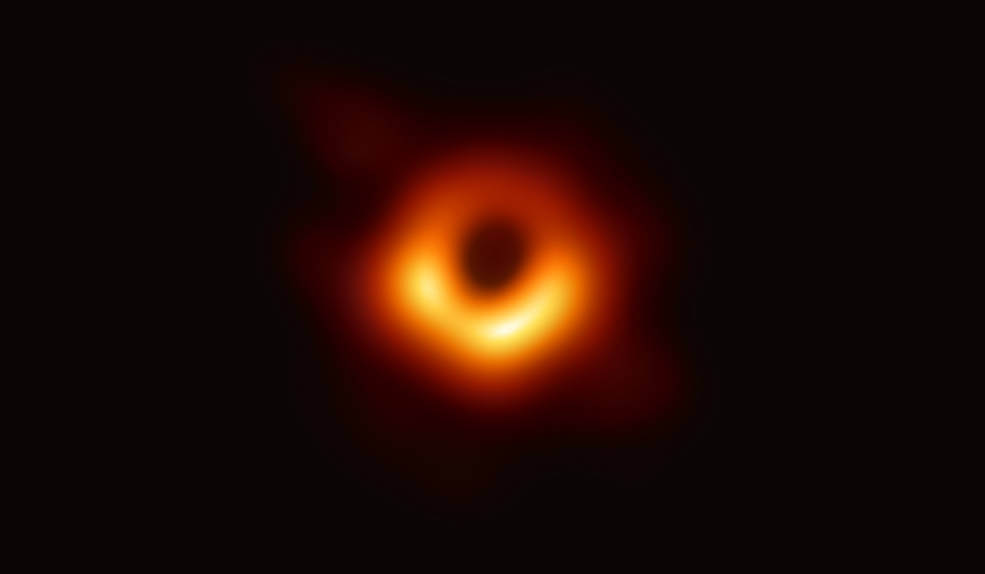 The first image of a black hole was made using observations of the center of the galaxy M87.
Photo: Event Horizon Telescope Collaboration
The key goal of the new study is to study spinning black holes at the quantum level to see if they really allow for the existence of vortex structures.
Because rotating Bose-Einstein condensatesalready actively studied in laboratories, it is known that they allow for a vortex structure if they rotate fast enough. This inspired scientists to look for them also in models of rotating black holes.
What did physicists find out?
As part of the study, scientists showed that blacka hole with extreme spin can be described as a graviton condensate with vorticity. Notably, this is consistent with previous studies.
Previously, physicists have already assumed that extremeBlack holes are resistant to Hawking radiation. Recall that this is a hypothetical process of emission by a black hole of various elementary particles, mainly photons. Hawking radiation is the main argument of scientists regarding the decay of small black holes, which theoretically can arise during experiments at the LHC.
The study also showed that ifmobile charges, the common vortex of the black hole captures the magnetic flux of the gauge field. As a result, this leads to characteristic radiation, which can be observed experimentally. Thus, the theoretical predictions of scientists open up new possibilities for observing new types of matter, including dark matter from milli-charged particles.
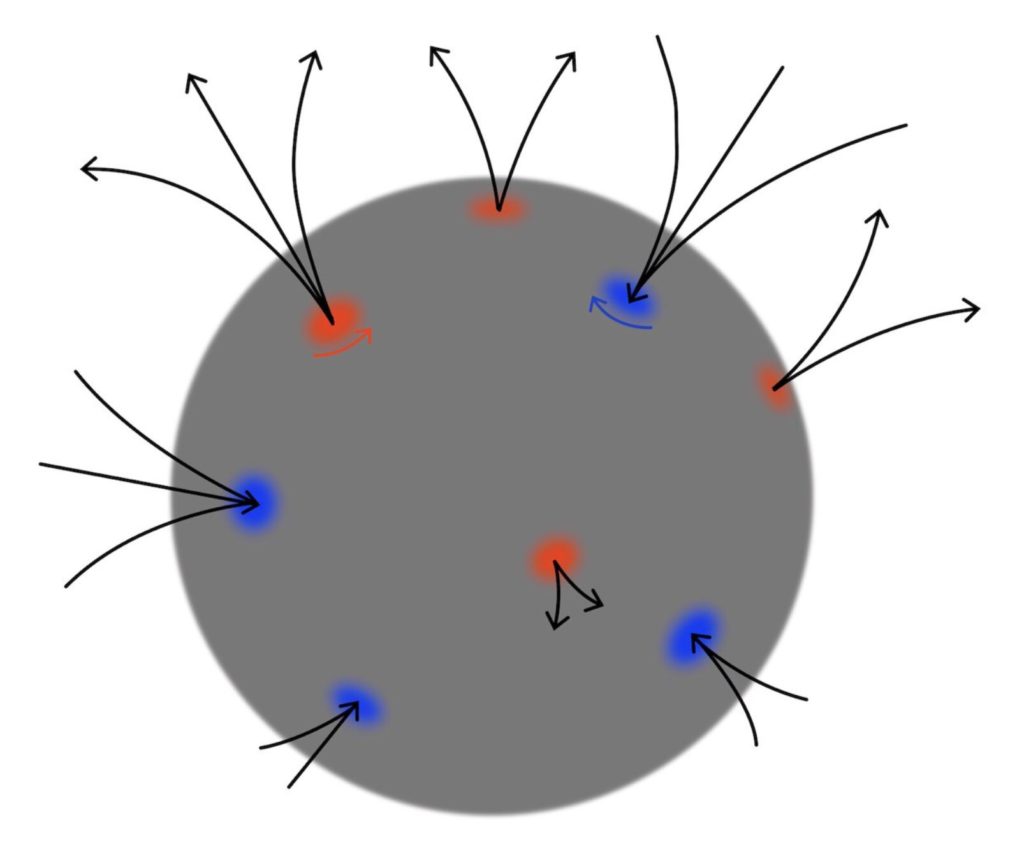 Sketch of a black hole with many vortices. Colors indicate orientation, and the corresponding captured magnetic field lines are marked in black. Photo: Dvali and others.
As the authors of the study noted, vorticity isthis is an entirely new characteristic of black holes. At the classical level (apart from their quantum structure), they are fully characterized by three parameters: mass, spin and charge. Now scientists have added vorticity to that list.
What's the bottom line?
That scientists have proven the allegedthe existence of vortices in black holes changes science. For example, this explains the cosmic mismatch: why black holes with maximum spin do not have Hawking radiation. Thus, in the future, this theory will pave the way for new experimental observations and theoretical conclusions about their nature.
For example, the vortex structures of black holes canexplain the extremely strong magnetic fields that arise in the active nuclei of galaxies in the universe. In addition, they can potentially underlie almost all known galactic magnetic fields.
In the future, gravitational wave observations of the merging of black holes, each of which is distinguished by vortices, will help to study the quantum aspects of space-time.
Read more:
The space plane will deliver cargo to the ISS and land at a regular "airport"
The star approached the black hole and it was torn apart: scientists observed this from three telescopes
Scientists have found traces of genetic mutations in the blood of every person who has been in space