Quantum physics breaks all the rules. For example, the classical laws of thermodynamics, which describe how
In some experiments, scientists have found thatthe object under study may be cooling down, although it is with something much hotter. Scientists say it's like taking a hot frying pan out of the oven, but your hand doesn't heat up, but rather cools down.
To find out what happens to quantum chaos and how it manages to stay outside the laws of thermodynamics, physicists conducted an experiment with ultracold lithium atoms and a laser.
Anomalous Chaos
If we take an ordinary pendulum and push it fromtime from different sides, then it will absorb the impact energy and sway, moving randomly in space. Despite the seeming randomness of movements, it is easy to describe with the help of equations that take into account the impulses and directions that the pendulum received during the impact.
In the quantum world, everything is not so simple.Instead of moving, disorder can cause particles to “stop.” While at the beginning of the experiment a quantum pendulum can absorb energy in the same way as a mechanical one, over time, with repeated impacts, it will reach a plateau and the momentum distribution will freeze in a dynamically localized state.
To explain such an anomaly for individualparticles, scientists used mathematics. They believe that quantum mechanical probability waves oscillate and collide with each other in precisely such a way that crests and troughs meet and eliminate any possibility of the particle absorbing energy.
But what happens in real life whenthe interaction that occurs between many particles, for example, in a system containing many colliding electrons, remained a mystery after decades of controversy.
Multiple localization
To understand what should be happening, scientistsoffer to imagine a cup into which coffee with milk is poured. If cold milk is poured into hot coffee, then over time the particles are mixed, and the whole drink comes to a homogeneous state. Such a process is called thermalization, and it was previously believed that it should be observed in any system.
Over the past few decades, scientistsrealized that this is not always the case. It turned out that chaos in a quantum system leads to the localization of many bodies. This means that the system cannot reach thermal equilibrium and retains the memory of its initial state in local areas for an infinite time.
What have the scientists done?
To check how the complexa system consisting of many particles, scientists used lithium gas. They placed about 100,000 ultracold atoms in a vertical wave of light. Each such atom was a quantum rotor (pendulum) that could be launched using a laser pulse.
Scientists explain that they forced atomscollide and fly apart, or use Feshbach resonance to keep them together. This effect occurs when two slow, cold atoms collide, temporarily sticking together and forming an unstable compound with a short lifespan.
When the particles didn't interact, the researcherssaw the expected result: the particles warmed up a little before they reached a constant temperature. When the researchers adjusted the experiment so that the atoms could interact a little, they first saw a temperature plateau at the same level. But unlike the one-dimensional theory, the atoms eventually began to heat up again, although not as quickly as conventional thermodynamics predicts.
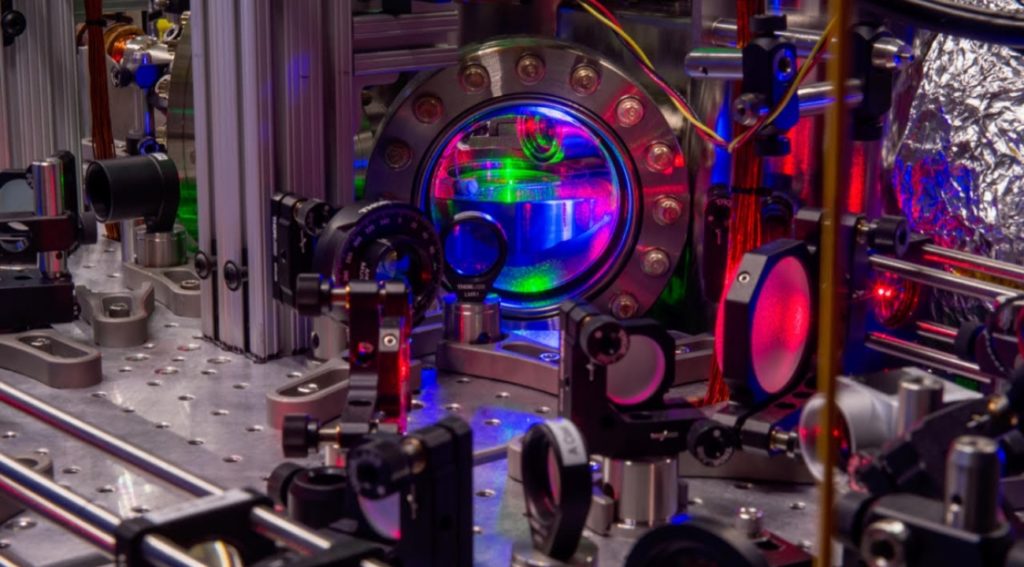 Experimental setup. Photo: Tony Masters, UCSB
It turned out that the new state is notcorresponded neither to classical thermodynamics nor to the expected behavior of a localized set of bodies. The hypothesis that the scientists studied did not assume such a result, but another theory describes similar behavior. It applies to very cold groups of particles that form a Bose-Einstein condensate. This is a phase of matter in which all particles have the same quantum state.
The equations describing the Bose condensate are −Einstein, predict the rate of slow heating exactly as it happened in the experiments. The surprising thing here is that the atoms studied by scientists were not such a condensate.
In a sense, this is a double riddle. We don't really know why this happens, but there is a theory that shouldn't work, but it seems to work.
Victor Galitsky, study co-author
Why is it important?
The observed plateaus prove that the interactionsdo not always force particles to obey the laws of thermodynamics. By investigating how laws change at the micro level, physicists hope to form a new theory that links the behavior of matter at both the micro and macro scales.
Such experiments can not only open a newquantum physics, but also lead to the development of new research tools. If the physics behind these experiments can be unraveled, perhaps one day the temperature plateaus will expand and be used to develop new and better quantum technologies, the scientists say.
Read more:
It turned out what happens to the human brain after one hour in the forest
It became known which tea destroys protein in the brain
Strange sea creatures in the depths of the ocean turned out to be similar to humans