Despite their tiny size, protons are incredibly important. They are located at the center of every atom in
What is a proton?
A proton is one of the three elementary particleswhich ordinary matter is built. Protons are part of atomic nuclei. It is the serial number of a chemical element in the periodic table that is equal to the number of protons in its nucleus. Together with the neutron, the proton is part of all atomic nuclei, determining the magnitude of its electric charge.
Like most particles,Protons have a spin that acts like tiny magnets. Changing the spin or polarity of a proton may seem like science fiction - because, in fact, it affects everything in the Universe. However, it is the basis of technological breakthroughs that have become an integral part of our daily lives. Thanks to the study of proton spin, people have technologies such as magnetic resonance imaging (MRI), an invaluable medical diagnostic tool. Despite such achievements, the internal structure of the proton remains a mystery.
Why is it important?
Basically everything around us existsthanks to protons. And yet, we still don’t know much about them. One of the huge mysteries that scientists want to solve is the rotation of the proton. The second secret is the time of his life, Hi-Tech wrote about this earlier.
Understanding how and why it rotatesThe proton will lead to technological advances that now seem unrealistic. It will also help scientists understand the strong force, the fundamental property that gives all protons, and therefore atoms, mass.
They support the universe: how the four main forces of nature work
What is the problem?
Rotation is not easy to understand.the problem is not so simple. Firstly, you cannot simply take a proton and place it in a Petri dish. As you know, rotons are incomprehensibly small - their radius barely reaches one quadrillionth of a meter, and visible light passes right through them. Moreover, it is impossible to examine their insides using the world's most powerful electron microscopes.
However, the authors of the new study bring closerscientists to solve this tangled proton mystery. The project was worked on by members of the H1 Collaboration, an international group that currently includes 150 scientists from 50 institutions and 15 countries. The project headquarters is based at the national research center DESY in Germany. The author of the new study is developing machine learning algorithms to speed up the analysis of data collected using the world's most powerful electron-proton collider, HERA. She worked at DESY from 1992 to 2007.
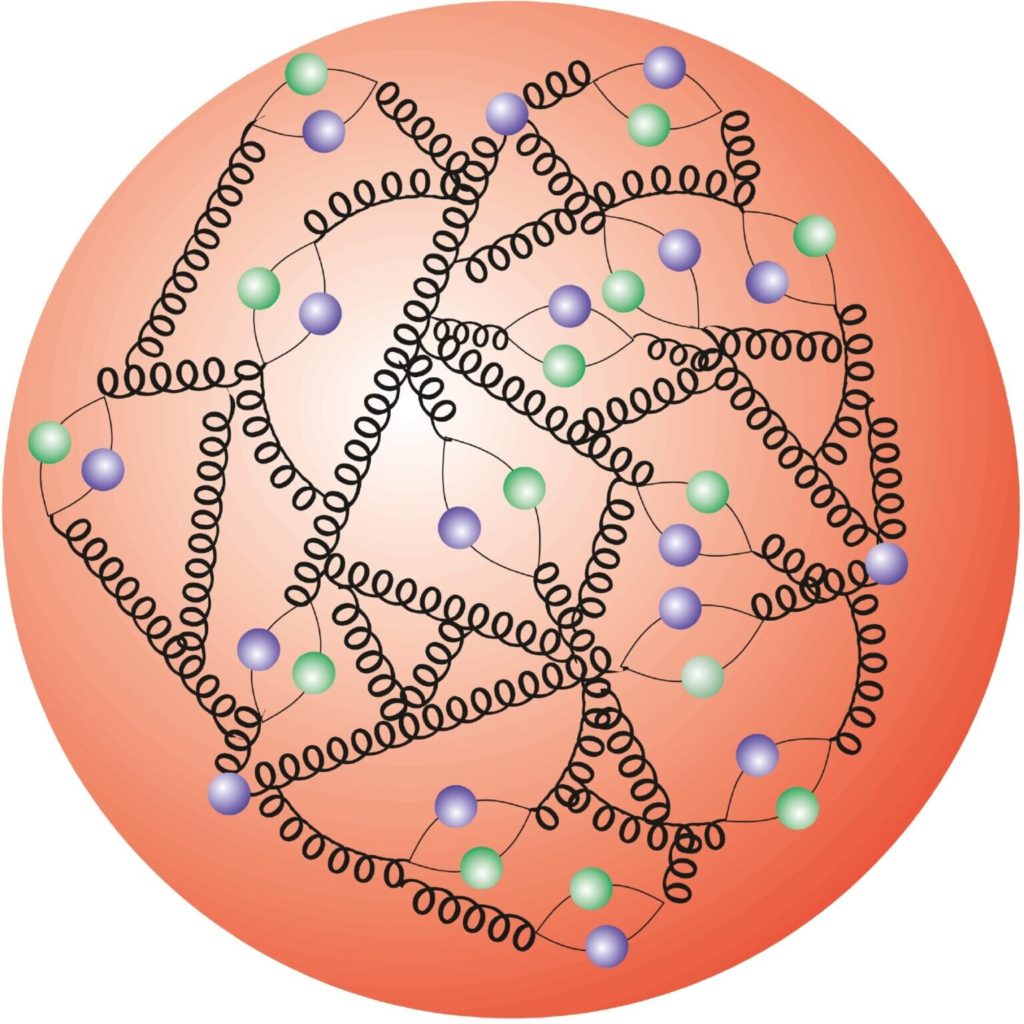 Electron-proton collider HERA dispersed andelectrons, and protons almost to the speed of light. The particles collided head-on, which could break the proton into its component parts: quarks (shown as green and purple balls in the illustration above) and gluons (shown as black coils). Image: DESY
H1 stopped collecting datain 2007 when HERA was taken out of operation. However, collaboration staff are still analyzing the data and publishing the results in scientific journals.
What have the scientists done?
When using conventional computational methodsIt can take a year or more to measure quantities related to proton structure and the strong force, such as how many particles are produced when a proton collides with an electron. And, if a physicist wants to study another quantity, for example, the speed of particles in the wake of a quark-gluon jet, he will have to start the long computational process all over again and wait another year.
To solve the problem, scientists usedmachine learning. A new instrument based on this OmniFold technology can measure multiple quantities simultaneously. This ultimately reduces the analysis time from several years to minutes.
How it works?
OmniFold works while simultaneously usingneural networks for combining computer simulations with data. To recap, a neural network is a machine learning tool that processes complex data that scientists cannot do manually.
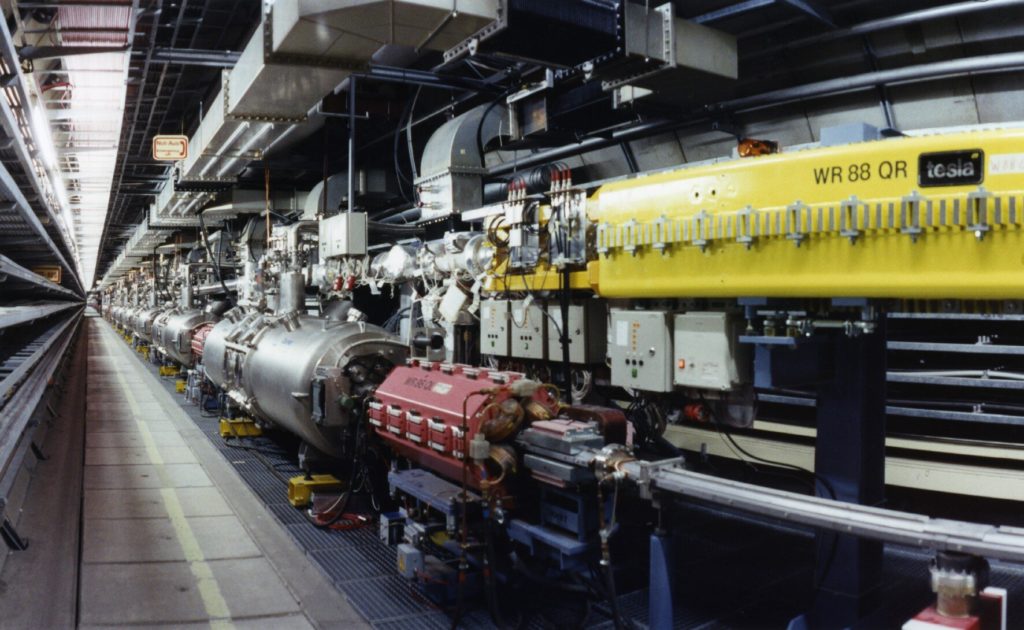 View of the HERA tunnel. Photo: DESY
The authors of the new study were the first to useOmniFold accessed the H1 experimental data and published the results in the journal Physical Review Letters, and most recently presented their findings at the 2022 Deep Inelastic Scattering (DIS) Conference.
Supercomputer help
To develop OmniFold and test itability to work with H1 data, physicists deployed a new supercomputer, Perlmutter, designed to support simulations, data analysis and artificial intelligence experiments that require the simultaneous use of multiple GPUs. Its development was completed in 2021.
The Perlmutter supercomputer, which is namedin honor of Berkeley Lab cosmologist and Nobel Prize winner Saul Perlmutter, it is equipped with 128 graphics processors that operate simultaneously.
The central task of calculations is to take into account detector distortions. The H1 detector tracks particles, but when they fly “around” rather than through it, it can skew the data.
Previously, simultaneous correction of all distortionswas not possible due to limited computational methods. The understanding of subatomic physics and data analysis techniques has advanced since 2007. And now scientists can use new insights to analyze H1 data.
What's next?
Today, physicists have renewed interestto HERA experiments with particles. They hope to use the data—and more accurate computer modeling based on tools like OmniFold—to analyze the results of future electron-proton experiments, such as the next-generation Energy collider. ;s next-generation Electron-Ion Collider, EIC).
It will be built at Brookhaven Nationallaboratory in partnership with the Thomas Jefferson National Accelerator Complex. It will be a powerful and versatile "machine" that will collide beams of high-energy polarized electrons with a wide range of ions (or charged atoms), including polarized protons and some polarized ions.
As the OmniFold developers noted, one day theyThe method will help scientists answer still remaining questions about the strong force. “Even though this work may not lead to practical applications in the near future, understanding the building blocks of nature is very important. If we don't research now, we will never know what exciting new technological advances will benefit future societies,” the scientists conclude.
Read more:
Archaeologists have officially confirmed the legends from the Bible
It turned out what happens to the cells of the body when the heart dies
Starlink signal hacked to be used as an alternative to GPS