The research team proposed a new TF QKD network structure that scales to a two-to-many (2:N) network on
To overcome the main obstacles to implementationThe team adopted a plug-and-play (PnP) design when developing the TF QKD system. A conventional TF QKD system requires multiple control systems, such as timing, wavelength, phase, and polarization controllers, to maintain the indistinguishability of two quantum signals emitted by two users' different light sources. While in the PnP TF QKD architecture developed by the KIST research group, the middle third party generates and transmits the initial signals to two users at once using one light source, and the signals are returned to the third party by making a circular journey.
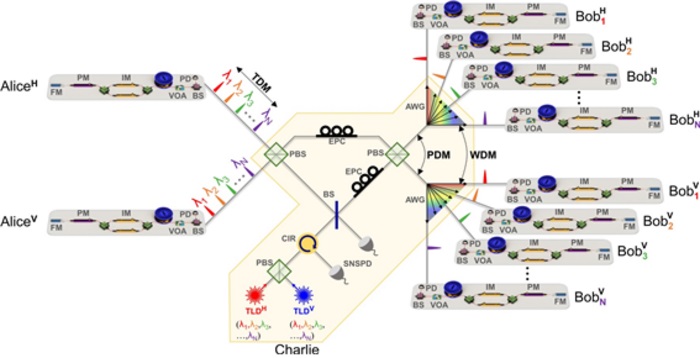 QRC network architecture
Therefore, the polarization drift due to the effectchannel birefringence is automatically compensated, and users have fundamentally the same wavelength. Also, because the two signals travel the same route in opposite directions, the arrival times of the signals are naturally identical. As a result, only a phase controller is required to implement the research team architecture. Based on the architecture, the team successfully conducted a pilot demonstration of the TF QKD network.
"This is an important research achievement,demonstrating the possibility of removing two major obstacles to the commercialization of QKD, and we have received a key technology leading relevant research,” said Sang-Vuk Khan, head of the Center for Quantum Information.
Read more:
Physicists have found a universal "clock" in space: they are more accurate than atomic
Archaeologists have found drawings of creepy people with huge heads: who they were
The James Webb telescope took the first picture of Jupiter: it shows 9 moving targets at once