Recently, researchers have also been exploring the possible development of molecular clocks.These systems
“Our recent work is the result of years ofefforts to create the so-called molecular clock,” said Tanya Zelevinsky, one of the researchers and authors of the new work, in an interview with Phys.org. “We were inspired by the rapid progress in the accuracy of atomic clocks. Molecular clocks are based on a different "ticking" mechanism and thus may be sensitive to additional phenomena. One of them is the idea that the fundamental constants of nature can change very little over time. Another possibility is that gravity between very small objects may differ from interactions on larger scales.”
Molecular clock created by Zelevinsky and hercolleagues are based on the diatomic Sr₂ molecule, structurally resembling two tiny spheres connected by a spring. The watch specifically uses the vibrational modes of this molecule as an accurate frequency reference, which in turn allows time to be tracked.
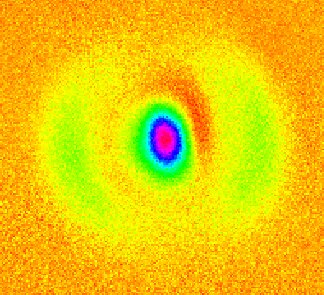 The image of supercold molecules broken down into atoms was used by the researchers. Photo: K. H. Leung
“Our watches require the use of lasers forcooling atoms near absolute zero and holding them in optical traps, causing them to combine into molecules and point high-precision “clock” lasers at them to actually make a measurement, ”explained Zelevinsky. “The advantage of molecular clocks is the very low sensitivity to stray magnetic or electric fields and the very long natural lifetime of vibrational modes.”
In a study published in the journal PhysicalReview X, Zelevinsky and colleagues evaluated the accuracy of molecular clocks in a series of tests by measuring their bias. They found that their design significantly minimized sources of error, and the clock itself achieved a total systematic error of 4.6×10⁻¹⁴, demonstrating particularly high accuracy.
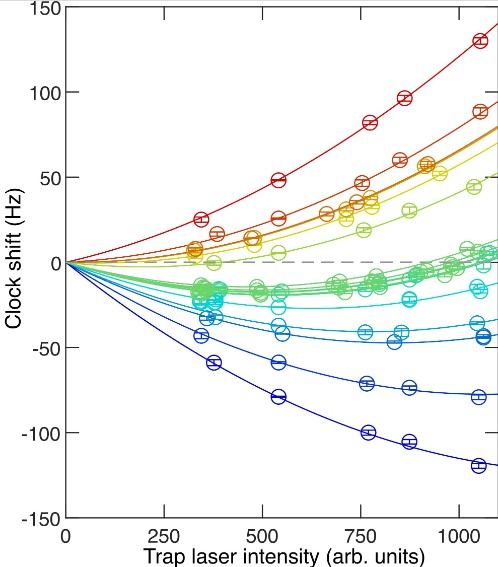 Small shifts in the position of the clock's resonance depending on the wavelength of the exciting light (indicated by color) limit the accuracy of a vibrating clock. Photo: K. H. Leung
Vibrational molecular clock createdby a group of researchers, can become the standard for terahertz frequency applications, as well as the basis for the creation of new tools for molecular spectroscopy. Its design can also be changed by replacing the Sr₂ molecules with other isotopic variants (with a different mass).
“In the future, we hope to apply molecularwatch for understanding molecular structure with the highest precision and studying any possible signature of non-Newtonian gravity at the nanometer scale,” concludes Zelevinsky.
Read more:
A photo appeared inside the second deepest underwater sinkhole in the world
See what happened to Mercury when it got as close as possible to the Sun
Scientists are ready to recognize the new tree as the oldest in the world
Cover photo by: Alex Berger