An international team of physicists has discovered a quantum state in which the alignment of atoms associated with
At first glance, quantum materials do notdifferent from ordinary substances, but there are still differences, the researchers say. Inside such materials, electrons interact with unusual intensity both with each other and with atoms of the crystal lattice. This close interaction leads to powerful quantum effects that manifest themselves not only on the microscopic but also on the macroscopic scale.
Thanks to these effects, quantum materialshave unusual properties. For example, they can conduct electricity with absolutely no loss at low temperatures. At the same time, even slight changes in temperature, pressure or electrical voltage are enough to radically change the behavior of the material.
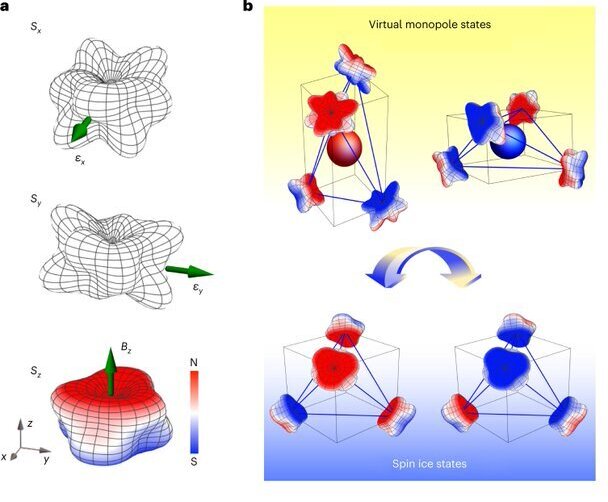 Quantum liquid. Image: Nan Tang et al., Nature Physics
In their work, the researchers sought to createa quantum material that will not change its properties regardless of the temperature of the environment. They used a combination of several elements - praseodymium, zirconium and oxygen. The researchers hypothesized that in this material, the properties of the crystal lattice would allow the spins of electrons to interact in a special way with the orbitals in which they "move" around the nuclei of atoms.
After a series of attempts, the researchers were able tocreate crystals sufficiently pure so that impurities and inhomogeneities do not affect the calculated properties. They cooled the sample down to 20 mK (one fiftieth of a degree from absolute zero). The results of the experiments showed that in this state the material retains "liquid properties - the electron spins are not ordered. This is the first observation of an unusual quantum state, the authors say. They compare it to "water that never freezes."
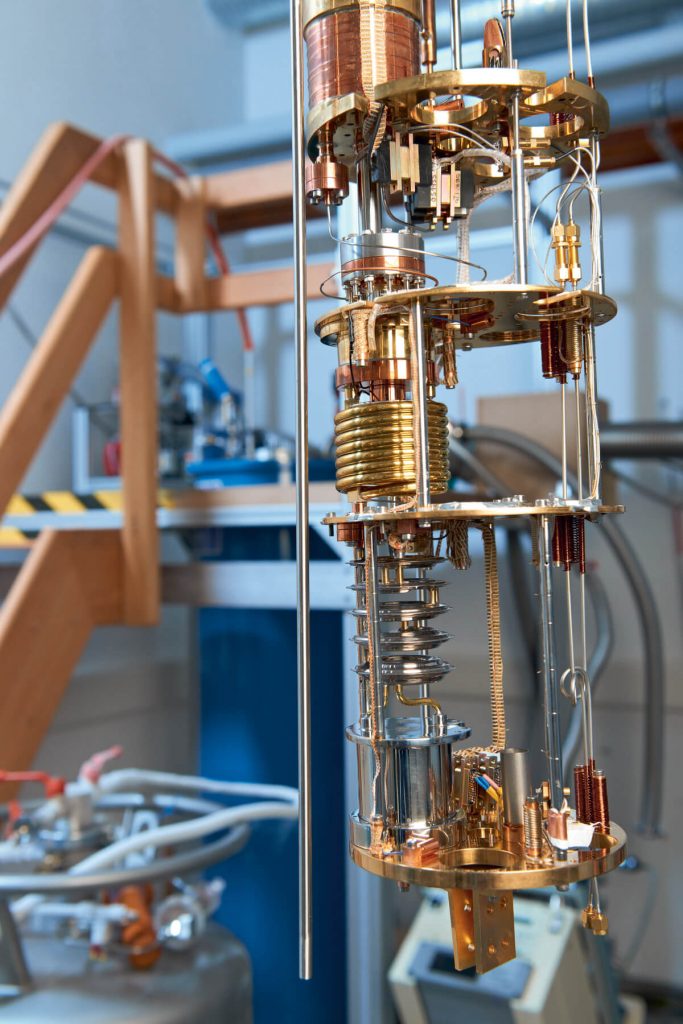 Cryogenic facility used in the experiment. Image: Jürgen Jeibmann, HZDR
A new quantum state can bebe used to develop highly sensitive quantum sensors, scientists believe. Since their quantum nature makes them extremely sensitive to external stimuli, such sensors can register magnetic fields or temperatures with much greater accuracy than conventional devices.
Read more:
The egg was dropped from space: look what happened to it
Brain-eating amoeba is spreading in the US: is there a danger to Russia
See what a woman Thora looks like. She lived 800 years ago