How do black holes "work"?
Black holes are regions in space where gravity is very strong.
In a normal black hole, Hawking radiation appears when there is an occurrence near the event horizona pair of virtual particles, which turns into a particle-antiparticle pair.over the horizon, and the other flies away.
What did Hawking predict?
Theoretical physicist Stephen Hawking predicted:although nothing can leave black holes, they themselves spontaneously emit a limited amount of light. It is known as Hawking radiation. According to the predictions of the physicist, this radiation is spontaneous (that is, it arises from nothing) and stationary (that is, its intensity does not change much with time).
Hawking radiation is the main argument of scientists regarding the decay (evaporation) of small black holes, which theoretically can This effect is the basis for the idea of a singular reactor, a device for obtaining energy from a black hole by means ofHawking radiation.
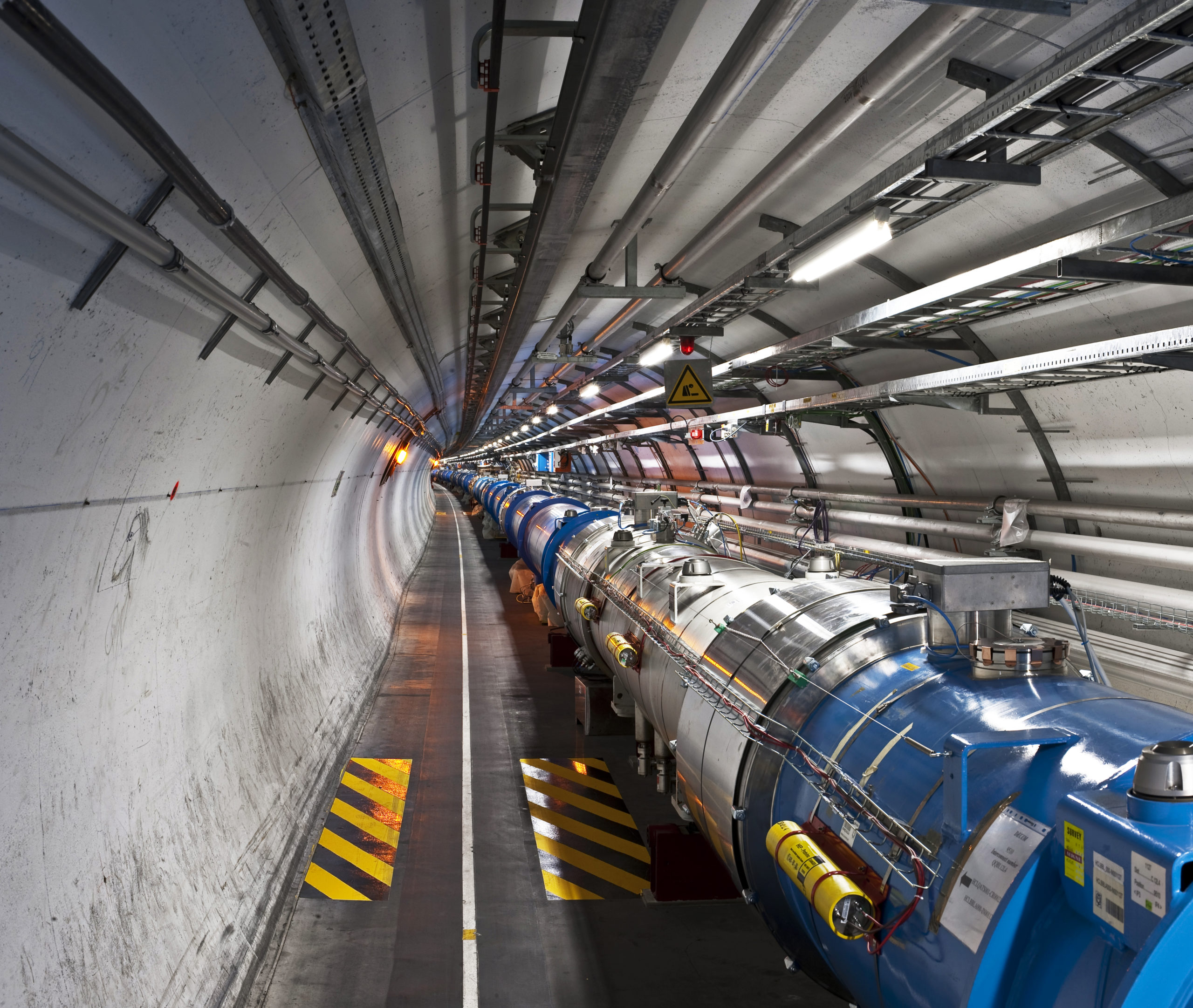 Author: Maximilien Brice, CERN — CERN Document Server, CC BY-SA 3.0
In a discussion with Y. Zeldovich, V. Gribov insisted that thanks to quantum tunneling, black holes should emit particles. Even before the publication of his work, Hawking visited Moscow in 1973, where he met with Soviet scientists Yakov Zeldovich and Alexei Starobinsky. They demonstrated to Hawking that, according to the uncertainty principle of quantum mechanics, spinning black holes should give rise to and emit particles.
According to Hawking's predictions, the radiation of blackhole is spontaneous. In their new study, the scientists set out to find out whether the radiation emitted by their black hole is also stationary (i.e., whether it remains constant over time).
What did the scientists find out?
Researchers from Israel TechnologicalThe Technion Institute recently conducted research aimed at testing Hawking's theoretical predictions. In particular, they studied whether the equivalent of Hawking radiation in a "artificial black hole" created in laboratory conditions was stationary.
If you go inside the event horizon, you can't get out of here even for the light.Hawking radiation begins just beyond the event horizon, from where light can barelyIt's really weird because there's nothing there; it's empty space.But this radiation starts out of nothing, goes out to the Earth.
Jeff Steinhauer, one of the researchers, in an interview with ScienceX
How did scientists create an artificial black hole?
Artificial black hole created by the Israelisscientists, had a length of about 0.1 mm and was made from a gas consisting of 8,000 rubidium atoms. This is a relatively small number of atoms. Every time the researchers photographed it, the black hole collapsed. Thus, in order to observe its evolution over time, they had to create a black hole, photograph it, and then create another one. This process was repeated many times over the course of months.
 An analog black hole created by researchers. Credit: Kolobov et al.
Hawking radiation emitted by this analogblack hole, consists of sound waves, not light. Rubidium atoms move faster than the speed of sound, so sound waves cannot reach the event horizon and escape from the black hole. However, outside the event horizon, gas flows slowly, so sound waves can move freely.
Rubidium flows fast, faster than the speed of sound, andthis means that the sound cannot go against the flow. Let's say a person is trying to swim against the current. If this current goes faster than he is able to swim, then it is simply impossible to move forward. The swimmer is constantly pushed back - the stream is moving too fast and in the opposite direction. As a result, a person gets stuck in one place. This is what it is like to be stuck in a black hole and try to reach the event horizon from within.
Hawking radiation is made up of parphotons (i.e., light particles): one comes outIn trying to identify the Hawking radiation emitted by an analog black hole, the scientists looked for similar pairs of sound waves, one coming out of the black hole and the other moving into it.Once they identified these pairs of sound waves, the researchers tried to determine if there werePhysicists repeated their experiment 97,000 times, which is 124 days of continuous measurements. As a result, the researchers found that the analogue of the black hole has aa pair of sound waves, and also confirmed the correlation between them.
Overall, the results seem to confirm thatthe radiation emitted by black holes is stationary, as Hawking predicted. While these results are primarily related to the analogue black hole they created, theoretical studies can help confirm whether they can be applied to real black holes.
What's the bottom line?
The fact is that they were able to observe the entire lifetime of an analog black hole and see how the Hawking radiation began.In future studies, you can try to compare the results of the work with predictions about what will happenIn this way, scientists will be able to see if "real" Hawking radiation starts from zero and then increases, as physicists observed during the experiment.
A real black hole has two horizons:the outer is the event horizon (more precisely, the horizon of visibility) and the inner is the Cauchy horizon. Between the two horizons there is a T-region, where movement for any objects is possible only in one direction: light, particle or person will only move inward. The tidal forces will increase as you move in this area towards the inner Cauchy horizon. Surprisingly, under it, the movement of the object towards the center slows down dramatically (in a sense, in the coordinates accompanying the object itself).
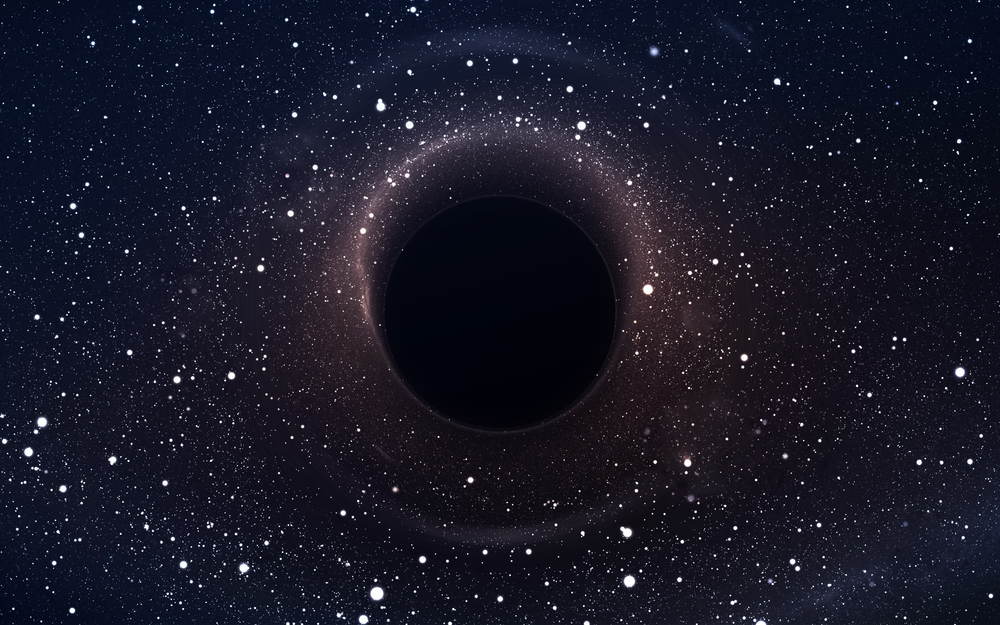
After stopping at the attendant facilitycoordinates, it begins to push outward - into another universe (the topology for real black holes is nontrivial, there is a connection between different universes, and the object must be pushed out into another universe). At the stopping point (it is also called the turning point, the throat point), there are maximum tidal forces for a given black hole, a given object and the initial conditions for the fall of this object (in other conditions, this maximum will be different, but always finite).
In the area inside the inner horizonthe gravitational pull is much lower, so objects can move freely and are no longer attracted to the center of the black hole. However, they still cannot leave the black hole because they cannot pass through the inner horizon in the opposite direction (i.e., heading towards the event horizon).
Essentially, the event horizon is the outer sphere.black hole, and inside it there is a small sphere called the inner horizon. If a person falls beyond the inner horizon, he will still be stuck in a black hole. But at least he will not feel the unthinkable physics of being in it. The person will find themselves in a more "normal" environment, since the force of gravity will be lower, and it will not be possible to feel it again.
Some physicists have predicted that whenthe analog black hole forms an inner horizon, the radiation it emits becomes stronger. Interestingly, this is exactly what happened in the analogue black hole created by the Technion researchers. Thus, this study may inspire other physicists to study the effect of inner horizon formation on Hawking radiation intensity.
Read also
The first accurate map of the world was created. What's wrong with everyone else?
Scientists have recorded for the first time how planets form around low-mass stars
An anti-aging medicine that removes senescent cells has been discovered