A team of scientists has developed an optical setup to send quantum light through a localization fiber
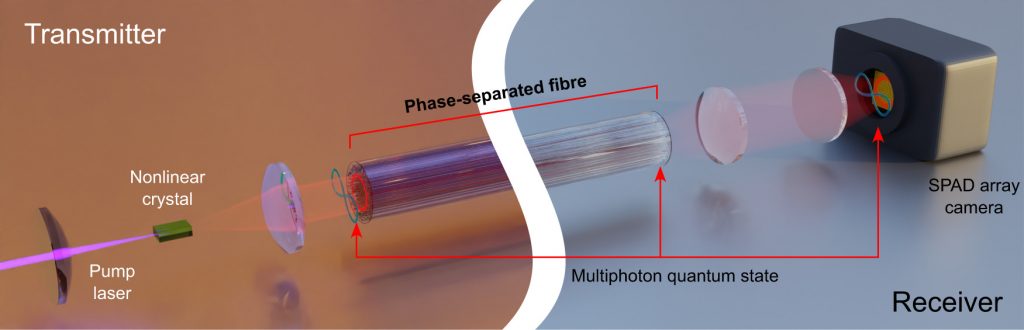 Schematic illustration of the experiment. Image: Alexander Demuth et al., Communications Physics
In an experiment conducted by physicists, a specialphase division optical fiber connects the transmitter and receiver. The first is a quantum light source. It generates quantum-correlated photon pairs through spontaneous parametric down-conversion in a non-linear crystal.
During the generation process, one high-energy photon is converted into pairs of photons, each of which has a lower energy. The wavelength of such a pair is 810 nm.
As a receiver, physicists useda matrix camera with a single-photon avalanche diode (SPAD). Such a camera, unlike conventional CMOS cameras, is so sensitive that it can detect single photons with extremely low noise levels, the scientists explain. In addition, it has a very large temporal resolution, so that the time of "arrival" of single photons is known with high accuracy.
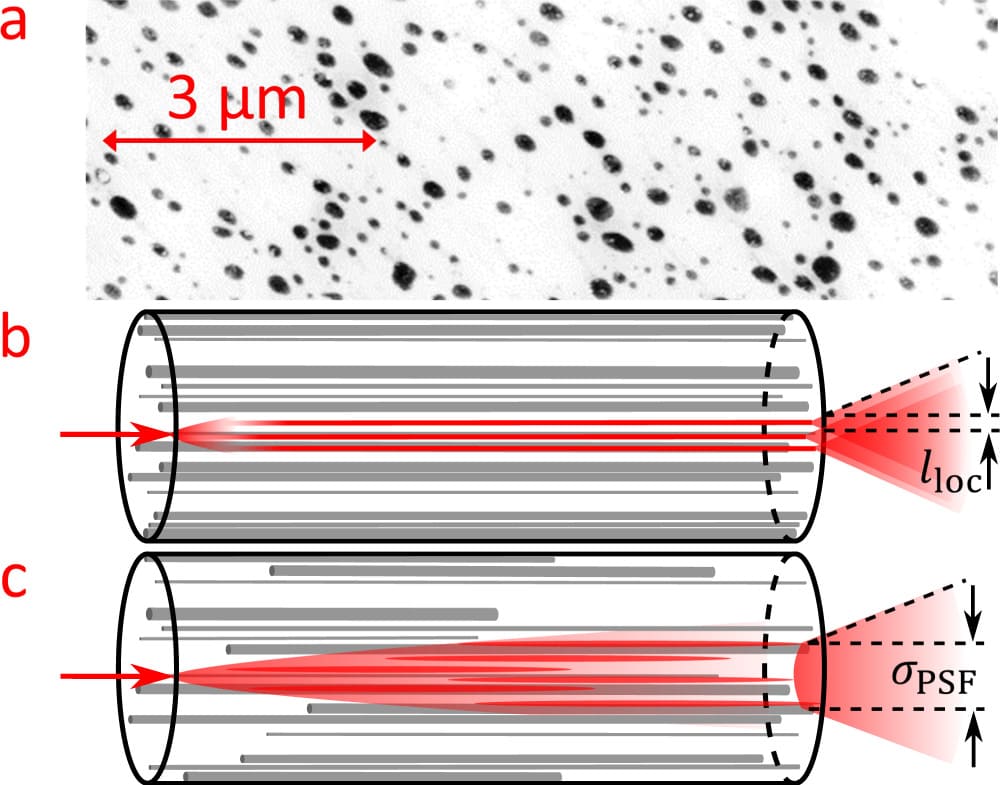 Phase division fiber:fiber structure (a), scheme of light propagation in ideal (b) and real (c) fibers. In the second case, the light is partially scattered, jumping between localized modes. Image: Alexander Demuth et al., Communications Physics
During the experiment, the SPAD array discovered andidentify pairs of photons that arrive at the same time (match). Since the pairs are quantum-correlated, knowing where one of the two photons is found tells the location of the other photon. The team tested this correlation before and after sending quantum light, successfully showing that the spatial anticorrelation of photons does indeed persist.
Researchers continue to work onimprovement of technology. In particular, they plan to create an optical fiber that will minimize the effects of attenuation, which will increase the range of transmission of associated data.
Unlike conventional single-mode opticalfibers that transmit data through a single core, phase division fiber (PSF) or Anderson localization fiber with phase division consists of many glass filaments embedded in a glass matrix with two different refractive indices. Since there are two refractive indices in the material, this creates a lateral disorder that results in transverse (two-dimensional) Anderson localization of light in the material.
Read more:
A magnetic storm is about to hit Earth
Named the main danger of the lunar mission "Artemis"
The true meaning of mummification is revealed: all this time, scientists were wrong
On the cover: an illustration of a setup for transmitting quantum light. Image: ICFO/ A. Cuevas