A research team at the Institute of Modern Physics of the Chinese Academy of Sciences recently synthesized
Scientists conducted experiments at the Centerheavy ion research at Lanzhou (HIRFL) and China Accelerator Facility for Superheavy Elements (CAFE2). The new actinium-204 isotope was obtained in a synthesis-evaporation reaction. It was identified by the recoil-α correlation on gas-filled recoil separators. This is the 35th nuclide synthesized in the center.
The scientists then determined the alpha particle energy and half-life to be 7948 keV and 7.4 ms, respectively. Both measures are consistent with the theoretical prediction.
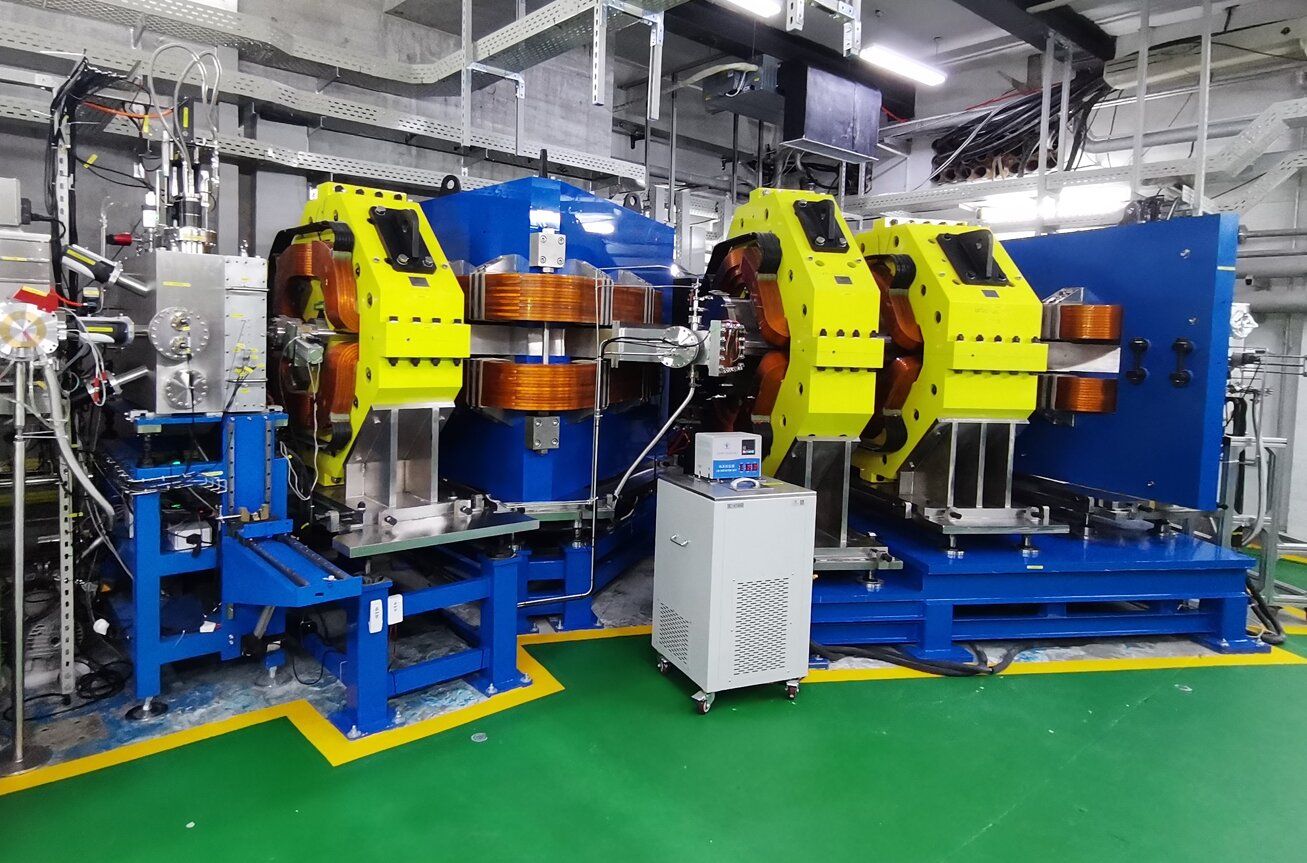 Spectrometer for Heavy Atoms and Nuclear Structure-2, SHANS2. Photo: IMP
For many isotopes, even-odd vibrationThe half-life is strictly synchronized with the change in the energy of α-particles. However, scientists have discovered that this rule does not apply to actinium-204, as well as some other isotopes with a neutron number of less than 119.
This phenomenon indicates a blockingthe effect of the α-decay process caused by an unpaired neutron in actinium-204. In other words, an unpaired neutron reduces the probability of α-cluster formation near the surface of the actinium-204 nucleus.
New research has helped scientists getexperimental data on the mass and α-decay of the new actinium-204 isotope. This ultimately brought physicists closer to understanding the role of the unpaired nucleon in the α-decay process.
Read more:
A monster black hole was found in the "backyard" of the Earth: it is very close to our planet
NASA revealed the origin of Haumea - the most mysterious planet in the solar system
Webb photographed the Pillars of Creation. Compare how Hubble shot them before