Physicists working on the ALICE detector used data from proton-proton collisions at the LHC over three years and
The researchers explain that the collision of elementary particles in colliders causes a high-energy interaction that leads toThese particles undergo subsequent transformations, emitting radiation in the form of additional gluons.In this cascade process, the energy of the original particles is transferred to many lower-energy particles.
The pattern of such radiation depends on the mass of the gluon-emitting parton.The region around the direction of flight of the parton in which the radiation is suppressed is called the dead cone.
Physicists note that the dead-cone effect waspredicted by the theory of strong interaction about thirty years ago, but until now, scientists have only been able to indirectly fix its presence. The main problem was the difficulty in determining the direction of parton motion, as well as the fact that the region of the dead cone can be filled with particles into which the radiating parton has turned.
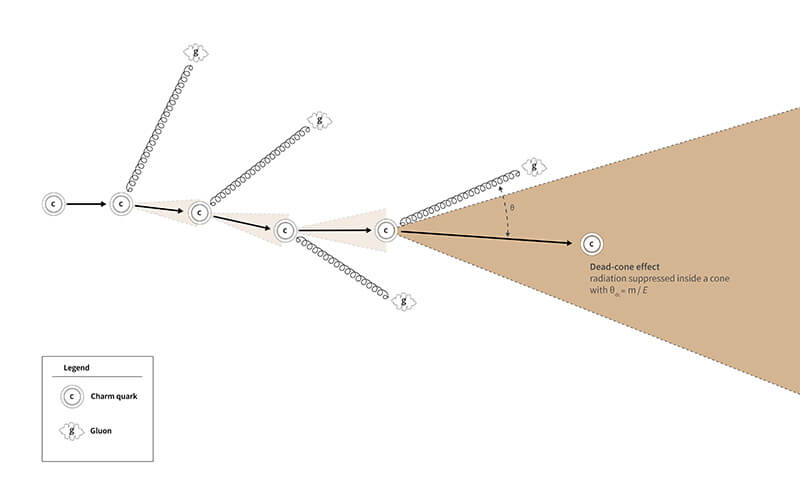 Cascade parton flow. Source: CERN
In their work, the researchers reconstructedthe flow of partons along its final product, the hadron jet, which is detected by the detectors. In the process of analyzing a large sample of observations of proton-proton collisions, physicists discovered a jet containing a c-quark (charmed quark). They were able to trace the entire history of the emission of gluons by this quark. A comparison of the gluon emission pattern of a charmed quark with the distribution of gluons and massless quarks revealed a dead cone in the c-quark structure.
The researchers note that in addition to confirmingtheory of the strong interaction and the existence of the dead cone effect, the discovery also proves that the charmed quark has mass. Massless particles do not have dead cones, which means that by studying this effect, one can estimate the mass of quarks.
Quark masses are fundamentalquantities in particle physics, but they cannot be accessed and measured directly in experiments because, with the exception of the top quark, quarks are trapped inside compound particles. Our technique for direct observation of the parton dead cone offers a way to measure the mass of quarks.
Andrea Dainese, ALICE physicist, study co-author
Cover image: CERN
Compare how the lunar eclipse was filmed by NASA and Roscosmos
The “fifth force” creates invisible “walls” in the universe. The main thing about the new theory of physicists
Monkeypox infection map published