Researchers used a supercomputer to test the Kibble-Zurek mechanism, the quantum effect,
If you want to calculate the movement of onebilliard ball, it's relatively simple. It is much more difficult to predict the trajectories of countless gas particles in a vessel that are constantly colliding, decelerated and deflected. Predicting the behavior of quantum particles is even more difficult. Not surprisingly, even the most powerful supercomputers cannot cope with this task.
To simplify this task, scientists usedartificial neural networks to reduce the degree of uncertainty of the task and reformulate it into a form that can be solved using modern computing tools.
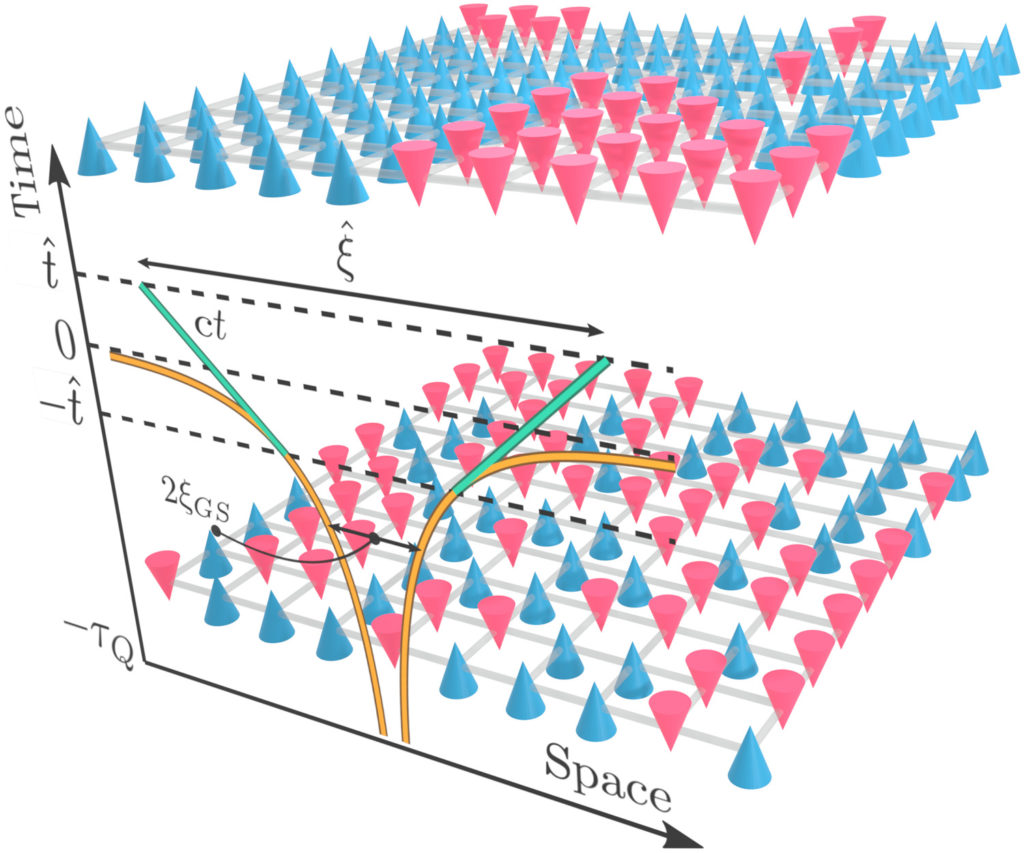 Schematic representation of a phase transition in a two-dimensional system with spin 1/2. Image: Markus Schmitt et al., Science Advances
Using this method, scientists investigated the importanta theoretical prediction that has so far failed to be calculated: the Kibble-Zurek quantum mechanical mechanism. It describes the dynamic behavior of physical systems during the so-called quantum phase transition. The most obvious of them: a change in the state of aggregation of a substance or the loss of properties of a magnet when heated.
For example, if the demagnetized material startscool, then its properties will return after a certain temperature. This moment is called a phase transition. Moreover, this occurs unevenly throughout the material. Instead, many small magnets are created simultaneously with poles oriented in different directions. Physicists call this “mosaic of magnets” defects.
The Kibble-Zurek mechanism was originally introducedto explain the formation of the structure of the Universe. After the Big Bang it was homogeneous, but as it cooled, defects began to form in it, as in magnets, which formed individual clusters, galaxies, stars.
In their work, scientists managed to show that the same effect also works in the microcosm at temperatures near absolute zero, when quantum effects begin to dominate.
Read more:
It became known which tea destroys protein in the brain
7,000-year-old structure found that is older than the Egyptian pyramids and Stonehenge
Look at the first photos of Mars that Webb took: they are literally dazzling