During the study, scientists created computer models that simulate the shock wave near Zeta
The problem is that all three models alsopredicted that the X-ray emission should be weaker than observed, so none of the models is completely accurate. But these models are difficult to do well, and this work is a good first start, the scientists note.
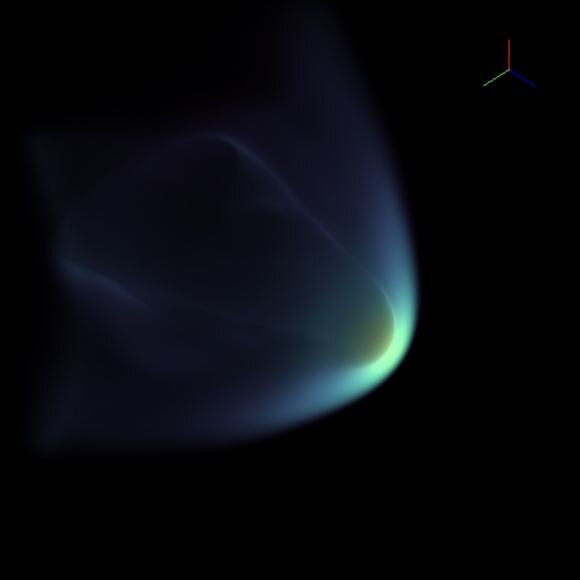 Shock wave simulation of Zeta Ophiuchus. Author: Green et al.
Zeta Ophiuchi had an interesting life.In the past, it was a typical large star, about twenty times more massive than the Sun. It orbited a large companion star until it went supernova about a million years ago. The explosion threw Zeta Ophiuchi away and now it is rushing through interstellar space.
The supernova also ejected the outer layerscompanion star, so instead of empty space, Zeta Ophiuchi hurtles through the residual gas. It's tricky, but it gives astronomers an extensive research topic and beautiful cover photos.
Penetrating through interstellar gas, the star createdheated shock waves that glow at all wavelengths, from infrared to x-rays. The physics of these shock waves is very complex and is governed by a set of mathematical equations of magnetohydrodynamics.
Modeling these equations is not easy.task, especially when the star has turbulent motion. Scientists already have an excellent overview of the shock wave, so physicists can easily compare observations with computer simulations.
Read more:
The supersonic plane will fly at a speed of 2,000 km/h and cross the ocean in 3.5 hours
Scientists filmed a strange creature with tentacles, which they mistook for a flower
Created a quantum computer that "went beyond the binary system"