Scientists from the Max Planck Institute for Nuclear Physics used specially to measure the g-factor
Like a charged particle with spin, each electronhas a magnetic moment, scientists explain. He, like a compass needle, is oriented in a magnetic field. The strength of this magnetic moment is determined by the g factor. A quantitative estimate of this parameter for a free electron is predicted with extraordinary accuracy by quantum electrodynamics.
The magnetic moment of an electron changes as soon asit ceases to be a "free" particle, entering into interactions with the environment, for example, with the atomic nucleus. The tiny changes in g-factor that occur during the interaction can be calculated based on quantum electrodynamics. The results of the experiment confirmed the theoretical calculations.
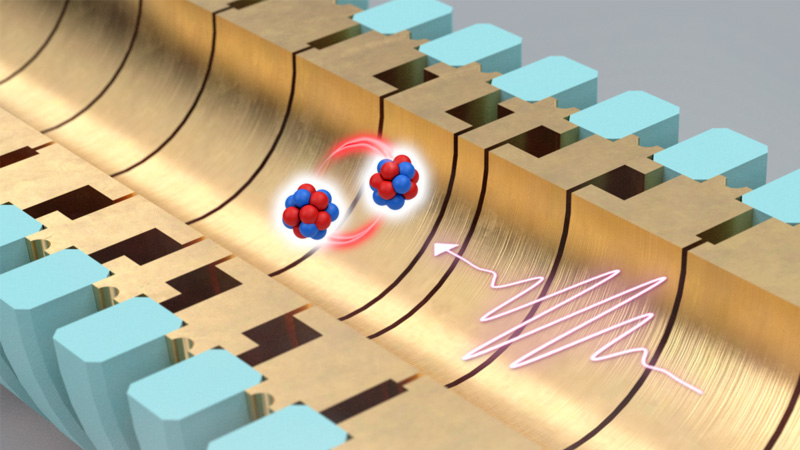 Scheme of the experiment. Source: Max-Planck-Institut für Kernphysik Heidelberg
In their work, physicists used two isotopesneon: atoms with 12 and 10 neutrons. The limitations of previous experiments were associated with magnetic field fluctuations: different effects of an external magnetic field on different atoms lead to a decrease in measurement accuracy.
To get around this limitation, in the new workthe researchers placed two atoms simultaneously in the same magnetic field in coupled motion. With such a motion, two ions always rotate against each other along a common circular trajectory with a radius of only 200 μm. Thanks to this effect, the researchers were able to determine the difference in the g-factors of both isotopes with a record accuracy of up to 13 digits. This is 100 times higher than the quality of previous experiments.
We have confirmed that the electron does indeed interact with the atomic nucleus through the exchange of photons, as predicted by quantum electrodynamics.
Zoltan Harman, researcher at the Max Planck Institute for Nuclear Physics and co-author of the paper
Physicists plan to use the new method for future research. For example, comparisons of matter and antimatter, as well as ultra-precise determination of a number of other fundamental constants of the standard theory.
Read more:
Quantum simulator showed the division of an electron into parts in one-dimensional space
Physicists have created an atomic laser that can work forever
Two planets found not far from Earth that are very similar to ours