Physicists from the University of Wisconsin at Madison observed how a stream of electrons turns into an analog
Graphene is a two-dimensional carbon material with a thicknessinto an atom arranged in a honeycomb pattern. It is a pure electrical conductor in which the electrons experience practically no resistance. For their experiment, the researchers added obstacles at controlled distances to graphene and then applied an electric current through it.
In the study, we show how the charge flowsaround the impurity, and in fact we see how this impurity blocks the current and causes resistance, which was not done before, in order to distinguish between gaseous and liquid electron flows.
Zach Krebs, graduate student in the Department of Physics at the University of Wisconsin-Madison and co-author of the study
The study showed that at temperaturesclose to absolute zero, the electrons in graphene behave like a gas: they move in all directions and collide with obstacles more often than interact with each other. In this situation, the resistance is higher and the electron flow is relatively inefficient, the authors note.
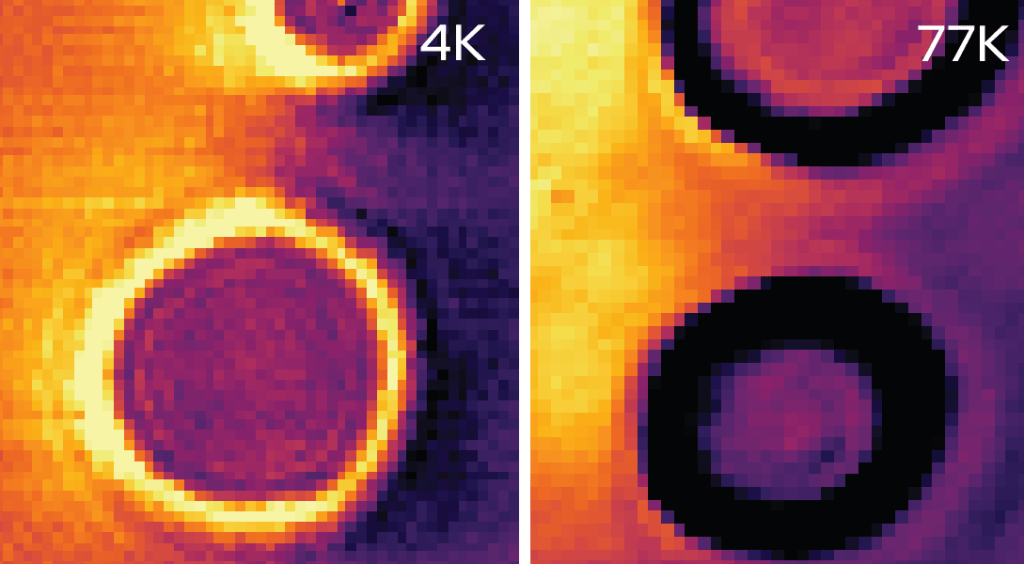 Heat map of the location of electrons in grapheneshows that at lower temperature (left), electrons collide with impurities more often (circles), and relatively fewer of them pass through the channel between them. At higher temperatures (right), the electron flow becomes "liquid", less likely to get stuck in impurities and better pass through the channel. Image: University of Wisconsin–Madison
On the contrary, at higher temperatures (approx.77 K, or –196 °C) electrons begin to interact with each other, as a result they begin to move like a viscous (Newtonian) fluid. This process resembles a river flowing around a rock. At the same time, the resistance in graphene is lower, and the flow of electrons is more efficient. Physicists found that regardless of the distance between obstacles, the voltage drop was much lower at 77 K than at 4 K.
The results of this study will help in the development of new materials with low resistance, scientists say.
Read more:
It's not about the Earth: scientists explained why the solar system is the rarest
Dinosaurs in bamboo corsets were found among the artifacts of the expedition of the early twentieth century
Substance from the "grandfather's beard" improves memory and neuronal growth