With the exception of black holes, neutron stars are the densest objects in the Universe. As follows
What are neutron stars?
After massive stars burn out their fueland explode as supernovae, extremely compact objects—neutron stars—can be formed. They are unusually dense. So, a teaspoon of neutron star matter will weigh about 112 million tons on Earth. However, they are very small - the average neutron star can fit within the boundaries of London. But the Sun, the closest star to us, can fit more than a million Earths.
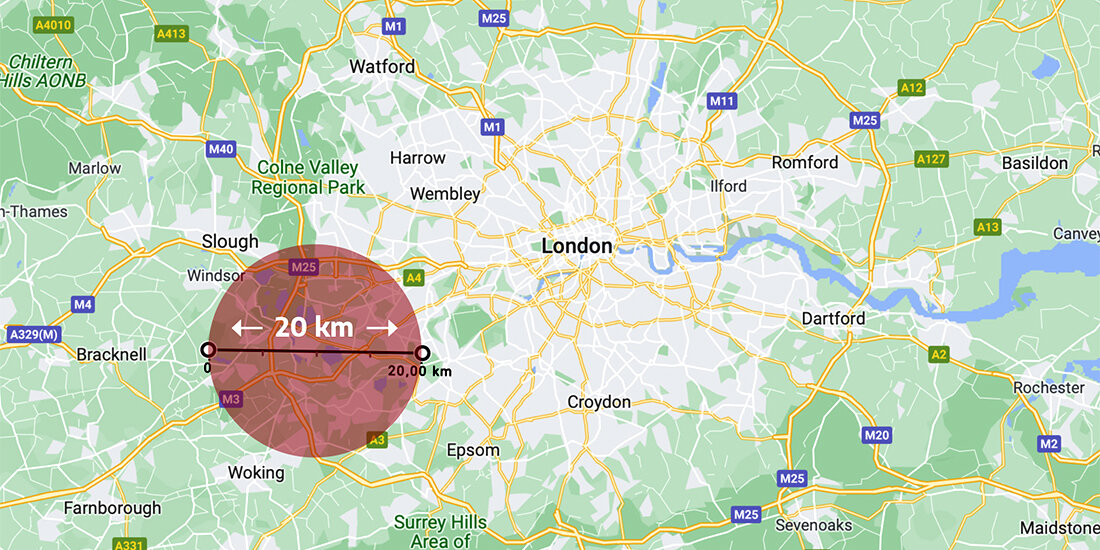 Neutron stars are tiny in size but very dense. A typical neutron star compared to London.
Image Credit & Copyright: Kolbjorn Skarpnes, NTNU
To achieve such density, you would have to compress a massive body like the Sun to the size of a city like Frankfurt.
Today scientists know about the existence2,000 to 3,000 neutron stars in the Milky Way. But it is believed that there are many more of them. They are difficult to detect for many reasons, from their tiny size (at least by astronomical standards) to their low luminosity in visible light.
Why are they so interesting?
All objects in the universe are made up of stars.substances. However, not all luminaries synthesize the same chemical elements. Ordinary stars are factories for the production of helium, carbon and other familiar light elements.
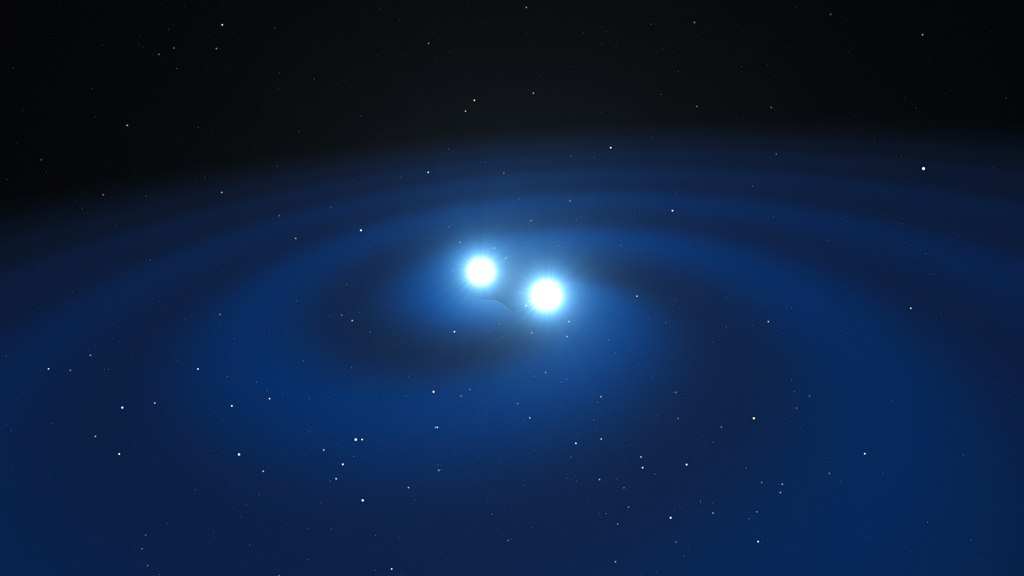 Illustration: ESO
The creation of heavier ones, such as silver, gold and platinum, requires the collision of neutron stars.
What questions do scientists have about neutron stars?
Measure gravitational waves, smalloscillations of space-time arising from the collision of two neutron stars were only succeeded in 2017. However, the composition of the resulting hot and dense fusion product is not precisely known. There are still open questions, for example, whether quarks, which are otherwise captured by neutrons, can appear in a free form after a collision. To find out, the authors of the new study developed a new model.
What did the researchers do?
As part of the new study, scientists expandednuclear physics models that are not applicable at high densities. To do this, they used a method that is used in string theory to describe the transition to dense and hot quark matter.
Quark is an elementary particle and fundamentalcomponent of matter. Quarks combine to form composite particles called hadrons, the most stable of which are protons and neutrons, components of atomic nuclei.
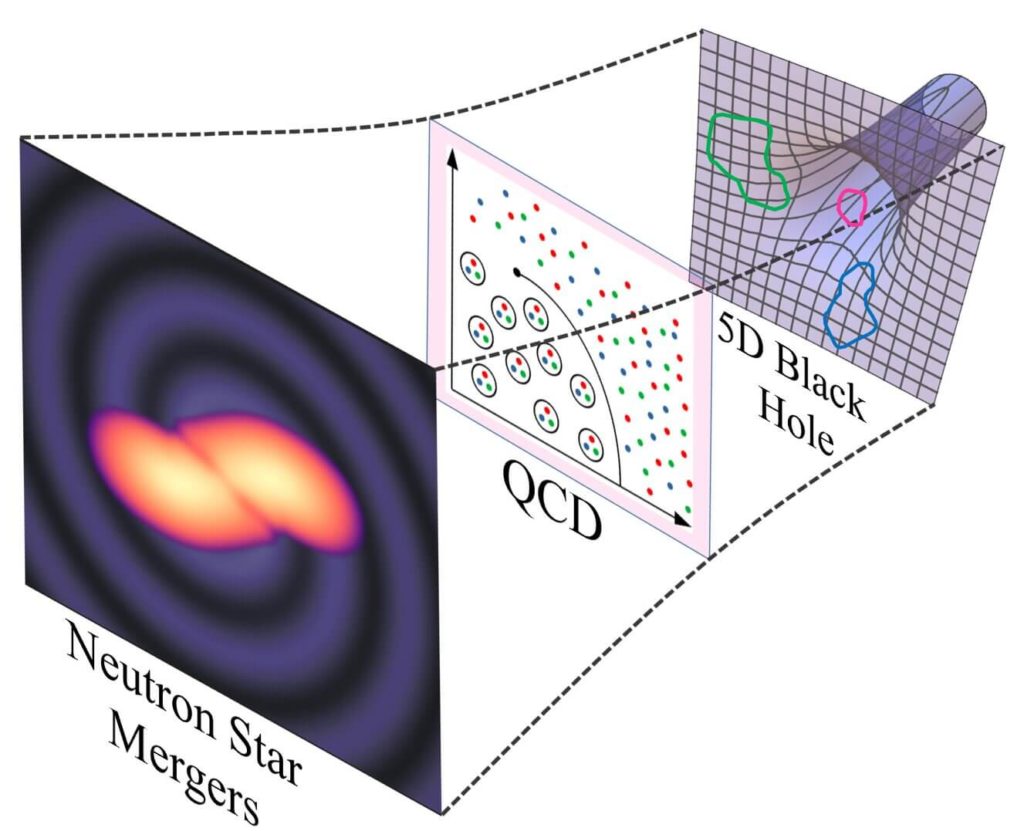 Illustration of the new method:researchers use five-dimensional black holes (right) to calculate the phase diagram of strongly bound matter (center). This makes it possible to simulate neutron star mergers and the resulting gravitational waves (left).
Credit: Goethe University Frankfurt am Main
The authors of the study used mathematicala relationship found in string theory, namely the correspondence between five-dimensional black holes and strongly interacting matter, to describe the phase transition between dense nuclear and quark matter.
In other words, physicists used five-dimensionalblack holes to calculate the phase diagram of strongly bound matter. This helped scientists simulate the merger of neutron stars and the resulting gravitational waves.
Quark matter consisting of u-and d-quarks, is distinguished by a very high Fermi energy compared to ordinary atomic matter. It is also only stable at extreme temperatures and/or pressures. This suggests that only neutron stars with a core of quark matter can be stable quark stars.
What did they find out?
Scientists have already used the new modelin computer modeling. So they were able to calculate the signal of gravitational waves from these collisions and show that as a result of the “cosmic rendezvous” of neutron stars, both hot and cold quark matter can appear.
Recall that gravitational waves are changesgravitational field, propagating like waves. They are emitted by moving masses, but after radiation they are separated from them and exist independently of these masses. Mathematically related to the perturbation of space-time metrics and can be described as “space-time ripples”.
What's next?
In the future, scientists hope to be able to compare the models with future gravitational waves measured from space to better understand quark matter in neutron star collisions.
Read more:
Archaeologists have officially confirmed the legends from the Bible
The grave of the "priestess" of Aphrodite was found: scientists showed what they found there
Scientists have seen what is on the territory of the Mayan capital. The find surprised them.
Cover: University of Warwick/Mark Garlick, CC BY 4.0, via Wikimedia Commons