Physicists from the Massachusetts Institute of Technology have developed a method for manipulating quantum
In a study published in Nature Physics,The scientists studied 400 ultracold atoms of ytterbium, one of two types of atoms used in modern atomic clocks. They cooled the atoms just above absolute zero. At this temperature, most classical effects such as heat disappear, and the behavior of atoms is determined solely by quantum effects.
 Installation chamber with ultracold ytterbium atoms. Photo: Simone Colombo, MIT
Scientists used a system of lasers to captureatoms, and then sent out "confusing" light with a bluish tinge that caused the atoms to oscillate in a correlated state. They allowed the entangled atoms to evolve forward in time and then subjected them to a small magnetic field. It introduced a small quantum change, slightly shifting the collective vibrations of the atoms.
Such a shift would be impossible to detect withusing existing measurement tools, the researchers note. Instead, physicists used time reversal to amplify this quantum signal. To do this, they sent out another laser beam with a red tint, which stimulated the atoms to unravel as if they were evolving backwards in time.
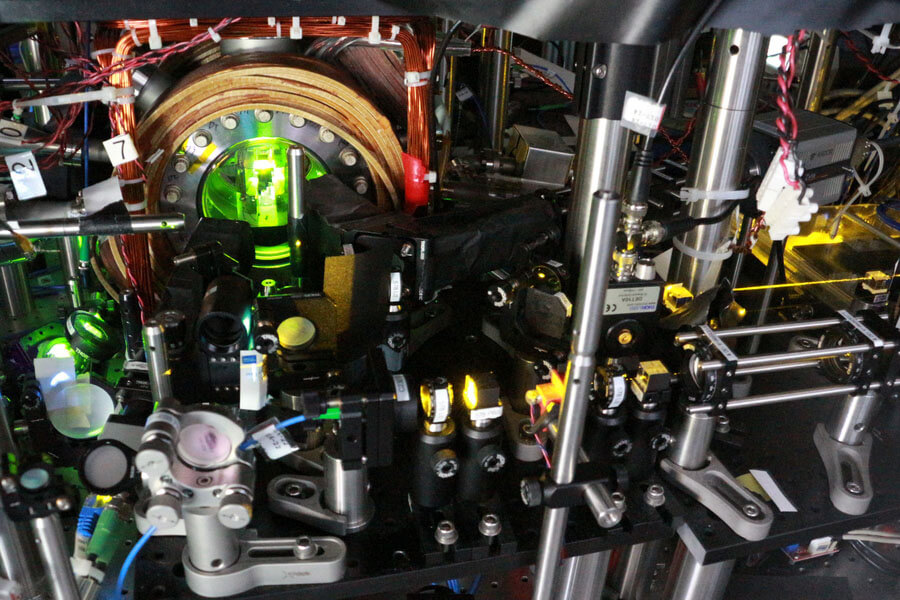 A laser machine used to entangle and disentangle atoms. Photo: Simone Colombo, MIT
The team ran this experiment thousands of times withclouds of 50 to 400 atoms, each time observing an increase in the quantum signal. Scientists have found that their entangled system is 15 times more sensitive than similar non-entangled atomic systems.
Each type of atom vibrates at a constant frequency,which, if properly measured, can serve as a very accurate pendulum, the authors explain. But on the scale of one atom, the laws of quantum mechanics come into force, and the vibrations of the atom change. Only after making many measurements of an atom, scientists get an estimate of its real vibrations.
For example, in modern atomic clocks of physicsrepeatedly measure the vibrations of thousands of ultracold atoms to increase their chances of obtaining accurate data. Using the increased sensitivity of a quantum entangled system, it is possible to reduce the number of measurements and improve the accuracy of atomic clocks and various sensors based on atomic vibrations.
Cover image: MIT
Read more:
The oldest Voyager 1 mission has a strange glitch that cannot be fixed
The James Webb telescope took the first picture of Jupiter: it shows 9 moving targets at once
Scientists have found a "Pandora's box" in the bowels of the Earth: the energy from there feeds life on the planet