An international team of researchers has developed an artificial cornea made from porcine collagen.
The researchers followed two groupssubjects from Iran and India within two years of transplantation. The study showed that in all participants in the experiment, vision was restored to at least 20/58. This means that from a distance of 20 m they see objects that people with normal vision see from a distance of 58 m. At the same time, vision improved by an average of 13.9 diopters in India and 11.2 diopters in Iran.
Two years after surgery, patients stillthese improvements were maintained. And although their corneas now technically contain foreign biological material, since collagen is a structured protein that lacks individual cells, the patient's immune system did not reject the implant. At the same time, the cornea recovered enough for patients to wear contact lenses.
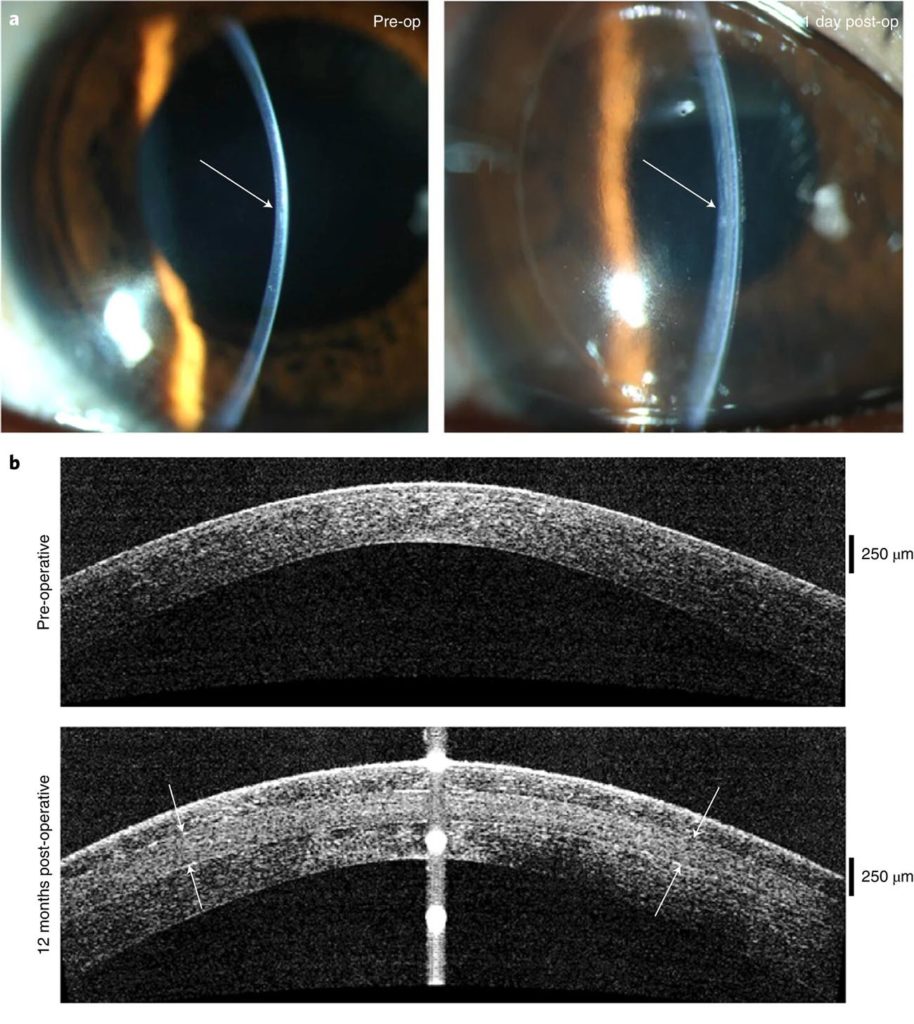 In figure a:photograph of the eye before (left) and after (right) surgery. Figure b: optical tomography data showing persistent thickening and regularization of corneal curvature after surgery (bottom). Image: Mehrdad Rafat et al., Nature Biotechnology
Pigskin collagen is a by-productproduct of the food industry, so it is widely available and cheap. In their work, the researchers dissolved pig skin tissue to extract the collagen, purified it, and then used it to create a hydrogel that mimics the human cornea. The hydrogel was injected into the cavities of the patient's cornea to thicken it and reshape it to restore corneal function.
In all patients participating in the study,keratoconus was diagnosed. This is an eye disease in which the central region of the cornea becomes thinner. As the disease progresses, it gradually bulges outward, taking the shape of a cone. The disease affects up to 2 in 1,000 people and often requires surgery to remove a full thickness portion of the damaged central cornea and replace it with donor tissue.
The use of porcine collagen instead of donor organs will help to significantly increase the number of operations and restore vision to more people, scientists say.
Read more:
On the pyramid in China found a portrait of the "king of ancestors". He ruled over 4,000 years ago
The length of the earth day is increasing. Scientists don't know why
Engineers have created a "perpetual motion machine" for portable atomic clocks