An international team of researchers used computational chemistry and computer modeling to
Venus is shrouded in thick cloudsmostly from sulfuric acid. These clouds reflect most of the sunlight that hits the planet, making it the brightest object in the sky after the Sun and Moon. But space missions and ground-based observations have found that the atmosphere does not reflect the entire spectrum of radiation, absorbing ultraviolet.
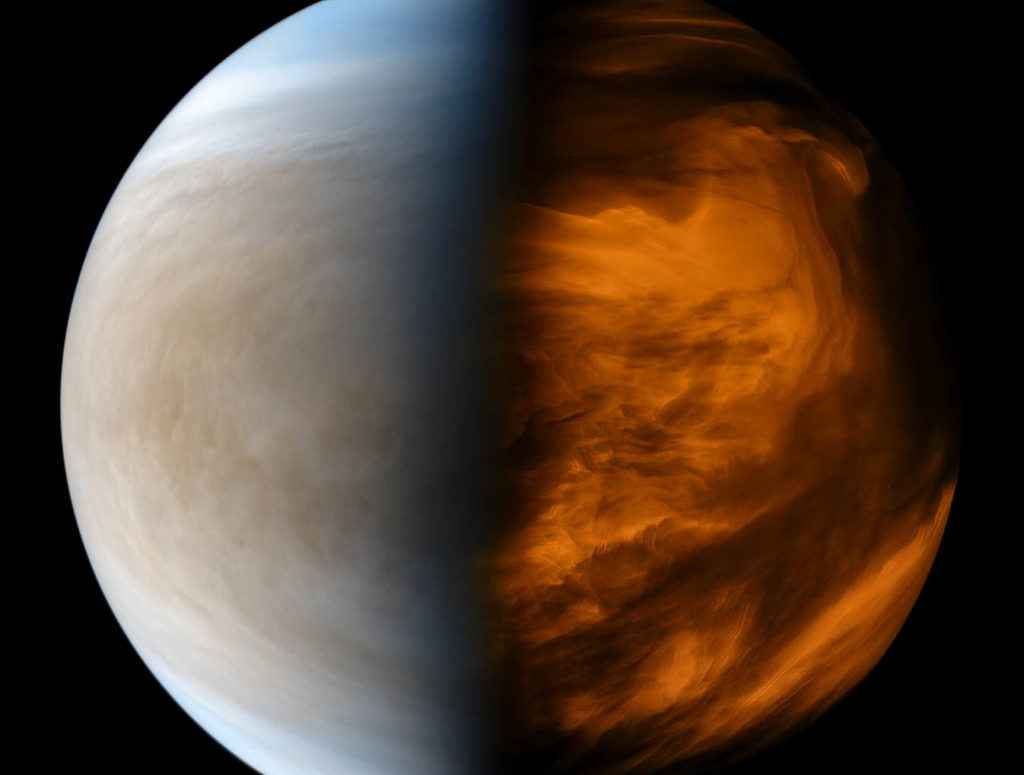 False color image of Venus showing infrared and ultraviolet radiation. Image: JAXA/ISAS/DARTS/Kevin M. Gill
Quantitative modeling showed thatthe most likely mysterious "sink" is sulfur molecules. Satellite observations have shown that the clouds on Venus contain large amounts of sulfuric acid and sulfur dioxide (SO2). The researchers saw that when exposed to sunlight, it can break down into sulfur monoxide (SO) and sulfur dioxide (S2O).
Interaction of new elements (SO and S2O)leads to the rapid formation of disulfur particles, that is, sulfur molecules consisting of two atoms (S2). These molecules can combine, creating more complex ones, consisting of four and eight atoms, and with the addition of individual sulfur atoms and other modifications. Planetologists believe that it is the triatomic and tetraatomic allotropes of sulfur that absorb ultraviolet radiation.
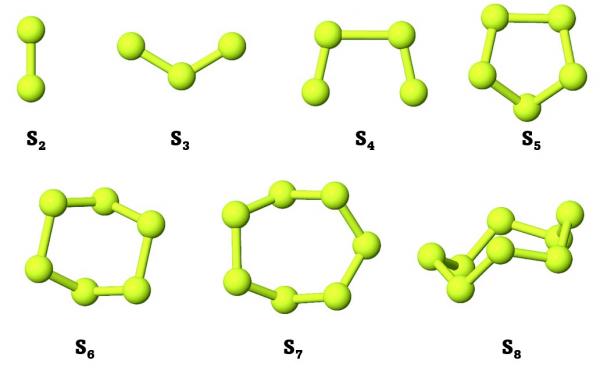 Various forms (allotropes) of sulfur molecules. Image: Planetary Science Institute
For the first time, we use computational methodschemistry to determine which reactions are most important, rather than waiting for laboratory measurements or using highly inaccurate rate estimates for unexplored reactions.
James Lyons, Senior Scientist at the US Planetary Institute and co-author of the paper
The researchers note that modeling and quantification capabilities could help unlock other mysteries of the complex chemical processes in Venus's atmosphere.
Read more:
"James Webb" sent a photo of the collision of two huge galaxies
"Useless" bacteria on Earth will provide life to the colonists of Mars
On the pyramid in China found a portrait of the "king of ancestors". He ruled over 4,000 years ago