Asteroids are one of the types of small bodies in the Solar System. As a rule, they are rocky
NASA estimated at the time of publication that there wereMore than 1.1 million such cosmic bodies have been discovered. Despite the huge number, the total mass of all these cosmic bodies does not exceed the lunar mass. It's all about size: the largest object, the Vesta asteroid, has a diameter of about 530 km, but most are much smaller, with a diameter at the lower limit of 30 m. Smaller objects are called meteoroids and are not included in this estimate.  ;
ESA announced an important milestone in the study of smallobjects of the solar system: scientists have discovered more than 30,000 near-Earth asteroids. This group includes bodies that approach the Sun closer than the Earth. And most of them were discovered in the last decade.
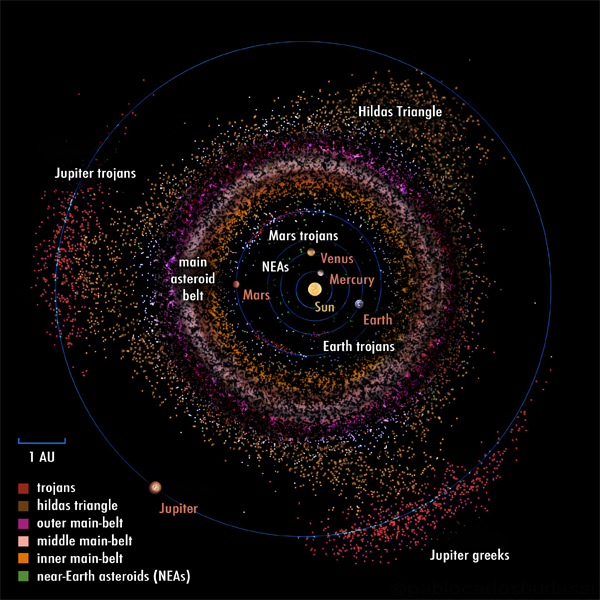 Distribution of asteroids in the inner part of the solar system. Image: Pablo Carlos Budassi, CC BY-SA 4.0, via Wikimedia Commons
First asteroids
Asteroids have been cataloged by astronomers for overtwo centuries. The search for such objects began after the discovery of the planet Uranus by William Herschel in 1781. The average distance between this planet and the Sun exactly confirmed the Titius-Bode rule. This is an empirical formula that approximately describes the average radius of the orbits of the planets in the Solar System.
All planets known at that time in fullsatisfied the rule and the new one - Uranus - ended up in the prescribed place. There was only one exception: another planet had to be between the orbits of Mars and Jupiter.
Since 1789, a group of astronomers led byFranz Xaver was looking for a planet, which, according to the Titius-Bode rule, should have been at a distance of about 2.8 AU. from the sun. To do this, scientists recorded the coordinates of all the stars in a certain area, and on subsequent nights they checked which of them had changed. According to calculations, the displacement of the planet should have been about 30 arc seconds per hour. This was enough to observe with the technology of the time.
Ironically, the first asteroid - Ceres - inIn 1801, it was discovered by Giuseppe Piazzi, who at that time was not part of the search group, but independently carried out his research. Over the next six years, a team of scientists joined by Piazzi found three more asteroids - Palada, Juno and Vesta.
All these objects were large enough, sono wonder they were found first. For example, scientists argued for a long time whether to consider Ceres an asteroid or a planet, and after clarifying the latter concept by the International Astronomical Union in 2006, they began to call it a dwarf planet. However, as surveillance technology has advanced, research and discovery has accelerated.
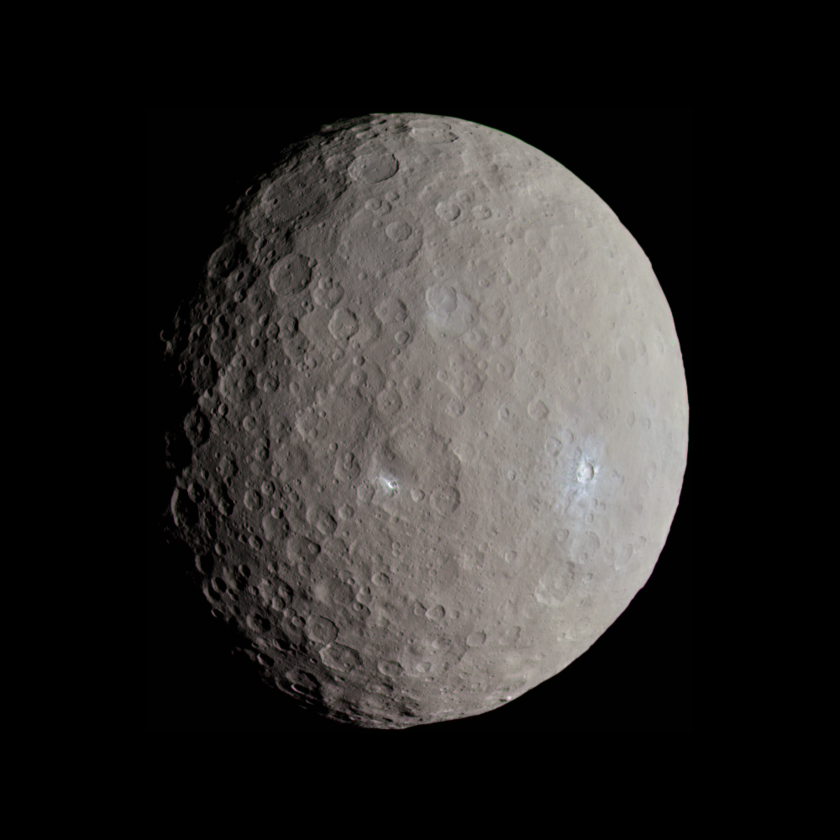 Ceres. Image: Emily Lakdawalla, Public domain, via Wikimedia Commons
Near Earth asteroids
An asteroid is called near-Earth if in the processmovement, it approaches the Sun closer than 1.3 astronomical units. 1 a.u. - This is about 149.6 million km, which roughly corresponds to the average distance between the Earth and the Sun. Asteroids from this group can pose a potential danger to our planet when crossing orbits.
According to the Minor Planet Center, whichBy cataloging the small bodies of the solar system, at the time of publication of this article, 30,056 near-Earth asteroids had already been discovered, with more than 2.2 thousand of them since the beginning of 2022.
The first near-Earth asteroid, Eros, was discoveredAugust 13, 1898 by Carl Gustav Witt and Felix Linke at the Urania Observatory in Berlin and independently by Auguste Charlois at the Nice Observatory. A "stone" about 30 km in size crosses the orbit of Mars and approaches the Earth at a maximum distance of about 22 million km. This is about 57 times farther than the Moon, but enough to consider this object as near-Earth.
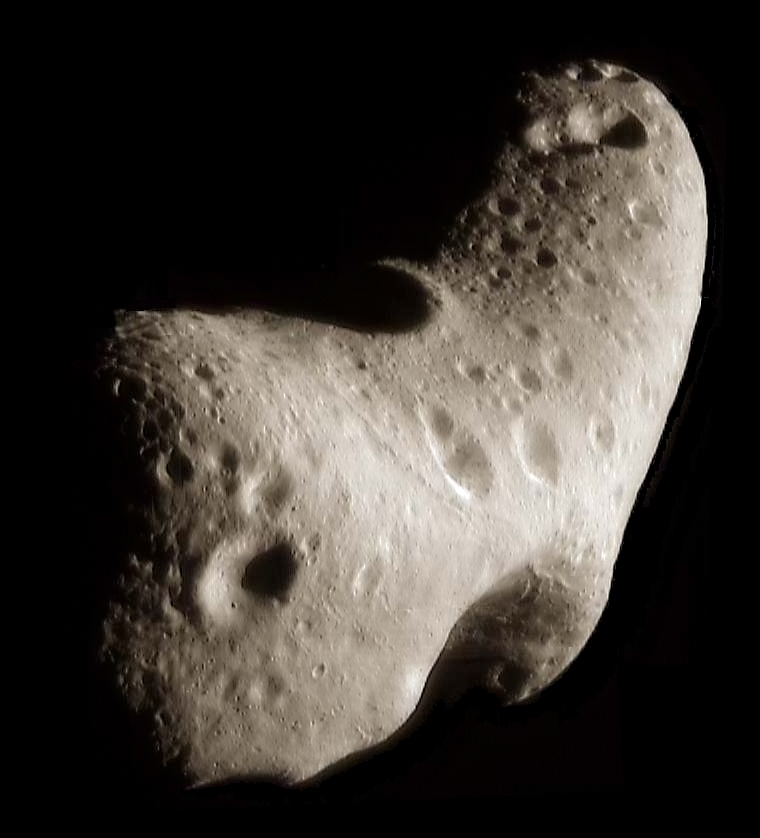 Asteroid Eros. Image: NASA/JPL/JHUAPL
How are asteroids found?
Naturally, large asteroids have been discoveredthe first, as they are much easier to see. But as telescopes become more sensitive, scientists are finding many more new objects much faster. At the same time, the size of many of them is only a few tens of meters. Planetary scientists use many different tools to find asteroids.
The main work is carried out by ground survey telescopes.They are designed to scan large areas of the sky in search of new moving objects against the background of "fixed" stars. Such devices detect new asteroids weekly.
The candidate object is further exposeddetailed inspection with more focused telescopes such as the Very Large Telescope (VLT) of the European Southern Observatory. Such a study helps to clarify the orbit, size and even composition of the new asteroid.
In addition, a significant contribution to the studybrought in by space satellites. For example, the Gaia mission, ESA's orbital observatory, helps to assess the danger of asteroids. The research satellite was created to catalog the objects of the solar system. It refines the positions of the stars that are used to calculate the orbits of small objects. Based on the data collected by the mission, scientists have refined the orbits of already known near-Earth asteroids, and some "lost" asteroids have been found again.
Asteroid exploration by the Gaia mission. Video: ESA/Gaia/DPAC, CC BY-SA 3.0 IGO
Is there a danger to the Earth?
In order for an asteroid to be recognized as near-Earth,its orbit should be at least 0.3 AU closer to Earth's. - this means that the distance between our planet and such objects can be up to 44.9 million km. The risk of a significant change in orbit and collision with the Earth is minimal for them.
However, there are laboratories all over the worldwho constantly monitor potentially hazardous and near-Earth objects to assess risks and prepare an action plan. According to the ESA, 1,427 asteroids have now been identified with a "non-zero" probability of impact. All of them are under close supervision, and the list of objects is constantly updated and updated.
At present, none of the discovered so farSince then, near-Earth asteroids are not of concern and should not collide with the Earth in the next 100 years. Some of the smaller objects - meteoroids - will collide with our planet, but they do not pose a serious danger and in most cases leave only a small trail in the sky.
Researchers are sure that everything is potentiallydangerous destructive asteroids larger than 1 km in diameter and above have already been detected and none of them will collide with the Earth in the near future. And for future generations, programs to protect the planet will be developed: there is enough time for this.
Now the planetologists of the defense centers are concentratingefforts on the study of medium-sized asteroids, the diameter of which is several hundred meters. Many of these objects may remain unknown.
The good news is that morehalf of the near-Earth asteroids known to date have been discovered in the past six years, showing how much our asteroid vision is improving.
Richard Moissl, Head of ESA's Planetary Defense Division
Planetologists are confident that they will soon establish the dimensionsand the orbits of all asteroids that can approach Earth. And at the same time, protection measures will be worked out. For example, NASA recently conducted the first experiment to change the orbit of an asteroid through a collision with a spacecraft.
Read more:
Black hole 'spit out' torn star three years after swallowing
Unusual structures found on the edge of the solar system. Only the Voyagers have been there.
Living organisms have made Mars uninhabitable